

Shown: · With its frame:
 Preview
 Send
Send Share
Share
 Details
 Guide
Guide

 Download
 Similars
 X-Ray
X-Ray Diaporama
 Q&A
Q&A Stats
StatsStill-Life Painted by hand in oil, brushstroke by brushstroke
 Oil On Canvas
- WallArt
- Baroque
 86.0 x 68.0 cm
 Hermitage Museum
$ 269
Hand Made Oil Reproduction
Hand-painted oil on canvas in your size and frame, made to order by our artists. ( Switch to Print Switch to Digital Image)
Size
·Standard
custom
CM
INCH
Pick from our preset sizes that match the artwork's original proportions.
Loading sizes...

width
height
Type the width and the height you need, to fit your frame or your wall. This is hand-painted, so for a size with a different shape the artist can paint a bit more around the picture, or cut a bit — you choose. We send you a digital mockup to approve before the painting starts. The picture shown on this page does not show the real result — only the mockup does.
 Read more
Finish
·
White $1

Blurside $1

Extended $1

P118B $10

P118H $10

P118W $10

P438Z $10

P508JH $12

P508YH $12

P805H $10

P805Z $10

P919BZ $10

P919G $10

P919XJ $10

P959ZH $10

P968JZ $12

W106C $8

W218G $10

W218JH $8

W218Y $10

W307PJ $10

W316G $10

W316PJ $8

W316Y $10

W398PJ $8

W4111J $10

W500HY $15

W500JH $15

W692G $12

W849H $8

W940BG $15

W953PJ $8

H24-GOLD $30

H24-SILVER $30

H36-GOLD $45

H36-SILVER $45
Shipped in a protective tube, ready for your own framer.
Above 105 cm the frame is shipped as a kit for a professional framer — read the details.
Extras
optionalWhat do the extras include?
Examples of what can be changed: Replace face with customer photo; Add pet (e.g., replace cat with dog); Include hidden message in background; Change background landscape or elements.
After order, TopImpressionists.com team will email client for instructions and provide a mockup preview
After order, TopImpressionists.com team will email client for instructions and provide a mockup preview
Worldwide Delivery () in 3/4 weeks instead of standard 5 weeks. (29 October). No compromise on quality.
Protective Varnish
Nameplate
Engraved Bronze Plaque Details
This elegant plaque features the artist's name and the title of the artwork, finely engraved for a timeless presentation.
It is made from bronze with a refined, elegant finish. The text is precisely laser-engraved for a sharp and permanent result. Measuring 9x2 cm, the plaque is compact yet easy to read. It's built to be durable and scratch-resistant, offering a professional, museum-quality look. Mounting is simple thanks to the included adhesive backing.
Transparent Acrylic Plaque Details
The plaque includes essential engraved details such as the artist's name, the title of the artwork, the date it was created, the type of media used-like oil on canvas or watercolor-a brief description of the piece, and a QR code that links to the complete artwork information.
It is crafted from clear acrylic, offering a sleek, modern appearance. The text is UV-engraved in black to ensure strong visual contrast. With a size of 10x15 cm, it ensures optimal readability. It comes equipped with two metal hooks for secure wall mounting. The plaque is designed to be weather-resistant, making it suitable for various environments, and it includes interactive features that work seamlessly with smartphone scanning.
Black Acrylic Plaque Details
This elegant plaque includes engraved information such as the artist's name, the title of the artwork, the date it was created, the type of media used (like oil on canvas or watercolor), a short description of the artwork, and a QR code for quick access to more information.
The plaque itself is made from refined black acrylic with a premium finish. The text is laser-engraved in white for high contrast and readability. Its size is 10x15 cm, designed to be easy to read. It comes with two metal hooks for professional mounting. The design is sleek and fits any interior style. It is also weather-resistant and durable, with built-in digital integration for mobile compatibility.
Glass option is only available in size under 110 CM
 Glass option is only available in size under 110 CM
- Free Worldwide Express Shipping
- High-Quality Linen Canvas
- Full Shipping Insurance
- Customs Tax Refund Guarantee
- True Color Matching Guarantee
- 100-Day Return Policy (Defects Only)
- 100% Money-Back Guarantee
- Bulk Discount Offer


Collectible Description
Discover Jan Weenix's 'Still-Life' – a stunning Baroque masterpiece featuring a monkey, grapes, and birds within a richly detailed Dutch landscape. Explore the artist’s legacy & original details.
Artist Biography
Jan Weenix (1641-1719): Dutch Baroque master renowned for richly detailed hunting still lifes, game paintings & landscapes. Admired for realism and vibrant color.
About the painting
A Glimpse into Baroque Grandeur: Jan Weenix’s “Still Life with a Monkey”
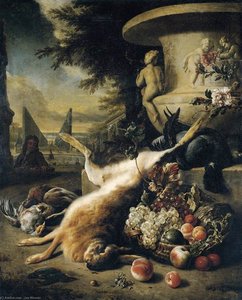
Jan Weenix's "Still Life with a Monkey," painted around 1697, is more than just a depiction of fruit and game; it’s a meticulously crafted window into the opulent world of Dutch Golden Age society. This remarkable piece, currently housed within the Hermitage Museum in St. Petersburg, Russia, offers a captivating blend of realism, theatricality, and subtle symbolism that continues to intrigue viewers centuries after its creation. Weenix, trained by his father Jan Baptist Weenix – himself a master of animal and still life painting – inherited a legacy of artistic precision and an appreciation for the natural world, but he quickly established his own distinctive style characterized by dramatic lighting, rich textures, and a keen eye for detail.
The composition immediately draws the viewer’s attention to a striking monkey perched on a ledge within a richly appointed interior. This isn't merely a decorative element; the monkey is the focal point, radiating an almost mischievous energy as it holds an apple in its hand. Surrounding this central figure are an abundance of carefully arranged objects: luscious grapes spilling from a basket, a plump pear glistening with ripeness, and a selection of game birds – a pheasant, a partridge, and a dove – all rendered with astonishing realism. The background is equally elaborate, featuring a large bird being plucked by two smaller birds, creating a dynamic and slightly unsettling tableau. The entire scene unfolds against the backdrop of a grand room, hinting at wealth and status—a testament to Weenix’s ability to seamlessly integrate elements of both naturalism and interior design.
Technique and Materials: A Masterclass in Baroque Realism
Weenix's mastery lies not only in his subject matter but also in his technical execution. He employed the oil painting technique with exceptional skill, layering thin glazes to achieve a remarkable sense of depth and luminosity. Notice how he captures the textures of the fruit – the velvety skin of the pear, the plumpness of the grapes – using subtle variations in color and brushstroke. The lighting is dramatic and carefully considered, casting strong shadows that accentuate the forms and create a sense of three-dimensionality. The use of chiaroscuro—the contrast between light and dark—is particularly effective in highlighting the monkey’s posture and drawing attention to its expressive face.
Furthermore, Weenix's meticulous observation of nature is evident throughout the painting. He studied animal anatomy with a keen eye, capturing their movements and expressions with remarkable accuracy. The arrangement of the game birds suggests a successful hunt, reflecting the importance of hunting in Dutch society at the time. The inclusion of the monkey adds an element of surprise and intrigue, hinting at the exotic and worldly influences that were increasingly prevalent in the Netherlands during the 17th century.
Symbolism and Context: A Window into Dutch Society
Beyond its aesthetic beauty, “Still Life with a Monkey” is rich in symbolism. The monkey itself has been interpreted as representing various concepts – from folly and deception to the fleeting nature of pleasure. Its holding of the apple can be seen as an allusion to the biblical story of Adam and Eve, suggesting a cautionary tale about temptation and indulgence. The presence of the hunting scene reflects the importance of hunting in Dutch society, not just for sustenance but also as a demonstration of wealth and status. The grand interior setting underscores the prosperity and sophistication of the merchant class who commissioned such elaborate artworks.
Painted during the Baroque period, this work embodies many of the key characteristics of the style: dramatic lighting, rich colors, complex compositions, and an emphasis on realism. However, Weenix’s approach is distinct from that of other Baroque painters, particularly in his use of light and shadow to create a sense of depth and atmosphere. The painting also reflects the growing interest in natural history and scientific observation during this period, as artists sought to accurately depict the world around them.
A Timeless Masterpiece: Reproductions and Beyond
Today, “Still Life with a Monkey” remains one of Jan Weenix’s most celebrated works. Its captivating composition, masterful technique, and rich symbolism continue to resonate with viewers centuries after its creation. High-quality reproductions offer an accessible way to appreciate the beauty and complexity of this remarkable painting. Whether displayed in a grand salon or a cozy corner, a reproduction of “Still Life with a Monkey” can bring a touch of Baroque grandeur into any setting, serving as a reminder of the artistic brilliance of the Dutch Golden Age.
Questions & Answers
How strong is the contrast in "Still-Life" by Jan Weenix?
The light-dark contrast of "Still-Life" is recorded as gentle. Contrast describes how strongly light and dark areas differ.
What is the dominant color of "Still-Life" by Jan Weenix?
The dominant color of "Still-Life" by Jan Weenix is phthalo green (#2d1d1f).
What stage of Jan Weenix's development does "Still-Life" represent?
Within Jan Weenix's career, "Still-Life" falls in the Mature Period. The phase helps compare it with the artist's other works.
Quick facts and art quiz
About Jan Weenix

Jan Weenix
1641 - 1719, Netherlands
Artist Biography
A Legacy of Dutch Realism: The Life and Art of Jan Weenix
Jan Weenix, born in Amsterdam in 1641, emerged from a lineage steeped in artistic tradition, inheriting a passion for painting from his father, the esteemed Jan Baptist Weenix. While precise details surrounding his early years remain somewhat elusive, it’s clear that young Jan received foundational training within his father's workshop, absorbing techniques crucial to depicting both still life and animal subjects—a hallmark of Dutch Golden Age artistry. This familial influence wasn’t merely technical; it instilled a deep appreciation for the meticulous observation of nature and a commitment to rendering its beauty with striking realism. The elder Weenix’s own artistic journey, including sojourns in Italy that infused his work with an Italianate sensibility, undoubtedly shaped Jan's developing aesthetic as well. Though initially overshadowed by his father’s reputation, Jan quickly distinguished himself, forging a unique path within the vibrant landscape of 17th-century Dutch painting.The Flourishing of a Baroque Style
Weenix’s artistic style blossomed during the height of the Baroque period, and it reflects the era's penchant for drama, rich detail, and dynamic composition. He wasn’t working in isolation; influences from contemporaries like Hendrick Cornelisz Vroom, renowned for his marine paintings, and potentially other animalier specialists such as Melchior de Hondecoeter and Gillis Claesz d'Hondecoeter, subtly informed his approach. However, Weenix synthesized these inspirations into a style distinctly his own. His canvases are characterized by an almost photographic precision in the rendering of textures—the sheen of feathers, the softness of fur, the delicate translucence of fruit – all achieved through masterful brushwork and a keen understanding of light and shadow. Chiaroscuro, the dramatic interplay between light and dark, is employed to create depth and visual interest, drawing the viewer into the scene with compelling realism. A vibrant color palette further enlivens his subjects, imbuing them with a sense of immediacy and vitality. He possessed an exceptional skill in arranging elements within the frame, creating balanced and harmonious compositions that are both visually appealing and narratively engaging.Masterpieces and Patronage
Throughout his career, Jan Weenix produced a substantial body of work celebrated for its technical brilliance and captivating subject matter. Paintings like Hunting and Fruit Still Life next to a Garden Vase (1714) exemplify his ability to seamlessly integrate diverse elements—game birds, luscious fruits, architectural details – into a complex and visually stunning arrangement. Still Life with a Hare and other Game (1697) showcases his mastery of animal anatomy and texture, capturing the lifelike quality of his subjects with remarkable accuracy. Even smaller works, such as A Seated Monkey (before 1685), reveal his talent for imbuing animals with personality and expressive character. This skill did not go unnoticed by prominent patrons. In 1702, Weenix received an invitation to the court of Johann Wilhelm, Elector Palatine, where he worked alongside other renowned artists, creating large-scale hunting scenes for Schloss Bensberg—a testament to his growing reputation and artistic prowess. These commissions provided him with both financial security and opportunities to further refine his skills.A Lasting Influence on Dutch Art
Jan Weenix played a pivotal role in popularizing hunting still lifes and game paintings during the Baroque period, elevating these genres beyond mere decoration. His works were highly sought after by collectors, contributing significantly to the development of Dutch artistic traditions. He didn’t simply replicate nature; he interpreted it through his unique lens, imbuing his paintings with a sense of realism, drama, and aesthetic beauty that resonated deeply with contemporary audiences. His legacy extends beyond his own creations; his daughter, Maria Weenix, continued the family tradition as a skilled flower painter, ensuring that the Weenix name remained synonymous with artistic excellence for generations to come. Today, Jan Weenix’s paintings are treasured in museums and private collections worldwide, continuing to inspire artists and captivate audiences with their masterful depictions of the natural world—a testament to his enduring contribution to the rich tapestry of Dutch art history.Quick facts about Jan Weenix
- Artistic Movement Or Style: Dutch Baroque
- Artists Or Movements Influenced By This Artist: ['Maria Weenix']
- Artists Who Influenced This Artist:
- Jan Baptist Weenix
- Hendrick Vroom
- Date Of Birth: 1641
- Date Of Death: 1719
- Full Name: Jan Weenix
- Nationality: Dutch
- Notable Artworks:
- Hunting and Fruit Still Life
- Still Life with a Hare
- A Seated Monkey
- The White Peacock
- Place Of Birth: Amsterdam, Netherlands
Explore artworks organized by themes, styles, and characteristics.




Still-Life
·