A Poignant Reflection on Time and Memory
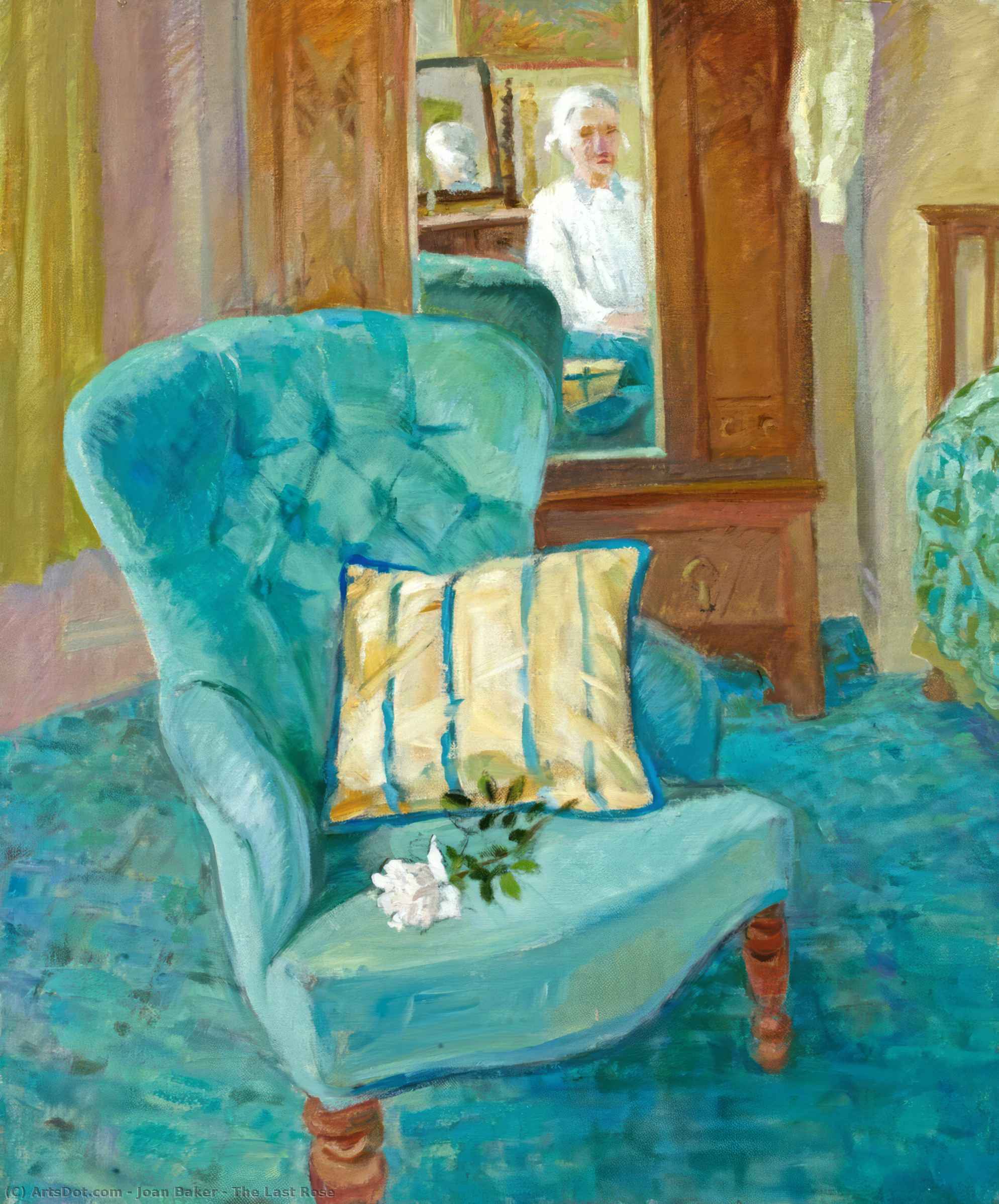
In the quietude of Joan Baker’s 1997 masterpiece, The Last Rose, viewers are invited into a sanctuary of contemplation where the boundaries between reality and reflection blur. This evocative oil-on-canvas work serves as a profound meditation on the passage of time and the delicate nature of human experience. At its heart, the painting presents an intimate domestic scene: an elderly woman seated at her desk, her presence captured not just in her physical form but through a subtle, haunting reflection in the mirror behind her. This dual perspective creates a dreamlike atmosphere, suggesting that while the body may age, the essence of the soul remains caught in a continuous loop of memory and thought.
The composition is masterfully orchestrated to guide the eye through a narrative of beauty and decay. A vibrant blue armchair, adorned with a yellow floral pillow, anchors the foreground, offering a striking contrast to the soft peach hues of the surrounding walls. Resting upon the seat of this chair is a single white rose—the titular subject that lends the piece its melancholic weight. This solitary bloom, paired with a potted plant that breathes life into the left side of the frame, acts as a powerful symbol of vitality amidst the inevitable approach of finality. The interplay of light and shadow across the green carpet and the textured fabrics creates a sense of depth that makes the room feel both tangible and ethereal.
The Mastery of Technique and Symbolism
Joan Baker, a formidable figure in Welsh art education, brings her meticulous technical skill to the forefront of this work. Her use of oil on canvas allows for a rich, tactile quality, where every brushstroke is deliberate, contributing to the painting's layered emotional resonance. The artist achieves a remarkable balance between realism and a soft abstraction, particularly in how she renders the light reflecting off the mirror’s surface and the subtle textures of the domestic setting. This technique does more than just replicate a scene; it elevates a simple moment of study or work into a universal allegory for the fleeting nature of youth and the enduring strength of memory.
For the discerning collector or interior designer, The Last Rose offers much more than mere decoration. It is a piece that commands attention through its emotional depth and sophisticated color palette. The bold contrast between the cool blues and warm peaches provides a dynamic energy suitable for a variety of high-end interiors, while the painting's underlying themes of nostalgia and grace offer a conversational centerpiece. To possess a reproduction of this work is to bring a sense of historical significance and quiet, contemplative beauty into a living space, making it an ideal acquisition for those who value art that speaks to the profound complexities of the human condition.


 Preview
 Switch to hand made Painting
 Send
Send Share
Share
 Details

 Download
 Similars
 X-Ray
X-Ray Diaporama


 Read More






































 Glass option is only available in size under 110 CM