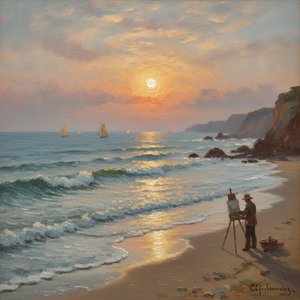
The Luminous Legacy of Joan Roig Soler
In the golden age of Spanish Impressionism, few artists captured the ephemeral dance of light upon the Mediterranean coast as poignantly as Joan Roig Soler. Born in Barcelona in 1852, Soler emerged from a lineage of artistic passion, having been nurtured by a father who first ignited his fascination with the nuances of color and form. His formal training at the Escuela Superior de Bellas Artes Barcelona provided him with a rigorous foundation in Academic realism, yet it was his ability to transcend the rigid boundaries of tradition that would define his career. As the nineteenth century progressed, Soler began to weave the meticulous precision of his classical education with the burgeoning, atmospheric sensibilities of the Impressionist movement, creating a style that felt both grounded in reality and elevated by light.
The heart of Soler’s oeuvre lies within the sun-drenched landscapes of Catalonia, particularly the picturesque seaside enclave of Sitges. It was here, amidst the shimmering vistas of the Costa Brava, that he truly found his voice. He possessed a rare, almost intuitive ability to translate the fleeting textures of the Mediterranean—the way sunlight refracts through sea spray or how the midday heat softens the edges of coastal villas. His works from this period are not merely landscapes but sensory experiences; in masterpieces such as Sitges Study, one can almost feel the warmth of the sand and the salt in the breeze. This dedication to capturing the transient beauty of the coast cemented his reputation as a master of Impressionistic realism, an artist capable of freezing a moment in time while maintaining its vibrant, breathing essence.
Urban Rhythms and Industrial Echoes
While the tranquil shores of Sitges offered him a sanctuary of light, Roig Soler was equally captivated by the burgeoning energy of Spain’s urban centers. His travels to Madrid allowed him to explore a different facet of the human experience—the dynamic, often chaotic pulse of city life. In canvases such as Avenida de los catalanes, he moved away from the serene coastal horizons to embrace the complex interplay of shadow and movement found in metropolitan streets. These urban impressions showcase his remarkable versatility, proving that his mastery of light was just as effective in the narrow, shaded corridors of a city as it was on an open beach.
Perhaps most striking is his ability to find beauty within the machinery of progress. In his evocative 1882 work, Sitges train station, Soler captures a profound intersection between the industrial revolution and the quietude of daily life. The painting presents a dramatic tableau where the heavy, dark presence of a steam engine meets the ethereal plumes of billowing smoke, creating a sense of atmospheric depth that pulls the viewer onto the platform. Through this work, he explores themes of nostalgia and modernization, using the locomotive as a symbol of an unstoppable future encroaching upon the timeless landscape. By focusing on the human element—the passengers caught in moments of waiting or curiosity—he imbues the industrial scene with a deeply relatable, emotional resonance.
Artistic Influences and Historical Significance
The evolution of Roig Soler’s technique was profoundly shaped by the giants of European art. He drew significant inspiration from the works of Claude Monet and Frédéric Bazille, adopting their focus on light and broken brushstrokes to enhance the luminosity of his palettes. Yet, unlike some of his more radical contemporaries, Soler never fully abandoned the structural integrity of the Academic tradition. This unique synthesis—the marriage of expressive, Impressionistic strokes with a disciplined, realist composition—distinguishes his work from the broader movement and provides it with a lasting, sculptural quality.
Though history occasionally places him in the shadow of contemporaries like Joaquín Sorolla, the enduring significance of Joan Roig Soler lies in his role as a vital chronicler of the Catalan spirit. His paintings serve as a visual archive of a transformative era in Spanish history, capturing both the natural splendor of the Mediterranean and the rapid modernization of the late nineteenth century. Today, his legacy continues to inspire, offering a window into a world where light, color, and movement converge to tell the story of a changing nation.



 Preview
 Buy Print
 Send
Send Share
Share
 Details

 Download
 Similars
 X-Ray
X-Ray Diaporama
 Read More






































 Glass option is only available in size under 110 CM