

 Preview
 Send
Send Share
Share
 Details
 Guide
Guide

 Download
 Similars
 X-Ray
X-Ray Diaporama
 Q&A
Q&A Stats
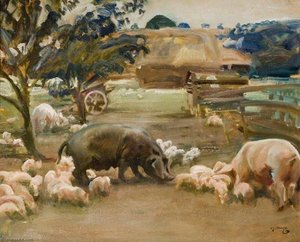
StatsPigs

- 24.0 x 45.0 cm

Discover Joseph Crawhall (1861-1913), a British artist famed for his evocative animal & landscape watercolors. Explore his work influenced by Impressionism & the Glasgow Boys.
 Read More
Giclée / Art Print
Museum-quality giclée or canvas print with fast production and flexible finish options. ( Buy Hand Made Painting Switch to Digital Image)




































Standard
custom
CM
INCH
Pick from our preset sizes that match the artwork's original proportions.
Loading sizes...

width
height
Type the width and the height you need, to fit your frame or your wall. A print can only be cut, never made bigger than the picture, so a size with a different shape loses a part of the image. We send you a digital mockup to approve before we print anything. The picture shown on this page does not show the real cut — only the mockup does.
Worldwide Delivery () in 2 weeks instead of standard 4/5 weeks. (14 November)

Free Worldwide Express Shipping

High-Quality Linen Canvas

Full Shipping Insurance

Customs Tax Refund Guarantee

True Color Matching Guarantee

100-Day Return Policy (Defects Only)

100% Money-Back Guarantee

Bulk Discount Offer
 Glass option is only available in size under 110 CM

Pigs
Giclée / Art Print
Reproduction Size
-


Total Price
$ 70
Related Artworks




Artist Biography
Joseph Crawhall (1861-1913): A Master of Animal and Landscape Watercolor
Born in Morpeth, Northumberland, in 1861, Joseph Crawhall III was a British artist whose evocative watercolors captured the essence of both animal and landscape subjects. Though often overlooked during his lifetime, particularly within the established art world, Crawhall’s work now stands as a testament to his unique vision and technical skill—a captivating blend of Impressionistic influence, Japanese aesthetics, and an intimate understanding of the natural world.
His early life was steeped in artistic tradition. He was the son of Joseph Crawhall II, a ropemaker, author, and watercolor painter himself, and Margaret Boyd. This familial connection provided a fertile ground for his own artistic development, though he deliberately distanced himself from his father’s more traditional approach, forging his own distinctive style. Crawhall received formal training at King's College London before embarking on a crucial period of artistic immersion in Paris under the tutelage of Aimé Morot in 1882. This Parisian experience exposed him to the vibrant currents of Impressionism, profoundly shaping his palette and technique – though he ultimately moved beyond strict adherence to the movement.
The Glasgow Boys and Early Influences
Crawhall’s name became inextricably linked with the “Glasgow Boys” in the 1880s and 1890s. This group of young Scottish artists, including Arthur Melville, Robert Penrose, and James Guthrie, challenged the conservative norms of the Royal Scottish Academy through their bold use of color, loose brushwork, and unconventional subject matter. While Crawhall wasn’t formally a member, his work shared many characteristics with theirs—a rejection of academic conventions and an embrace of capturing fleeting moments of light and atmosphere. The influence of Japanese art was also significant during this period, evident in the flattened perspectives and simplified forms often found in his compositions.
However, Crawhall’s artistic journey took a fascinating turn in 1887/88 when he traveled to Tangier with Pollock Nisbet, Robert Alexander, and Edwin Robert. This Moroccan sojourn proved transformative. Disillusioned with oil painting's demands, he transitioned to watercolors, adopting a lighter palette and focusing on capturing the vibrant colors and atmospheric conditions of North Africa and Spain. The experience profoundly impacted his style, leading him to prioritize spontaneity and direct observation – a shift that would define much of his later work.
A Distinctive Style: Animals and Landscapes
Crawhall’s paintings are immediately recognizable for their remarkable ability to convey the essence of animal movement and emotion. He possessed an extraordinary gift for capturing the subtle nuances of posture, expression, and texture—whether it was a proud stallion galloping across open fields or a delicate bird perched on a branch. His subjects weren't merely depicted; they were imbued with life and personality.
Alongside his animal paintings, Crawhall excelled at rendering landscapes, often infused with the same sensitivity and attention to detail. He frequently painted scenes of Northumberland’s rugged terrain, capturing the interplay of light and shadow across rolling hills and dramatic coastlines. His compositions are characterized by a sense of tranquility and connection to nature—a reflection of his own deep appreciation for the natural world.
Legacy and Recognition
Despite facing initial rejection from established art institutions like the Royal Scottish Academy, Crawhall’s work gradually gained recognition in the early 20th century. His paintings are now held by prestigious collections such as the Kelvingrove Art Gallery and Museum in Glasgow and the Burrell Collection in Edinburgh. His dedication to preserving his own artistic vision is evident in the fact that he reportedly destroyed many works he deemed unsatisfactory, leaving a relatively small but highly valued body of work.
A portrait by Walter Westley Russell offers a glimpse into Crawhall’s personality and character. His legacy endures as a significant figure in British watercolor painting—an artist who defied convention, embraced innovation, and created works that continue to captivate viewers with their beauty, sensitivity, and profound connection to the natural world.

Joseph Crawhall
1861 - 1913 , United Kingdom
Quick Facts
- Full Name: Joseph Crawhall III
- Nationality: British
- Date Of Birth: 1861
- Date Of Death: 1913
- Place Of Birth: Morpeth, United Kingdom
- Notable Artworks:
- Horse paintings
- Wildlife art
- Artistic Movement Or Style: Impressionism, Glasgow Boys
- Artists Who Influenced This Artist: ['Aimé Morot']
- Artists Or Movements Influenced By This Artist: ['Glasgow Boys']
Explore artworks organized by themes, styles, and characteristics.


