
 Preview
 Send
Send Share
Share
 Details
 Guide
Guide

 Download
 Similars
 X-Ray
X-Ray Diaporama
 Q&A
Q&A Stats
StatsCottage Garden


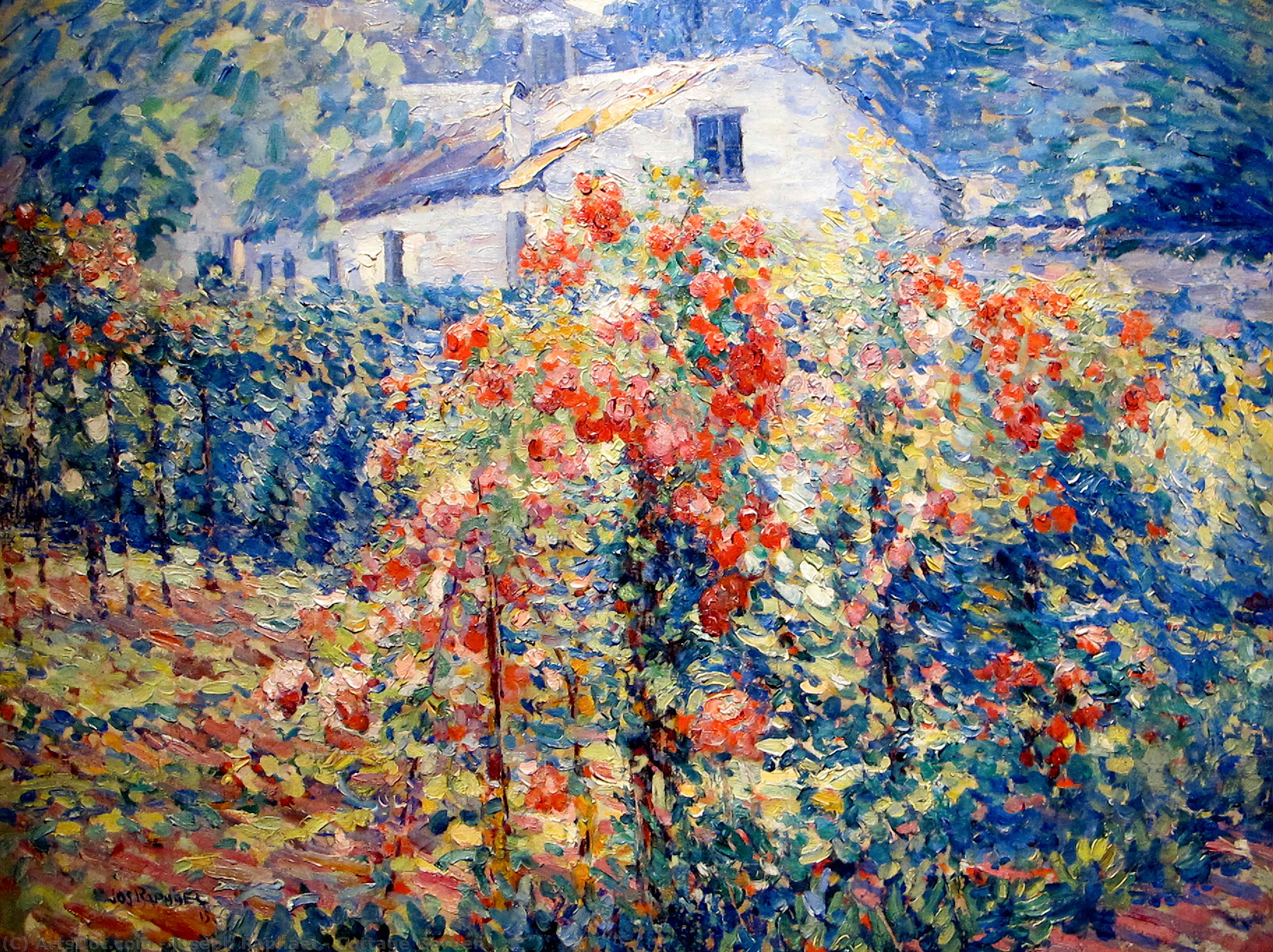
A serene white cottage surrounded by vibrant red flowers defines this peaceful landscape by American Impressionist Joseph M Raphael, offering a tranquil escape for your home through a beautiful oil painting reproduction.
 Read More
An American Impressionist master known for works like Cottage Garden, Joseph M. Raphael captured the luminous beauty of European landscapes through vibrant brushstrokes that invite you to discover his timeless world.
Giclée / Art Print
Museum-quality giclée or canvas print with fast production and flexible finish options. ( Buy Hand Made Painting Switch to Digital Image)




P118B $10

P118H $10

P118W $10

P438Z $10

P508JH $12

P508YH $12

P805H $10

P805Z $10

P919BZ $10

P919G $10

P919XJ $10

P959ZH $10

P968JZ $12

W106C $8

W218G $10

W218JH $8

W218Y $10

W307PJ $10

W316G $10

W316PJ $8

W316Y $10

W398PJ $8

W4111J $10

W500HY $15

W500JH $15

W692G $12

W849H $8

W940BG $15

W953PJ $8




Standard
custom
CM
INCH
Pick from our preset sizes that match the artwork's original proportions.
Loading sizes...

width
height
Type the width and the height you need, to fit your frame or your wall. A print can only be cut, never made bigger than the picture, so a size with a different shape loses a part of the image. We send you a digital mockup to approve before we print anything. The picture shown on this page does not show the real cut — only the mockup does.
Worldwide Delivery () in 2 weeks instead of standard 4/5 weeks. (9 November)

Free Worldwide Express Shipping

High-Quality Linen Canvas

Full Shipping Insurance

Customs Tax Refund Guarantee

True Color Matching Guarantee

100-Day Return Policy (Defects Only)

100% Money-Back Guarantee

Bulk Discount Offer
 Glass option is only available in size under 110 CM

Cottage Garden
Giclée / Art Print
Reproduction Size
-


Total Price
$ 70
A Sanctuary in Color: The Serenity of Cottage Garden
In the quiet corners of the art world, few works possess the ability to instantly transport a viewer to a state of profound tranquility quite like Joseph M. Raphael’s Cottage Garden. This exquisite painting serves as more than just a depiction of a landscape; it is an invitation into a private, sun-drenched sanctuary where time seems to slow its frantic pace. At first glance, the eye is drawn to the charming white house that anchors the composition, a symbol of domestic peace and stability amidst the wilder, more exuberant growth of nature. Surrounded by a lush tapestry of trees and dense bushes, the architecture does not dominate the scene but rather nestles into it, suggesting a harmonious coexistence between human habitation and the natural world.
The emotional resonance of the piece lies in its ability to evoke a sense of nostalgia for a simpler, pastoral existence. As one gazes upon the vibrant red flowers scattered throughout the foreground, there is an undeniable pulse of life that breaks through the verdant greens and earthy tones. These splashes of crimson act as rhythmic accents, guiding the viewer’s gaze deeper into the garden and toward the secondary dwellings visible in the soft distance. The painting captures that fleeting, magical moment of a summer afternoon when the light is perfect, and the air feels heavy with the scent of blooming flora and the quiet hum of the countryside.
Mastery of Light and Impressionistic Spirit
Technically, Cottage Garden is a testament to Raphael’s skill as an American Impressionist. His approach utilizes delicate brushstrokes that allow light to dance across the canvas, creating a shimmering effect that mimics the way sunlight filters through leaves. The artist does not rely on harsh outlines; instead, he uses color and value to define form, allowing the edges of the bushes and trees to bleed softly into one another. This technique creates a painterly texture that is both rich and airy, providing a sense of depth that draws the collector into the very heart of the garden.
The palette is a masterful balance of vitality and calm. While the vibrant reds provide necessary energy, they are tempered by a sophisticated range of greens, creams, and soft shadows. This careful orchestration of color ensures that the painting remains soothing rather than overwhelming. For the interior designer or art enthusiast, this balance makes the work incredibly versatile; it possesses enough visual interest to serve as a focal point in a room, yet its inherent peacefulness allows it to complement a variety of decor styles, from classic traditionalism to modern organic aesthetics.
An Eternal Legacy for the Modern Home
Owning a reproduction of such a significant work is an opportunity to integrate a piece of art history into the contemporary living space. The handmade oil painting reproduction offered by TopImpressionists.com captures every nuance of Raphael’s original vision, from the thick, intentional application of pigment to the subtle transitions of light and shadow. Each stroke on the canvas is meticulously crafted to ensure that the soul of the original—its quietude, its warmth, and its vibrant life—is preserved for generations.
For collectors seeking to cultivate an atmosphere of elegance and repose, Cottage Garden offers a timeless solution. It is a piece that does not merely decorate a wall but enriches the very spirit of a home. By bringing this pastoral masterpiece into one's personal environment, one invites the enduring beauty of the countryside to become a permanent resident, offering a daily reprieve from the complexities of modern life through the sheer power of color and light.
Questions & Answers
What is the dominant hue of "Cottage Garden" by Joseph M Raphael?
The dominant hue of "Cottage Garden" by Joseph M Raphael is warm sunset tones. The hue is the underlying tone of the palette.
How does the subject of "Cottage Garden" relate to Joseph M Raphael's usual themes?
Among Joseph M Raphael's recorded themes - american impressionism, peaceful countryside scenes, vibrant landscape painting, serene garden settings - "Cottage Garden" brings its own focus on white house, red flowers, trees, bushes, garden, landscape, countryside.
What use is suggested for "Cottage Garden" by Joseph M Raphael?
The recommended use of a print of "Cottage Garden" is relaxation.
Related Artworks


Artist Biography
A Life Between Continents
The life of Joseph M Raphael was a sweeping journey that bridged the rugged landscapes of California with the refined artistic traditions of Europe. Born in Jackson, California, his early years were shaped by the artistic foundations laid at the California School of Design under the guidance of Arthur F. Mathews. However, the pull of the Old World proved irresistible. In 1902, Raphael sought the rigorous training of Paris, entering the École nationale supérieure des Beaux-Arts and later moving to the Académie Julian to study under Jean-Paul Laurens. This period of intense academic study provided him with a technical mastery that would serve as the bedrock for his future explorations.
As he traversed through Europe, his artistic voice underwent a profound transformation. During his time in the Netherlands, he engaged deeply with the legacy of the Dutch Masters, producing works characterized by a darker, more somber palette. This early fascination with light and shadow would eventually give way to a much brighter, more luminous approach as he moved through Belgium and France. Living for many years as an expatriate, particularly in Uccle, Belgium, and near Leiden in Holland, Raphael drew endless inspiration from the European countryside, capturing the quiet beauty of landscapes that felt both intimate and timeless.
The Evolution of Light and Impressionism
While his roots were firmly planted in academic tradition, Joseph M Raphael is most celebrated as a foremost exponent of pure French Impressionism. His stylistic evolution saw him move away from the heavy, dark tones of his early Dutch-inspired period toward a much more liberated and vibrant technique. He began to adopt broader, freer, and more Post-Impressionist brushstrokes, allowing color and value to define form rather than relying on rigid outlines. This shift allowed him to capture the ephemeral qualities of light—the way it filters through leaves or dances across a garden path—with an almost palpable energy.
His mastery is particularly evident in his ability to evoke atmosphere and emotion through texture and color. In works such as Cottage Garden, he creates a sun-drenched sanctuary where the architecture of a white house nestles harmoniously within a lush tapestry of greenery. His use of delicate brushstrokes creates a shimmering effect, mimicking the natural movement of sunlight. Whether depicting the nostalgic joy of children in Blowing Bubbles or the lively energy of a public gathering in his etchings like Our Place, Rue England, Raphael’s work remains a testament to the power of the Impressionistic spirit to transform a simple scene into a profound sensory experience.
Legacy and Connection to California
Despite his long years spent abroad, Raphael maintained an enduring connection to the artistic community of San Francisco. He was not merely an expatriate looking back at his homeland, but an active participant in its cultural growth. His relationship with patrons like Albert M. Bender ensured that his works found their way back to California, where they were embraced by local art associations and collectors alike. This dual identity—as a student of European tradition and a son of the American West—allowed him to bring a unique, international perspective to the California art scene.
In his final years, Raphael returned to San Francisco, where he continued to work in his studio on Sutter Street until his passing. His legacy survives through a diverse body of work that spans painting and printmaking, encompassing landscapes, figures, still lifes, and genre scenes. He remains a significant figure for those studying the spread of Impressionism, representing a beautiful synthesis of American origin and European refinement.

Joseph M Raphael
1869 - 1950 , United States of America
Quick Facts
- Artistic Movement Or Style: American Impressionism
- Artists Who Influenced This Artist:
- Arthur F. Mathews
- Jean-Paul Laurens
- Full Name: Joseph Morris Raphael
- Nationality: American
- Notable Artworks:
- Our Place, Rue England
- Cottage Garden
- Blowing Bubbles
- La Fete du Bourgmestre
- Place Of Birth: Jackson, United States of America
- Date Of Birth: 1869
- Date Of Death: 1950
Related Articles

10 Iconic Masterpieces That Defined American Realism
Journey through the soul of American Realism. Explore 10 iconic masterpieces, from Edward Hopper to classic landscapes, and learn the stories behind these timeless works. Find museum-quality art reproductions for your decor. Discover all masterpieces on TopImpressionists.com.

Pure Brilliance: 10 Iconic Masterpieces Defined by White Tones
Experience the ethereal beauty of light and shadow in our curated list of 10 iconic paintings dominated by white tones. From Impressionist masterpieces to minimalist wonders, explore the stories behind these timeless works. Find museum-quality reproductions at TopImpressionists.com.
The Soul of the Heartland: A Reflective Journey Through American Regionalism and the Legacy of Grant Wood
Explore the profound beauty of American Regionalism. Discover how Grant Wood captured the resilient soul of the Midwest through masterful oil paintings that celebrate the enduring spirit of the American heartland.

Capturing a Vanishing World: The 25 Best Artworks by George Catlin
Journey through history with our curated guide to the top 25 George Catlin artworks. Explore vibrant portraits and iconic scenes of Native American life. Find museum-quality art reproductions and timeless decor inspiration. Discover all masterpieces on TopImpressionists.com.
Explore artworks organized by themes, styles, and characteristics.


