
 Preview
 Send
Send Share
Share
 Details
 Guide
Guide

 Download
 Similars
 X-Ray
X-Ray Diaporama
 Q&A
Q&A Stats
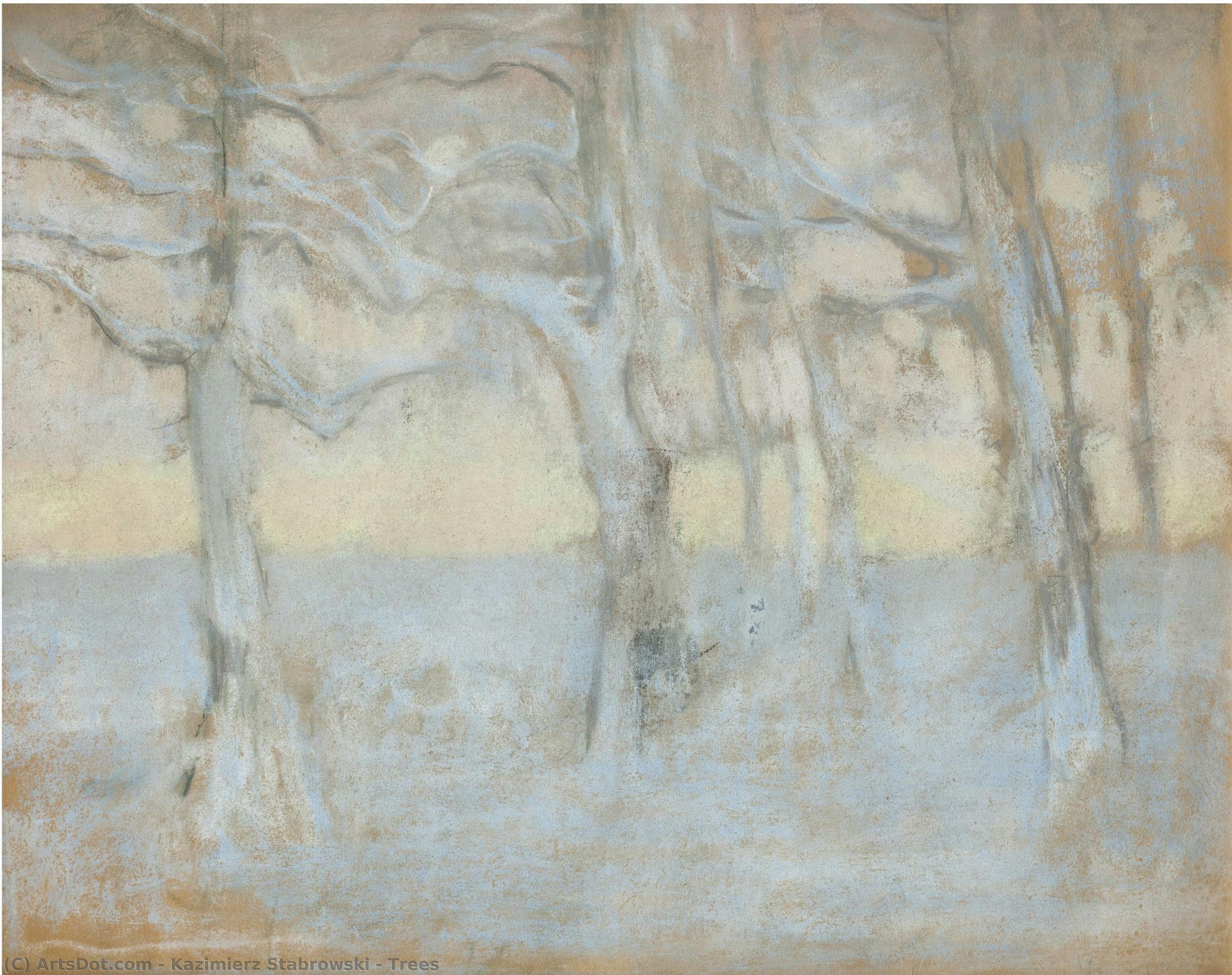
StatsTrees

- 47.0 x 63.0 cm


Explore Kazimierz Stabrowski's 'Trees' (1895), a mesmerizing pastel blending symbolism and romanticism. Witness nature's transformation in this unique Polish masterpiece.
 Read More
Discover Kazimierz Stabrowski (1869-1929), a renowned Polish painter known for his dreamy Symbolist landscapes & romantic scenes. Director of Warsaw's Academy of Fine Arts and founder of the Theosophical Society in Poland. Explore his captivating wor
Get a print-ready file that goes far beyond the web preview. Every digital image we sell comes from a high-resolution master in our stock database — usually 5,000 to 15,000 pixels wide — so you can print large, crop tightly, or reproduce fine detail with confidence.
No file leaves our studio untouched. A digital expert checks the colors against the original painting and corrects them if needed, then improves clarity and detail with professional retouching tools — always staying faithful to the artist's brushwork and style. The result is an image that looks like the painting, not like a filtered scan.
You approve before you're done: our expert sends the image by e-mail within 72 hours for your review. Not satisfied? Ask for improvements or corrections, or request a refund if the quality falls short.
This is the quality relied on by publishers, design studios, galleries and print shops.
Digital Image
Download a high-resolution file for personal display, printing, and creative projects. ( Switch to Print Buy Hand Made Painting)
Included in Every Digital Image Order
Expert Digital Delivery, Guaranteed
When you choose TopImpressionists.com, you're not just getting an image - you're receiving a professionally enhanced digital artwork, crafted with precision and backed by a satisfaction guarantee. Here's everything that comes with your order, automatically:

Fast Email Delivery
Your high-resolution digital image file will be emailed to you within 72 hours of ordering - ready for immediate use.

AI-Enhanced Digital File
Your artwork is professionally optimized using advanced AI tools and manual editing, ensuring maximum detail, clarity, and color accuracy.

Free Lifetime Re-Delivery
Accidentally deleted or lost your file? No worries - we'll resend it to you anytime, free of charge.

No Import Fees - Ever
Enjoy your artwork instantly with zero customs, duties, or delivery fees - digital downloads are always tax-free.

Color Accuracy Guarantee
We ensure your digital image reflects the original colors as closely as possible using professional tools and color management.

100-Day Satisfaction Guarantee
If you're not satisfied with your digital image, we'll revise it or refund 100% within 100 days - no questions asked.

100% Money-Back Guarantee
Not satisfied? Get a full refund within 100 days of receiving your digital file - no questions asked.

Bulk Order Discounts
Buy 3 images, save 10% - Buy 5, save 15% - Buy 10+, save 20%. Great for creative projects, galleries, and agencies.
Kazimierz Stabrowski's "Trees": A Symbolist Landscape of Transformation
- Artist: Kazimierz Stabrowski (1869-1929)
- Date: 1895
- Medium: Pastel on paper
- Size: 47 x 63 cm
Kazimierz Stabrowski's "Trees" is a captivating pastel drawing that transcends simple representation, offering instead a glimpse into the artist’s exploration of symbolism and romanticism within the natural world. This work, created in 1895, showcases a pivotal moment in Stabrowski's artistic development as he moves away from strict realism towards abstraction, while retaining a profound emotional depth.
Subject Matter & Composition
"Trees" depicts a cluster of trees set against what appears to be a beach or shoreline. The composition is dominated by the verticality of the tree trunks and branches, rendered with loose, flowing lines and blended colors. Unlike traditional landscape paintings that prioritize accurate depiction, Stabrowski prioritizes conveying an atmosphere and feeling. There's no clear focal point; instead, the eye wanders across the dense visual field created by the clustered trees, eventually settling on the hazy background suggesting a distant shoreline. The horizontal format emphasizes the breadth of the scene while maintaining a sense of intimacy through the close proximity of the trees in the foreground.
Style and Technique: A Shift Towards Abstraction
The artwork exemplifies a transition towards abstraction. Stabrowski’s technique is characterized by loose, gestural strokes that capture the essence of the trees rather than their precise form. The blending of colors—primarily muted tones of beige, grey, blue, and brown with subtle hints of yellow and green—creates a hazy, dreamlike effect. This soft palette contributes to the overall melancholic and contemplative mood. The use of pastels lends itself beautifully to this style, creating a velvety texture that enhances the sense of depth and dimension. The lines themselves are not sharp or defined but rather flow into one another, suggesting movement and growth within the trees. It's worth noting the similarities in tree depiction with those found in Mikalojus Konstantinas Čiurlionis’ “Winter” collection (1907), highlighting a shared artistic sensibility of the time.
Symbolism & Emotional Impact
Beyond its aesthetic qualities, "Trees" carries significant symbolic weight. The transforming trees represent change, growth, and potentially even spiritual evolution—themes central to Stabrowski’s interest in symbolism and romanticism. The artist's intention was not merely to depict a scene but to express ideas, feelings, and experiences through the landscape. The hazy atmosphere and muted colors evoke a sense of longing or introspection, inviting viewers to contemplate their own connection to nature and the passage of time. This work is more than just a depiction of trees; it’s an exploration of the human condition within the context of the natural world.
Historical Context & Artistic Significance
Created during a period of artistic experimentation, "Trees" reflects the broader shift away from realism and towards symbolism and abstraction in late 19th-century art. Stabrowski’s work stands as an important example of Polish Symbolism, demonstrating a desire to move beyond mere representation and explore deeper emotional and spiritual truths. His exploration of these themes, combined with his later involvement in the Theosophical Society, further enriches the interpretation of this evocative pastel drawing.
Questions & Answers
What subjects appear in "Trees" by Kazimierz Stabrowski?
The subjects of "Trees" are trees, landscape, symbolism, romanticism, pastel, nature, abstraction, polish art.
How does the subject of "Trees" relate to Kazimierz Stabrowski's usual themes?
"Trees" depicts trees, landscape, symbolism, romanticism, pastel, nature, abstraction, polish art, while Kazimierz Stabrowski's recorded themes are symbolism & romanticism, čiurlionis’ landscape style, transformation and change, spiritual evolution symbolism, polish national identity, exploration of nature's power, early exploration of abstraction. Comparing the two shows how the work relates to the artist's usual subjects.
What color palette is used in "Trees" by Kazimierz Stabrowski?
The palette of "Trees" by Kazimierz Stabrowski is described as monochrome. It is a compact description of the work's colors.
Artist Biography
early life and education
kazimierz stabrowski, a renowned polish painter, was born in 1869 in navahroudak, belarus. he went on to study at the academy of fine arts in warsaw, where he later became the director. this pivotal role not only showcased his artistic prowess but also solidified his influence on the next generation of artists.artistic style and notable works
stabrowski's work is characterized by its dreamy, symbolic quality, often blending elements of symbolism and romanticism. one of his most celebrated pieces, the snow maiden (1891), exemplifies this unique style, which has captivated art enthusiasts for over a century.founding the theosophical society in poland
apart from his artistic achievements, stabrowski played a significant role in establishing the first lodges of the theosophical society in poland. this philosophical society, founded on the principles of spirituality and the occult, further underscores stabrowski's multifaceted nature.legacy and later life
stabrowski passed away in 1929 in garwolin, poland, leaving behind a legacy that continues to inspire artists and art lovers alike. his influence can be seen in various aspects of polish art, from the academy of fine arts in warsaw to his numerous symbolic and romantic pieces.selected works by kazimierz stabrowski on TopImpressionists.com
- spirit of the mountains (105 x 85 cm, lithuanian art fund, vilnius, lithuania, oil on canvas) - a quintessential example of stabrowski's symbolic style.
- colosseum in the moonlight (47 x 65 cm, lithuanian art fund, vilnius, lithuania, pastel) - this piece showcases stabrowski's ability to capture ethereal landscapes.
- trees (47 x 63 cm, lithuanian art fund, vilnius, lithuania, pastel) - a unique blend of realism and abstract imagery, characteristic of stabrowski's later work.
museums featuring kazimierz stabrowski's work on TopImpressionists.com
- lithuanian art fund (vilnius, lithuania) - this institution houses several of stabrowski's notable works, including those mentioned above.

Kazimierz Stabrowski
1869 - 1929 , Belarus
Quick Facts
- Full Name: Kazimierz Stabrowski
- Nationality: Polish
- Date Of Birth: 1869
- Date Of Death: 1929
- Place Of Birth: Novahrudok, Belarus
- Notable Artworks:
- Snow Maiden
- Trees
- Rome. Fontana Dei Cavalli Marini
- Artistic Movement Or Style: Symbolism
- Artists Who Influenced This Artist:
- Gustav Klimt
- Jean Sibelius