

Shown: · With its frame:
 Preview
 Send
Send Share
Share
 Details
 Guide
Guide

 Download
 Similars
 X-Ray
X-Ray Diaporama
 Q&A
Q&A Stats
Stats

$ 269
Hand Made Oil Reproduction
Hand-painted oil on canvas in your size and frame, made to order by our artists. ( Switch to Print Switch to Digital Image)
Size
·Standard
custom
CM
INCH
Pick from our preset sizes that match the artwork's original proportions.
Loading sizes...

width
height
Type the width and the height you need, to fit your frame or your wall. This is hand-painted, so for a size with a different shape the artist can paint a bit more around the picture, or cut a bit — you choose. We send you a digital mockup to approve before the painting starts. The picture shown on this page does not show the real result — only the mockup does.
 Read more
Finish
·
White $1

Blurside $1

Extended $1

P118B $10

P118H $10

P118W $10

P438Z $10

P508JH $12

P508YH $12

P805H $10

P805Z $10

P919BZ $10

P919G $10

P919XJ $10

P959ZH $10

P968JZ $12

W106C $8

W218G $10

W218JH $8

W218Y $10

W307PJ $10

W316G $10

W316PJ $8

W316Y $10

W398PJ $8

W4111J $10

W500HY $15

W500JH $15

W692G $12

W849H $8

W940BG $15

W953PJ $8

H24-GOLD $30

H24-SILVER $30

H36-GOLD $45

H36-SILVER $45
Shipped in a protective tube, ready for your own framer.
Above 105 cm the frame is shipped as a kit for a professional framer — read the details.
Extras
optionalWhat do the extras include?
Examples of what can be changed: Replace face with customer photo; Add pet (e.g., replace cat with dog); Include hidden message in background; Change background landscape or elements.
After order, TopImpressionists.com team will email client for instructions and provide a mockup preview
After order, TopImpressionists.com team will email client for instructions and provide a mockup preview
Worldwide Delivery () in 3/4 weeks instead of standard 5 weeks. (30 October). No compromise on quality.
Protective Varnish
Nameplate
Engraved Bronze Plaque Details
This elegant plaque features the artist's name and the title of the artwork, finely engraved for a timeless presentation.
It is made from bronze with a refined, elegant finish. The text is precisely laser-engraved for a sharp and permanent result. Measuring 9x2 cm, the plaque is compact yet easy to read. It's built to be durable and scratch-resistant, offering a professional, museum-quality look. Mounting is simple thanks to the included adhesive backing.
Transparent Acrylic Plaque Details
The plaque includes essential engraved details such as the artist's name, the title of the artwork, the date it was created, the type of media used-like oil on canvas or watercolor-a brief description of the piece, and a QR code that links to the complete artwork information.
It is crafted from clear acrylic, offering a sleek, modern appearance. The text is UV-engraved in black to ensure strong visual contrast. With a size of 10x15 cm, it ensures optimal readability. It comes equipped with two metal hooks for secure wall mounting. The plaque is designed to be weather-resistant, making it suitable for various environments, and it includes interactive features that work seamlessly with smartphone scanning.
Black Acrylic Plaque Details
This elegant plaque includes engraved information such as the artist's name, the title of the artwork, the date it was created, the type of media used (like oil on canvas or watercolor), a short description of the artwork, and a QR code for quick access to more information.
The plaque itself is made from refined black acrylic with a premium finish. The text is laser-engraved in white for high contrast and readability. Its size is 10x15 cm, designed to be easy to read. It comes with two metal hooks for professional mounting. The design is sleek and fits any interior style. It is also weather-resistant and durable, with built-in digital integration for mobile compatibility.
Glass option is only available in size under 110 CM
 Glass option is only available in size under 110 CM
- Free Worldwide Express Shipping
- High-Quality Linen Canvas
- Full Shipping Insurance
- Customs Tax Refund Guarantee
- True Color Matching Guarantee
- 100-Day Return Policy (Defects Only)
- 100% Money-Back Guarantee
- Bulk Discount Offer


Collectible Description
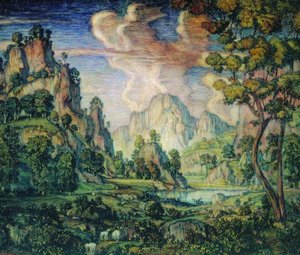
Admire 'A Cloud' by Konstantin Bogaevsky – a stunning Symbolist landscape painting from 1910. Explore Crimean beauty & the artist’s unique vision.
Artist Biography
Explore the dreamlike landscapes of Konstantin Bogaevsky (1872-1943), a Ukrainian-Russian Symbolist painter influenced by Aivazovsky & Mantegna. Discover his unique vision of 'Bogaevia' and evocative Crimean scenes.
About the painting
Quick facts and art quiz
About Konstantin Fyodorovich Bogaevsky

Konstantin Fyodorovich Bogaevsky
1872 - 1943, Ukraine
Artist Biography
A Dreamer of Crimea: The Evocative World of Konstantin Bogaevsky
Konstantin Fyodorovich Bogaevsky, born in 1872 in the Crimean port city of Feodosia, was an artist whose work exists suspended between reality and reverie. His canvases aren’t merely depictions of landscapes; they are portals to “Bogaevia,” a fantastical realm born from his imagination, steeped in symbolism, and profoundly influenced by both the natural beauty of his homeland and the artistic currents sweeping through Europe at the turn of the 20th century. Bogaevsky's story is one of early struggle, persistent vision, and ultimately, lasting recognition as a key figure in Russian Symbolism. His lineage itself was a blend of cultures – descended from an old Italian-German family with Genoese roots – perhaps foreshadowing his own artistic synthesis of diverse influences. From his earliest lessons with the renowned marine painter Ivan Aivazovsky, Bogaevsky demonstrated a sensitivity to light and atmosphere that would become hallmarks of his style. However, his path wasn’t immediately assured; initial studies at the Imperial Academy of Arts in St. Petersburg were met with skepticism, even temporary dismissal for perceived lack of talent. It was the unwavering support of Arkhip Kuindzhi, another master of landscape, that allowed him to persevere and ultimately hone his skills.
The Shaping of a Vision: Italy, Symbolism, and ‘Bogaevia’
A pivotal moment in Bogaevsky's artistic development came with travels to Italy and France in 1898. While he absorbed the lessons of various masters, it was Claude Lorrain who profoundly resonated with him, becoming, as Bogaevsky declared, his “true teacher.” Lorrain’s classical landscapes, bathed in golden light and imbued with a sense of idyllic calm, provided a foundation upon which Bogaevsky would build his own unique vision. However, he didn't simply imitate; instead, he began to infuse his work with the burgeoning spirit of Symbolism. This movement, rejecting realism in favor of subjective experience and emotional resonance, found fertile ground in Bogaevsky’s imagination. He started creating imaginary landscapes—the aforementioned “Bogaevia”—populated by ancient ruins, fantastical architecture, and an ethereal light that hinted at hidden meanings. These weren't mere escapist fantasies; they were explorations of the subconscious, reflections on history, and meditations on the human condition. A later visit to Italy in 1911 brought a new influence: the powerful compositions and dramatic perspective of Andrea Mantegna, which further refined his approach to form and structure. The artist’s unique world wasn't simply invented; it was *felt*, a distillation of Crimean history, personal longing, and artistic inspiration coalescing into something wholly original.
Recognition and Artistic Circles
Bogaevsky’s work gradually gained recognition through the writings of Maximilian Voloshin, a prominent poet and art critic who championed the symbolism inherent in his paintings. Voloshin's essays brought Bogaevsky to a wider audience, establishing him as a significant voice within the Russian avant-garde. He became associated with several influential artistic groups, including *Mir iskusstva* (World of Art), the Union of Russian Artists, and *Zhar-tsvet*, participating in exhibitions that showcased his work alongside other leading artists of the time. A notable early success was his inclusion in the Exposition de l'Art Russe organized by Sergei Diaghilev in 1906, a landmark event that introduced Russian art to an international audience. Throughout his career, Bogaevsky cultivated close friendships with a vibrant circle of intellectuals and artists – Alexander Grin, the celebrated author of fantastical tales; Marina Tsvetaeva, the passionate poet; Osip Mandelstam, the enigmatic modernist writer; and members of the Koktebel group, all drawn to the artistic haven that Crimea had become. These connections weren’t merely social; they were intellectual and creative exchanges that fueled Bogaevsky's imagination and shaped his artistic philosophy.
Later Years and Enduring Legacy
The tumultuous events of the early 20th century – World War I, the Russian Revolution – profoundly impacted Bogaevsky’s life and work. Following the revolution, he retreated into relative obscurity, continuing to paint but largely removed from the center of artistic discourse. Interestingly, his later work, *Port of an Imaginary City* (1932), found a degree of acceptance within the framework of Socialist Realism, demonstrating a surprising adaptability in his style. He died in his beloved Feodosia in 1943 during World War II, a poignant end to a life dedicated to artistic vision. Today, Konstantin Fyodorovich Bogaevsky is remembered as a significant Russian Symbolist painter whose evocative landscapes and unique creation of “Bogaevia” bridge Romanticism with the early modern artistic trends. His work continues to resonate with viewers captivated by its dreamlike quality, historical allusions, and profound emotional depth. A testament to his enduring influence, a minor planet – 3839 Bogaevskij – was named in his honor in 1971, ensuring that his name will continue to orbit within the vast cosmos of artistic achievement. His paintings are not just windows onto landscapes; they are mirrors reflecting the depths of the human soul. Bogaevsky’s legacy lies not only in his technical skill but also in his ability to transport viewers to a realm where imagination reigns supreme.
Key Characteristics and Influences
- Symbolism: Bogaevsky was deeply influenced by the Symbolist movement, prioritizing subjective experience and emotional resonance over realistic representation. His landscapes are imbued with hidden meanings and symbolic imagery.
- Influence of Claude Lorrain: The classical landscapes of Lorrain, characterized by golden light and idyllic calm, provided a foundational influence on Bogaevsky’s style.
- The Creation of ‘Bogaevia’: Bogaevsky's most distinctive contribution was the creation of “Bogaevia,” an imaginary world populated with ancient ruins and fantastical architecture, reflecting his inner landscape and artistic vision.
- Crimean Landscape as Inspiration: The natural beauty of Crimea served as a constant source of inspiration for Bogaevsky, shaping the atmosphere and mood of his paintings.
- Connection to Russian Intellectual Circles: His friendships with prominent writers and artists like Alexander Grin and Marina Tsvetaeva enriched his artistic perspective and contributed to his recognition within the Russian avant-garde.
Quick facts about Konstantin Fyodorovich Bogaevsky
- Full Name: Konstantin Fyodorovich Bogaevsky
- Nationality: Ukrainian/Russian
- Date Of Birth: 1872
- Date Of Death: 1943
- Place Of Birth: Crimea, Ukraine
- Notable Artworks:
- Tropical Landscape
- Sea Shore
- South Country. Cave Town
- Port of an Imaginary City
- Artistic Movement Or Style: Symbolism
- Artists Who Influenced This Artist:
- Ivan Aivazovsky
- Arkhip Kuindzhi
- Claude Lorrain
- Andrea Mantegna
Explore artworks organized by themes, styles, and characteristics.


Konstantin Fyodorovich Bogaevsky
A cloud
() ·
With its frame: · Hand-painted in oil on linen
Total