

Shown: · With its frame:
 Preview
 Send
Send Share
Share
 Details
 Guide
Guide

 Download
 Similars
 X-Ray
X-Ray Diaporama
 Q&A
Q&A Stats
Stats

$ 269
Hand Made Oil Reproduction
Hand-painted oil on canvas in your size and frame, made to order by our artists. ( Switch to Print Switch to Digital Image)
Size
·Standard
custom
CM
INCH
Pick from our preset sizes that match the artwork's original proportions.
Loading sizes...

width
height
Type the width and the height you need, to fit your frame or your wall. This is hand-painted, so for a size with a different shape the artist can paint a bit more around the picture, or cut a bit — you choose. We send you a digital mockup to approve before the painting starts. The picture shown on this page does not show the real result — only the mockup does.
 Read more
Finish
·
White $1

Blurside $1

Extended $1

P118B $10

P118H $10

P118W $10

P438Z $10

P508JH $12

P508YH $12

P805H $10

P805Z $10

P919BZ $10

P919G $10

P919XJ $10

P959ZH $10

P968JZ $12

W106C $8

W218G $10

W218JH $8

W218Y $10

W307PJ $10

W316G $10

W316PJ $8

W316Y $10

W398PJ $8

W4111J $10

W500HY $15

W500JH $15

W692G $12

W849H $8

W940BG $15

W953PJ $8

H24-GOLD $30

H24-SILVER $30

H36-GOLD $45

H36-SILVER $45
Shipped in a protective tube, ready for your own framer.
Above 105 cm the frame is shipped as a kit for a professional framer — read the details.
Extras
optionalWhat do the extras include?
Examples of what can be changed: Replace face with customer photo; Add pet (e.g., replace cat with dog); Include hidden message in background; Change background landscape or elements.
After order, TopImpressionists.com team will email client for instructions and provide a mockup preview
After order, TopImpressionists.com team will email client for instructions and provide a mockup preview
Worldwide Delivery () in 3/4 weeks instead of standard 5 weeks. (1 November). No compromise on quality.
Protective Varnish
Nameplate
Engraved Bronze Plaque Details
This elegant plaque features the artist's name and the title of the artwork, finely engraved for a timeless presentation.
It is made from bronze with a refined, elegant finish. The text is precisely laser-engraved for a sharp and permanent result. Measuring 9x2 cm, the plaque is compact yet easy to read. It's built to be durable and scratch-resistant, offering a professional, museum-quality look. Mounting is simple thanks to the included adhesive backing.
Transparent Acrylic Plaque Details
The plaque includes essential engraved details such as the artist's name, the title of the artwork, the date it was created, the type of media used-like oil on canvas or watercolor-a brief description of the piece, and a QR code that links to the complete artwork information.
It is crafted from clear acrylic, offering a sleek, modern appearance. The text is UV-engraved in black to ensure strong visual contrast. With a size of 10x15 cm, it ensures optimal readability. It comes equipped with two metal hooks for secure wall mounting. The plaque is designed to be weather-resistant, making it suitable for various environments, and it includes interactive features that work seamlessly with smartphone scanning.
Black Acrylic Plaque Details
This elegant plaque includes engraved information such as the artist's name, the title of the artwork, the date it was created, the type of media used (like oil on canvas or watercolor), a short description of the artwork, and a QR code for quick access to more information.
The plaque itself is made from refined black acrylic with a premium finish. The text is laser-engraved in white for high contrast and readability. Its size is 10x15 cm, designed to be easy to read. It comes with two metal hooks for professional mounting. The design is sleek and fits any interior style. It is also weather-resistant and durable, with built-in digital integration for mobile compatibility.
Glass option is only available in size under 110 CM
 Glass option is only available in size under 110 CM
- Free Worldwide Express Shipping
- High-Quality Linen Canvas
- Full Shipping Insurance
- Customs Tax Refund Guarantee
- True Color Matching Guarantee
- 100-Day Return Policy (Defects Only)
- 100% Money-Back Guarantee
- Bulk Discount Offer


Collectible Description
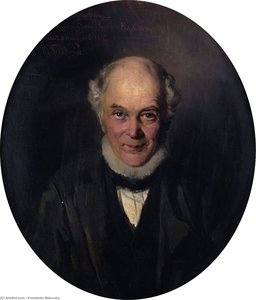
Explore Makovsky's captivating Self-Portrait (1856), a stunning example of Russian realism at the Tretyakov Gallery. Witness his introspective gaze & masterful technique.
Artist Biography
Discover Konstantin Makovsky (1839-1915), a prominent Russian realist painter celebrated for his historical scenes, genre paintings of Russian life, and association with the Peredvizhniki movement. Explore iconic artworks today!
About the painting
Self Portrait by Konstantin Yegorovich Makovsky
- Artist: Konstantin Yegorovich Makovsky
- Birth Year: 1839
- Death Year: 1915
- Date: 1856
- Medium: Oil on Canvas
- Size: Unknown
- Location: State Tretyakov Gallery, Russia
A Glimpse into the Artist's Life and Work
Konstantin Yegorovich Makovsky (1839-1915) was a prominent Russian painter deeply associated with the Peredvizhniki (Wanderers) movement. This group of artists championed realism and social commentary in their work, often depicting scenes from everyday Russian life and historical events. The "Self Portrait," created in 1856, offers an intimate look into Makovsky's persona during his formative years as an artist. It’s a testament to his developing skill and provides insight into the mindset of a young man embarking on a significant artistic career.
Artistic Style and Technique
The "Self Portrait" exemplifies Makovsky's early embrace of Romanticism, though it foreshadows his later development towards realism. The painting features Makovsky with a serious expression, sporting a beard and mustache – details that convey a sense of introspection and perhaps even a touch of melancholy. His gaze is direct, engaging the viewer in a silent dialogue. The artist demonstrates a keen understanding of light and shadow, skillfully using them to define his facial features and create depth within the composition.
- Romanticism Influence: Evident in the emotional intensity and focus on individual expression.
- Realist Tendencies: The meticulous detail and accurate portrayal of physical characteristics hint at Makovsky's future shift towards realism.
- Brushwork: The visible brushstrokes contribute to a sense of texture and dynamism, adding life to the portrait.
Symbolism and Emotional Impact
While seemingly straightforward, the "Self Portrait" carries subtle symbolic weight. The dark background draws attention solely to Makovsky's face, emphasizing his individuality and perhaps suggesting a contemplative nature. The inclusion of two smaller figures in the background adds depth and complexity, hinting at relationships or influences that shaped the artist’s life. Overall, the painting evokes a feeling of quiet dignity and introspection, inviting viewers to contemplate the inner world of the young artist.
Historical Context and Legacy
The "Self Portrait" is housed within the esteemed State Tretyakov Gallery in Russia, a national treasure renowned for its extensive collection of Russian art. It stands alongside masterpieces by other prominent figures like Karl Pavlovich Brulloff and Ilya Yefimovich Repin, solidifying Makovsky's place within the pantheon of Russian artistic giants. The painting serves as a valuable historical document, offering a glimpse into the life and aspirations of a significant artist during a period of great social and cultural change in Russia.
Questions & Answers
What atmosphere does "Self Portrait" have?
The overall mood of "Self Portrait" by Konstantin Yegorovich Makovsky is nostalgic. The mood describes the general atmosphere of the work.
What does "Self Portrait" by Konstantin Yegorovich Makovsky depict, and in what mood?
"Self Portrait" by Konstantin Yegorovich Makovsky depicts portrait, self-portrait, russian art, realism, makovsky, 1856, introspection, in a nostalgic mood. Subject and atmosphere together describe the work.
In what year was "Self Portrait" by Konstantin Yegorovich Makovsky created?
The creation of "Self Portrait" by Konstantin Yegorovich Makovsky is dated 1856.
Quick facts and art quiz
About Konstantin Yegorovich Makovsky

Konstantin Yegorovich Makovsky
1839 - 1915, Russia
Artist Biography
A Life Immersed in Russian Realism: The World of Konstantin Makovsky
Konstantin Yegorovich Makovsky, born into a Moscow household brimming with artistic sensibility in 1839, became one of the most celebrated and financially successful painters of his era. His father, Egor Ivanovich Makovsky, was an amateur artist and a pivotal figure in establishing the foundations of art education in Moscow, while his mother nurtured musical aspirations within young Konstantin. This dual influence – visual artistry from his father and a deep appreciation for harmony and expression from his mother – shaped a sensibility that would permeate his entire oeuvre. The family’s creative atmosphere extended beyond Konstantin; his brothers Vladimir and Nikolay also pursued painting careers, alongside their sister Alexandra, creating a dynasty of artistic talent. From an early age, Makovsky demonstrated exceptional aptitude, entering the Moscow School of Painting, Sculpture, and Architecture at just twelve years old, where he flourished under the tutelage of Karl Bryullov and Vasily Tropinin. It was Bryullov’s influence that instilled in him a penchant for romanticism and decorative effects, qualities that would subtly color his later, more realist works.
From Academic Roots to the Wanderers' Path
Makovsky continued his artistic education at the Imperial Academy of Arts in Saint Petersburg, beginning in 1858. Here, he produced significant early pieces like *Curing of the Blind* (1860) and *Agents of the False Dmitry kill the son of Boris Godunov* (1862), showcasing a developing skill for narrative composition and historical detail. However, it was his involvement in the “Revolt of the Fourteen” in 1863 that truly defined his artistic trajectory. Along with thirteen fellow students, Makovsky protested the Academy’s restrictive focus on mythological subjects, choosing instead to depict contemporary life and Russian realities. This act of defiance signaled a commitment to artistic freedom and paved the way for his association with the *Peredvizhniki*, or Wanderers – a group of artists dedicated to bringing art directly to the people through traveling exhibitions. This movement aimed to break away from academic constraints and address social issues, reflecting the changing currents of Russian society. Makovsky’s early work aligned perfectly with this ethos, focusing on scenes of everyday life—the struggles and triumphs of ordinary Russians—as seen in paintings like *Widow* (1865) and *Herring-seller* (1867).
Capturing the Soul of Russia: Themes and Style
Throughout his career, Makovsky’s art served as a window into Russian life, particularly its historical and cultural richness. He possessed an extraordinary ability to capture the nuances of Russian character and tradition. His paintings weren't merely depictions; they were immersive experiences that transported viewers to bustling marketplaces, grand weddings, or intimate family gatherings. *The Russian Bride’s Attire* (1889), also known as *Beneath the Crown*, stands as a prime example—a lavishly detailed portrayal of pre-wedding rituals, brimming with symbolism and vibrant color. Similarly, works like *A Boyar Wedding Fest, Kissing Ceremony, and Before the Wedding* demonstrate his fascination with Russian customs and celebrations. While initially aligned with the Wanderers’ focus on social realism, Makovsky's style evolved over time. A journey to Egypt and Serbia in the 1870s sparked a shift towards exploring artistic problems of color and form, leading to more polished and decorative compositions. This transition, while earning him widespread acclaim and financial success, also drew criticism from some who felt he had strayed from the movement’s original ideals.
Recognition and a Tragic End
By the late 19th century, Konstantin Makovsky was arguably the most highly regarded and well-compensated artist in Russia. His talent for capturing both historical grandeur and intimate human moments resonated with audiences across Europe. The pinnacle of his recognition came at the 1889 World’s Fair in Paris, where he received a Large Gold Medal for *Death of Ivan the Terrible*, *The Judgement of Paris*, and *Demon and Tamara*. These works showcased his mastery of composition, dramatic lighting, and psychological depth. However, Makovsky's life was tragically cut short in 1915. While traveling in Saint Petersburg, his horse-drawn carriage collided with an electric tram, resulting in fatal injuries. His untimely death marked the end of a remarkable career that left an indelible mark on Russian art history. He remains celebrated for his ability to blend historical accuracy with emotional resonance, offering a captivating glimpse into the soul of Russia.
Legacy and Influence
Konstantin Makovsky’s influence extends beyond his impressive body of work. He played a crucial role in shaping the landscape of Russian art during a period of significant social and political change. His commitment to depicting Russian life, coupled with his technical skill and artistic vision, inspired generations of artists. He bridged the gap between academic tradition and the emerging realist movement, paving the way for future explorations of national identity and cultural heritage in art. Today, Makovsky’s paintings are held in prominent museums and private collections worldwide, continuing to captivate audiences with their beauty, detail, and profound understanding of the human condition. His legacy endures as a testament to the power of art to reflect, preserve, and celebrate the richness of Russian culture.
Quick facts about Konstantin Yegorovich Makovsky
- Full Name: Konstantin Yegorovich Makovsky
- Nationality: Russian
- Date Of Birth: 1839
- Date Of Death: 1915
- Place Of Birth: Moscow, Russia
- Notable Artworks:
- The Russian Bride's Attire
- Death of Ivan the Terrible
- Artistic Movement Or Style: Realism, Academic art
- Artists Who Influenced This Artist:
- Karl Bryullov
- Vasily Tropinin
- Artists Or Movements Influenced By This Artist: ['Russian Impressionism']
Explore artworks organized by themes, styles, and characteristics.




Konstantin Yegorovich Makovsky
Self Portrait
() ·
With its frame: · Hand-painted in oil on linen
Total