


 Preview
 Send
Send Share
Share
 Details
 Guide
Guide

 Download
 Similars
 X-Ray
X-Ray Diaporama
 Stats
StatsNew Planet


Experience Konstantin Yuon’s ‘New Planet’! A powerful Symbolist painting from 1921 depicting the birth of a new era. Vibrant colors & rich symbolism – a unique art historical piece.
 Read More
Konstantin Yuon (1875-1958) was a renowned Russian painter evolving from Impressionist landscapes & Symbolism to Soviet Realism. Explore iconic works like 'Parade on Red Square' and his diverse artistic journey.
Purchase a high-resolution, enhanced digital image, far superior to the online preview.
Each file is meticulously prepared by our in-house specialists using advanced tools and expert manual retouching. We ensure every image has exceptional clarity, precise color accuracy, and fine detail.
The final file is delivered via email within 72 hours, optimized for immediate use in professional, editorial, and print environments. This is the same quality trusted by top-tier design studios, publishers, and galleries.
Digital Image
Download a high-resolution file for personal display, printing, and creative projects. ( Switch to Print Buy Hand Made Painting)
Included in Every Digital Image Order
Expert Digital Delivery, Guaranteed
When you choose TopImpressionists.com, you're not just getting an image - you're receiving a professionally enhanced digital artwork, crafted with precision and backed by a satisfaction guarantee. Here's everything that comes with your order, automatically:

Fast Email Delivery
Your high-resolution digital image file will be emailed to you within 72 hours of ordering - ready for immediate use.

AI-Enhanced Digital File
Your artwork is professionally optimized using advanced AI tools and manual editing, ensuring maximum detail, clarity, and color accuracy.

Free Lifetime Re-Delivery
Accidentally deleted or lost your file? No worries - we'll resend it to you anytime, free of charge.

No Import Fees - Ever
Enjoy your artwork instantly with zero customs, duties, or delivery fees - digital downloads are always tax-free.

Color Accuracy Guarantee
We ensure your digital image reflects the original colors as closely as possible using professional tools and color management.

100-Day Satisfaction Guarantee
If you're not satisfied with your digital image, we'll revise it or refund 100% within 100 days - no questions asked.

100% Money-Back Guarantee
Not satisfied? Get a full refund within 100 days of receiving your digital file - no questions asked.

Bulk Order Discounts
Buy 3 images, save 10% - Buy 5, save 15% - Buy 10+, save 20%. Great for creative projects, galleries, and agencies.
A Celestial Revolution: The Visionary World of Konstantin Yuon
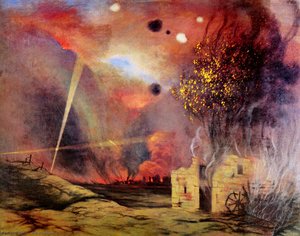
In the wake of the profound political tremors that reshaped Russia in the early twentieth century, few artists captured the psychological landscape of a nation in flux as poignantly as Konstantin Yuon. His 1921 masterpiece, New Planet, stands as a breathtaking testament to this era of transformation. Originally conceived for the grand stage of the Bolshoi Theatre, this work transcends mere theatrical design to become a profound piece of Symbolist storytelling. The painting presents us with a cosmic event that is simultaneously celestial and deeply terrestrial, capturing the precise moment when an old world dissolves to make way for the unknown.
The composition is dominated by a colossal, radiant orb—a scarlet planet that pulses with intense heat and light. This celestial body, rendered in brilliant shades of yellow, orange, and deep crimson, serves as the painting's emotional heartbeat. As it emerges against a stark, dark blue void, it evokes a complex tapestry of human emotion: the awe of witnessing a miracle, the anxiety of facing an unpredictable future, and the fiery fervor of a revolution. To gaze upon this piece is to feel the heat of that rising sun, making it an arresting focal point for any collection dedicated to art that stirs the soul.
Symbolism and the Texture of Change
Beyond its visual splendor, New Planet is a dense thicket of symbolism. The scarlet planet is not merely an astronomical phenomenon; it is a metaphor for the revolutionary spirit that swept through Russia following the October Revolution of 1917. Yuon utilizes the language of Symbolism to represent the birth of a new era—a "new country" emerging from the shadows of the past. The vibrant, almost aggressive colors reflect the heat of political upheaval, suggesting a world being forged in fire.
Below this cosmic spectacle, the human element provides a grounded, poignant contrast. A group of figures is scattered across the lower canvas, their forms rendered in more subdued tones that allow the celestial light to take center stage. Some individuals appear to be gathered in collective anticipation, while others are fallen or retreating, mirroring the diverse and often conflicting reactions of a populace undergoing radical change. This interplay between the monumental heavens and the vulnerable human figures creates a dynamic tension that keeps the viewer's eye moving, searching for meaning within the glow.
A Masterclass in Color and Technique
Technically, Yuon demonstrates his mastery of both Impressionist light and Symbolist depth. Using tempera on canvas, he achieves a luminous quality that allows the oranges and yellows to appear as if they are truly radiating from within the work. His background in Impressionist landscape painting is evident in the way he handles light and atmosphere, yet he pushes these techniques toward something more spiritual and psychological. The contrast between the deep, nocturnal blues of the background and the incandescent warmth of the planet creates a dramatic chiaroscuro effect that is both visually striking and emotionally resonant.
For the discerning collector or interior designer, a high-quality reproduction of New Planet offers more than just decoration; it offers a window into a pivotal moment in art history. The painting’s scale and vibrant palette make it an ideal centerpiece for spaces that demand a sense of drama, intellect, and historical weight. Whether placed in a contemporary gallery setting or a classic study, Yuon's work continues to radiate the same energy and uncertainty that defined his era, inviting every viewer to contemplate their own place within the ever-changing cosmos of human history.
Questions & Answers
What color leads the composition of "New Planet" by Konstantin Yuon?
The color that stands out most in "New Planet" is phthalo green (#232c3f). The dominant color is useful when matching an artwork to an interior.
What mood and emotion come together in "New Planet"?
The recorded mood of "New Planet" by Konstantin Yuon is dramatic, and its emotional tone is dramatic.
What stage of Konstantin Yuon's career does "New Planet" (1921) belong to?
Given its 1921 date, "New Planet" falls in Konstantin Yuon's Early Modern.
Related Artworks



Artist Biography
Early Life and Artistic Foundations
Konstantin Fyodorovich Yuon, born in Moscow on October 24, 1875, emerged from a family steeped in both Swiss-Russian heritage and artistic inclination. His brother, Paul Juon, would achieve renown as a composer, hinting at the creative currents flowing through their upbringing. From a young age, Konstantin demonstrated an affinity for visual expression, nurtured by a mother who fostered artistic pursuits within the home. This early exposure laid the groundwork for his formal education at the Moscow School of Painting, Sculpture and Architecture from 1892 to 1898. There, he came under the tutelage of distinguished masters like Konstantin Savitsky and Konstantin Korovin, absorbing their techniques and philosophies that would shape his initial artistic trajectory. These formative years weren’t confined to Russia; Yuon embarked on journeys to Western Europe, particularly Paris, where he encountered the burgeoning Impressionist movement. While captivated by artists such as Camille Pissarro, he didn't simply imitate—he synthesized these influences with a uniquely Russian sensibility, forging his own distinct style.From Symbolism to Soviet Realism
Yuon’s early work is characterized by an evocative blend of Impressionistic landscapes infused with subtle Symbolist undertones. Paintings like To the Trinity (1903) and Tverskoy Boulevard (1909) exemplify this period, capturing fleeting moments of light and atmosphere while hinting at deeper emotional resonances. He wasn’t content to remain solely within the realm of Impressionism; Yuon began experimenting with lyrical landscapes that incorporated elements drawn from traditional Russian art forms—the delicate precision of Palekh miniature painting and the spiritual depth of icon artistry. This fusion created a visual language uniquely his own, steeped in national identity yet open to innovation. However, the political upheaval of the early 20th century dramatically altered the course of Yuon’s artistic development. As the Soviet era dawned, he navigated the shifting demands of a new ideological landscape. His style gradually evolved towards a more academic approach, embracing the tenets of Socialist Realism—a style that prioritized accessibility and served as a tool for propagating revolutionary ideals. This shift is powerfully evident in his monumental work Parade on the Red Square on November 7, 1941, a patriotic depiction of Soviet strength during wartime.A Multifaceted Career and Institutional Leadership
Konstantin Yuon’s contributions extended far beyond the canvas. He was not merely a painter but also an influential figure in the organization and administration of the Russian art world. He co-founded both the Union of Russian Artists and, later, the Association of Artists of Revolutionary Russia, actively shaping the direction of artistic expression during periods of profound social change. His administrative talents were further recognized through his leadership roles: he served as director of the Research Institute of the Academy of Arts (1948–1950) and, culminating in a distinguished career, became the First Secretary of the Union of Soviet Artists (1956–1958). These positions afforded him considerable influence over artistic policy and education, allowing him to champion his vision for Russian art. His dedication was acknowledged with prestigious accolades, including the Stalin Prize in 1943 and the Order of Lenin, solidifying his status as a national treasure.Legacy and Enduring Influence
Konstantin Yuon’s legacy is complex and multifaceted—a testament to an artist who navigated turbulent times while remaining committed to his craft. He stands as a pivotal figure in Russian art history, bridging the gap between the aesthetic sensibilities of the late 19th century and the ideological demands of the Soviet era. His early Symbolist landscapes possess a haunting beauty that continues to captivate viewers, while his later Socialist Realist works offer valuable insights into the artistic strategies employed by the Soviet regime. Today, Yuon’s paintings are held in prominent museum collections across Russia, including the Tretyakov Gallery and the Taganrog Art Museum, ensuring their accessibility for generations to come.- Notable Works: New Planet, Bean Vine, Parade on the Red Square on November 7, 1941.
- Key Influences: Konstantin Savitsky, Konstantin Korovin, Valentin Serov, Camille Pissarro.
- Artistic Movements: Impressionism, Symbolism, Socialist Realism.

Konstantin Yuon
1875 - 1958 , Russia
Quick Facts
- Full Name: Konstantin Fyodorovich Yuon
- Nationality: Russian
- Date Of Birth: 1875
- Date Of Death: 1958
- Place Of Birth: Moscow, Russia
- Notable Artworks:
- To the Trinity
- Tverskoy Boulevard
- New Planet
- Parade on Red Square
- Artistic Movement Or Style: Impressionism, Symbolism, Socialist Realism
- Artists Who Influenced This Artist:
- Konstantin Korovin
- Valentin Serov
- Camille Pissarro