


 Preview
 Send
Send Share
Share
 Details
 Guide
Guide

 Download
 Similars
 X-Ray
X-Ray Diaporama
 Stats
StatsThe Winter Landscape
 Impressionism
 1910
1910 23.0 x 30.0 cm
Discover 'The Winter Landscape' by Konstantin Yuon (1910). A serene watercolor capturing a Russian village in winter. Impressionistic & melancholic, perfect for art lovers.
Konstantin Yuon (1875-1958) was a renowned Russian painter evolving from Impressionist landscapes & Symbolism to Soviet Realism. Explore iconic works like 'Parade on Red Square' and his diverse artistic journey.
 Read More
The artwork displayed on this page is protected by copyright law, which means we cannot legally create or sell an identical reproduction. This protection is enforced under international agreements such as the Berne Convention and by national laws, including those outlined by the U.S. Copyright Law - Title 17.
This method fully complies with copyright regulations because it does not involve copying or duplicating the protected artwork. Instead, it is a creative reinterpretation - a new painting that is influenced by the original but not identical to it.
Giclée / Art Print
Museum-quality giclée or canvas print with fast production and flexible finish options. ( Buy Hand Made Painting Switch to Digital Image)




































Standard
custom
CM
INCH
Pick from our preset sizes that match the artwork's original proportions.
Loading sizes...

width
height
Type the width and the height you need, to fit your frame or your wall. A print can only be cut, never made bigger than the picture, so a size with a different shape loses a part of the image. We send you a digital mockup to approve before we print anything. The picture shown on this page does not show the real cut — only the mockup does.
Worldwide Delivery () in 2 weeks instead of standard 4/5 weeks. (15 October)

Free Worldwide Express Shipping

High-Quality Linen Canvas

Full Shipping Insurance

Customs Tax Refund Guarantee

True Color Matching Guarantee

100-Day Return Policy (Defects Only)

100% Money-Back Guarantee

Bulk Discount Offer
 Glass option is only available in size under 110 CM

The Winter Landscape
Giclée / Art Print
Reproduction Size
-


Total Price
$ 70
Related Artworks


Artist Biography
Early Life and Artistic Foundations
Konstantin Fyodorovich Yuon, born in Moscow on October 24, 1875, emerged from a family steeped in both Swiss-Russian heritage and artistic inclination. His brother, Paul Juon, would achieve renown as a composer, hinting at the creative currents flowing through their upbringing. From a young age, Konstantin demonstrated an affinity for visual expression, nurtured by a mother who fostered artistic pursuits within the home. This early exposure laid the groundwork for his formal education at the Moscow School of Painting, Sculpture and Architecture from 1892 to 1898. There, he came under the tutelage of distinguished masters like Konstantin Savitsky and Konstantin Korovin, absorbing their techniques and philosophies that would shape his initial artistic trajectory. These formative years weren’t confined to Russia; Yuon embarked on journeys to Western Europe, particularly Paris, where he encountered the burgeoning Impressionist movement. While captivated by artists such as Camille Pissarro, he didn't simply imitate—he synthesized these influences with a uniquely Russian sensibility, forging his own distinct style.From Symbolism to Soviet Realism
Yuon’s early work is characterized by an evocative blend of Impressionistic landscapes infused with subtle Symbolist undertones. Paintings like To the Trinity (1903) and Tverskoy Boulevard (1909) exemplify this period, capturing fleeting moments of light and atmosphere while hinting at deeper emotional resonances. He wasn’t content to remain solely within the realm of Impressionism; Yuon began experimenting with lyrical landscapes that incorporated elements drawn from traditional Russian art forms—the delicate precision of Palekh miniature painting and the spiritual depth of icon artistry. This fusion created a visual language uniquely his own, steeped in national identity yet open to innovation. However, the political upheaval of the early 20th century dramatically altered the course of Yuon’s artistic development. As the Soviet era dawned, he navigated the shifting demands of a new ideological landscape. His style gradually evolved towards a more academic approach, embracing the tenets of Socialist Realism—a style that prioritized accessibility and served as a tool for propagating revolutionary ideals. This shift is powerfully evident in his monumental work Parade on the Red Square on November 7, 1941, a patriotic depiction of Soviet strength during wartime.A Multifaceted Career and Institutional Leadership
Konstantin Yuon’s contributions extended far beyond the canvas. He was not merely a painter but also an influential figure in the organization and administration of the Russian art world. He co-founded both the Union of Russian Artists and, later, the Association of Artists of Revolutionary Russia, actively shaping the direction of artistic expression during periods of profound social change. His administrative talents were further recognized through his leadership roles: he served as director of the Research Institute of the Academy of Arts (1948–1950) and, culminating in a distinguished career, became the First Secretary of the Union of Soviet Artists (1956–1958). These positions afforded him considerable influence over artistic policy and education, allowing him to champion his vision for Russian art. His dedication was acknowledged with prestigious accolades, including the Stalin Prize in 1943 and the Order of Lenin, solidifying his status as a national treasure.Legacy and Enduring Influence
Konstantin Yuon’s legacy is complex and multifaceted—a testament to an artist who navigated turbulent times while remaining committed to his craft. He stands as a pivotal figure in Russian art history, bridging the gap between the aesthetic sensibilities of the late 19th century and the ideological demands of the Soviet era. His early Symbolist landscapes possess a haunting beauty that continues to captivate viewers, while his later Socialist Realist works offer valuable insights into the artistic strategies employed by the Soviet regime. Today, Yuon’s paintings are held in prominent museum collections across Russia, including the Tretyakov Gallery and the Taganrog Art Museum, ensuring their accessibility for generations to come.- Notable Works: New Planet, Bean Vine, Parade on the Red Square on November 7, 1941.
- Key Influences: Konstantin Savitsky, Konstantin Korovin, Valentin Serov, Camille Pissarro.
- Artistic Movements: Impressionism, Symbolism, Socialist Realism.

Konstantin Yuon
1875 - 1958 , Russia
Quick Facts
- Full Name: Konstantin Fyodorovich Yuon
- Nationality: Russian
- Date Of Birth: 1875
- Date Of Death: 1958
- Place Of Birth: Moscow, Russia
- Notable Artworks:
- To the Trinity
- Tverskoy Boulevard
- New Planet
- Parade on Red Square
- Artistic Movement Or Style: Impressionism, Symbolism, Socialist Realism
- Artists Who Influenced This Artist:
- Konstantin Korovin
- Valentin Serov
- Camille Pissarro
Related Articles
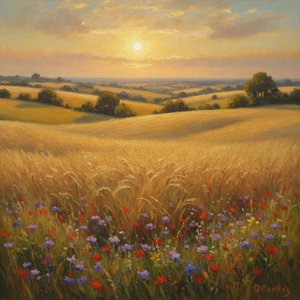
Golden Fields & Sun-Drenched Meadows: Capturing the Soul of Impressionist Landscapes
Immerse yourself in the luminous world of Impressionist landscapes. Discover how masters like Monet and Gauguin captured ephemeral light through plein air painting, and learn to bring the soul of sun-drenched meadows into your home with exquisite, hand-painted oil reproductions.

Capturing Light: The Ethereal Beauty and Timeless Legacy of Watercolor Landscapes
Embark on a visual journey through the ethereal beauty of watercolor landscapes. Discover how Impressionist masters captured light and emotion, and learn to bring this timeless, luminous elegance into your home with expert art curation and hand-painted reproductions.

The Beauty of Impermanence: Capturing Decay through Impressionist Eyes
Explore the profound beauty of impermanence through Impressionist and Post-Impressionist eyes. Discover how masters like Monet and Van Gogh captured fleeting light and the poetic essence of nature's transitions in our deep dive into art history and emotional landscapes.

Capturing the Soul of Russia: A Reflective Journey Through the Profound Beauty of Breathtaking Landscape Art
Embark on a soulful journey through Russia's breathtaking landscapes. Discover exquisite, hand-painted oil reproductions of Peredvizhniki masterpieces, meticulously crafted to bring the emotional depth and timeless beauty of Russian fine art into your personal sanctuary.

Capturing the Soul: The Most Emotionally Moving Impressionist and Post-Impressionist Masterpieces
Discover the profound emotional depth of Impressionist and Post-Impressionist masterpieces. Explore how legends like Monet, Van Gogh, and Gauguin captured light and soul through evocative landscapes and vibrant brushwork for a timeless connection to art history.
Explore artworks organized by themes, styles, and characteristics.


