Preview
 Send
Send Share
Share
 Details
 Guide
Guide

 Download
 Similars
 X-Ray
X-Ray Diaporama
 Stats
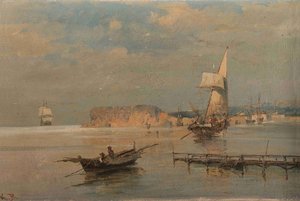
StatsBefore dusk

Discover Konstantinos Volanakis, "Father of Greek Seascape Painting." Explore his iconic maritime scenes & influence on Greek art – a master of seascapes from 1837.
 Read More
Giclée / Art Print
Museum-quality giclée or canvas print with fast production and flexible finish options. ( Buy Hand Made Painting Switch to Digital Image)




































Standard
custom
CM
INCH
Pick from our preset sizes that match the artwork's original proportions.
Loading sizes...

width
height
Type the width and the height you need, to fit your frame or your wall. A print can only be cut, never made bigger than the picture, so a size with a different shape loses a part of the image. We send you a digital mockup to approve before we print anything. The picture shown on this page does not show the real cut — only the mockup does.
Worldwide Delivery () in 2 weeks instead of standard 4/5 weeks. (25 October)

Free Worldwide Express Shipping

High-Quality Linen Canvas

Full Shipping Insurance

Customs Tax Refund Guarantee

True Color Matching Guarantee

100-Day Return Policy (Defects Only)

100% Money-Back Guarantee

Bulk Discount Offer
 Glass option is only available in size under 110 CM

Before dusk
Giclée / Art Print
Reproduction Size
-


Total Price
$ 70
Related Artworks


Artist Biography
The Bard of the Greek Sea
Konstantinos Volanakis stands as a monumental figure in the annals of Hellenic art, a painter whose brush captured the very soul of the Aegean. Known affectionately as the "Father of Greek Seascape Painting," his life was a journey that mirrored the ebb and flow of the tides he so lovingly depicted. Born in 1837 in Heraklion, Crete, Volanakis emerged from modest beginnings near Rethymno, a landscape shaped by the rugged beauty of his homeland. His early years were marked by movement and transition, eventually leading him to the island of Syros, where he completed his basic education in 1856 amidst the bustling maritime commerce that would later become the central protagonist of his life's work.
The trajectory of his career was irrevocably altered not by a formal calling, but by a serendipitous detour into commerce. Moving to Trieste to serve as a bookkeeping clerk for a family of Greek merchants, Volanakis found himself surrounded by the salt air and the silhouettes of great vessels. It was within the margins of his meticulous account ledgers that his true passion began to surface; rather than mere figures and sums, the pages became littered with exquisite sketches of ships and harbors. This latent talent did not go unnoticed by his patrons, who recognized a profound artistic spark and facilitated his journey to the prestigious Academy of Fine Arts in Munich. Under the tutelage of the renowned Karl von Piloty, Volanakis joined an illustrious cohort of Greek students, honing a technique that would eventually bridge the gap between classical precision and atmospheric emotion.
A Mastery of Light and Maritime Grandeur
While his formal training initially pushed him toward portraiture—as landscape painting was then viewed by many academics as a declining genre—Volanakis remained steadfastly tethered to the sea. His development as an artist was characterized by an unparalleled ability to convey the weight of water, the translucency of light through waves, and the complex rigging of sailing vessels. He possessed a keen and affectionate eye for nature, transforming maritime scenes into profound studies of atmosphere. Whether capturing the moonlit tranquility of a harbor or the dramatic tension of a storm-tossed vessel, his work resonates with a deep, rhythmic vitality.
His achievements were marked by significant historical milestones that elevated his status from a talented student to an internationally recognized master. One such moment arrived in 1869, following the Battle of Lissa; Volanakis secured victory in a prestigious drawing competition instituted by Emperor Franz Joseph. The prize—a substantial sum of gold florins and three years of free travel aboard Austrian naval vessels—provided him with an unparalleled vantage point to observe the majesty of naval life firsthand. This period of exploration allowed him to refine his depictions of steam and sail, cementing his reputation as a premier naval painter.
Legacy and Historical Significance
The historical significance of Volanakis extends far beyond the aesthetic beauty of his canvases. His work serves as a visual chronicle of a transformative era in Greek history, capturing the maritime essence of Greece's post-independence consolidation. One of his most profound contributions to the national identity is his masterpiece, the "Naval Battle of Salamis." This epic depiction of the ancient clash between Greek city-states and the Persian Empire is so revered that it belongs to the Hellenic Navy and traditionally hangs in the office of the Prime Minister of Greece.
Despite the later years of his life being marked by personal hardship and economic strain, his influence on the trajectory of Greek art remains indelible. He returned permanently to Greece in 1883, settling in Piraeus, where he continued to teach at the Athens School of Fine Arts until his health began to decline. Volanakis left behind a legacy that transcends simple maritime documentation; he gifted the world a poetic interpretation of the sea, ensuring that the spirit of the Aegean would forever be preserved through the delicate interplay of light, shadow, and salt.

Konstantinos Volanakis
1837 - 1907 , Greece
Quick Facts
- Full Name: Konstantinos Volanakis
- Nationality: Greek
- Date Of Birth: 1837
- Date Of Death: 1907
- Place Of Birth: Heraklion, Greece
- Notable Artworks:
- Outside the harbor
- The crossing
- Sunset over the bay
- Artistic Movement Or Style: Seascape Painting
- Artists Who Influenced This Artist: ['Karl von Piloty']
- Artists Or Movements Influenced By This Artist: ['Romanticism']
Explore artworks organized by themes, styles, and characteristics.