Atelier — Complimentary worldwide shipping — Delivery 2–6 weeks
Painting from Photo Wishlist Cart
PreviewPreview AR previewAR preview Buy Print Buy PrintBuy Hand Made Painting Buy Hand Made Painting SendSend
DetailsDetails Add to favorites Add to favorites DownloadDownload SimilarsSimilars X-RayX-Ray DiaporamaDiaporama

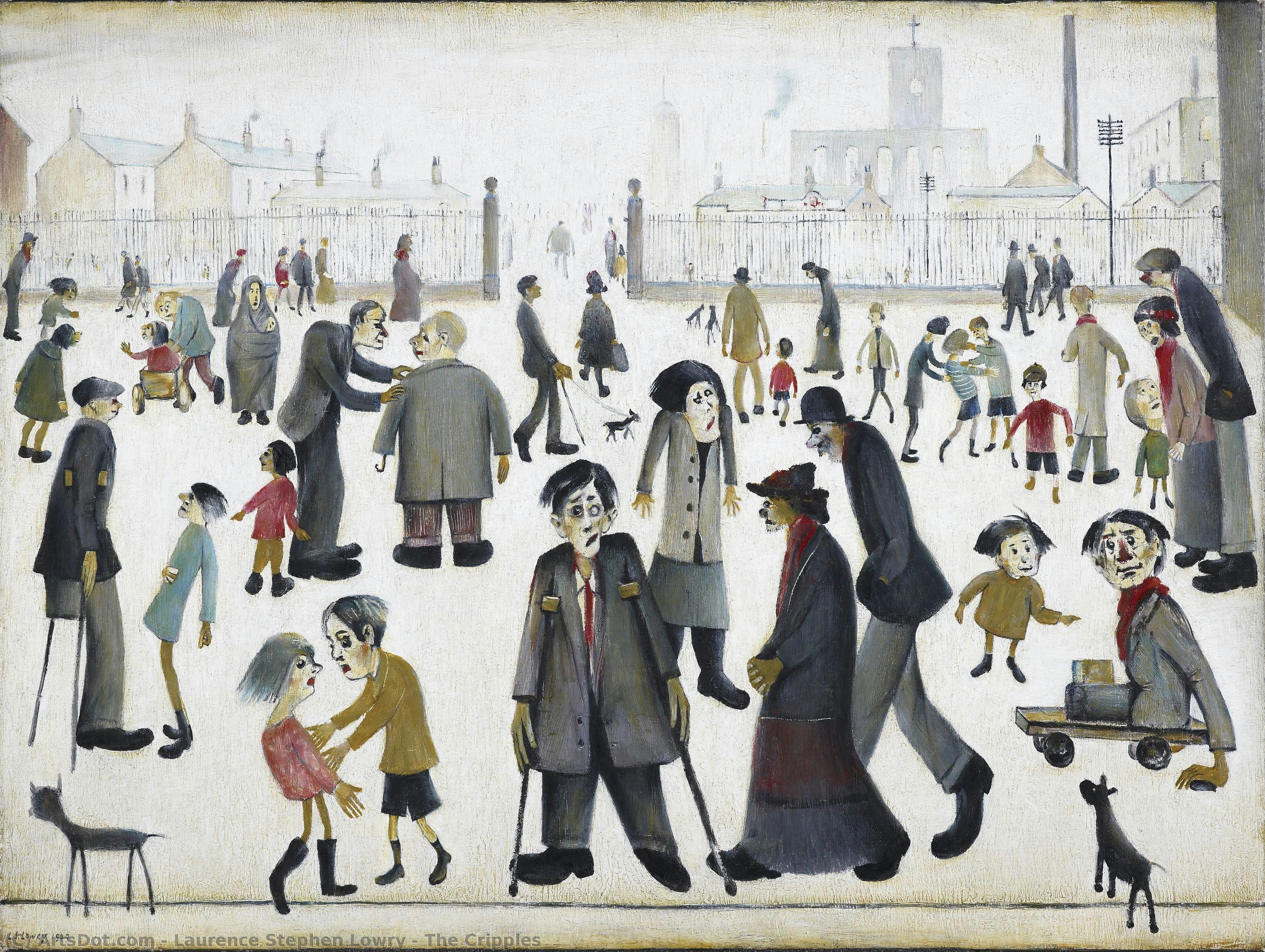
The Cripples

Explore Laurence Stephen Lowry's 'The Cripples,' a poignant depiction of urban life and its marginalized figures. A stark, evocative painting reflecting social commentary & human experience.

Discover L.S. Lowry (1887-1976), the iconic British artist famed for his poignant depictions of Northern industrial life, 'matchstick men', and haunting landscapes. Explore his unique style & legacy.

Purchase a high-resolution, enhanced digital image, far superior to the online preview.

Each file is meticulously prepared by our in-house specialists using advanced tools and expert manual retouching. We ensure every image has exceptional clarity, precise color accuracy, and fine detail.

The final file is delivered via email within 72 hours, optimized for immediate use in professional, editorial, and print environments. This is the same quality trusted by top-tier design studios, publishers, and galleries.

Digital Image

Download a high-resolution file for personal display, printing, and creative projects. (Buy Print Buy PrintBuy Hand Made Painting Buy Hand Made Painting)

Total Price

$ 24.90

Included in Every Digital Image Order

Expert Digital Delivery, Guaranteed

When you choose TopImpressionists.com, you're not just getting an image - you're receiving a professionally enhanced digital artwork, crafted with precision and backed by a satisfaction guarantee. Here's everything that comes with your order, automatically:

shipping_icon
Fast Email Delivery

Your high-resolution digital image file will be emailed to you within 72 hours of ordering - ready for immediate use.

canvas_icon
AI-Enhanced Digital File

Your artwork is professionally optimized using advanced AI tools and manual editing, ensuring maximum detail, clarity, and color accuracy.

insurance_icon
Free Lifetime Re-Delivery

Accidentally deleted or lost your file? No worries - we'll resend it to you anytime, free of charge.

tax_icon
No Import Fees - Ever

Enjoy your artwork instantly with zero customs, duties, or delivery fees - digital downloads are always tax-free.

color_icon
Color Accuracy Guarantee

We ensure your digital image reflects the original colors as closely as possible using professional tools and color management.

return_icon
60-Day Satisfaction Guarantee

If you're not satisfied with your digital image, we'll revise it or refund 100% within 60 days - no questions asked.

guarantee_icon
100% Money-Back Guarantee

Not satisfied? Get a full refund within 60 days of receiving your digital file - no questions asked.

discount_icon
Bulk Order Discounts

Buy 3 images, save 10% - Buy 5, save 15% - Buy 10+, save 20%. Great for creative projects, galleries, and agencies.

Quick Facts

  • Notable elements: Urban scene, figures
  • Artist: Laurence Stephen Lowry
  • Influences: Social realism
  • Medium: Oil on canvas
  • Title: The Cripples
  • Artistic style: Naive realism
  • Subject or theme: Industrial life

Art Quiz

There is only one correct answer for each question.

Question 1:
According to Lowry, what was a primary intention behind his painting ‘The Cripples’?
Question 2:
What medium did Lowry primarily use to create ‘The Cripples’?
Question 3:
What is the overall mood conveyed by the composition of ‘The Cripples’?
Question 4:
What is the significance of the ‘foxtails’ worn by some of the figures in ‘The Cripples’?
Question 5:
In what year was ‘The Cripples’ painted?

Collectible Description

Laurence Stephen Lowry’s “The Cripples”: A Study in Urban Isolation

Laurence Stephen Lowry's "The Cripples," painted in 1949, isn’t merely a depiction of Manchester street life; it’s a poignant and unsettling meditation on anonymity, social exclusion, and the quiet dignity of those often overlooked. This iconic work, now housed within the collection of The Lowry in Salford, offers a rare glimpse into the artist's unique perspective – one that eschewed sentimentality for a starkly observed reality, revealing a profound sensitivity to the human condition amidst the relentless march of industrial progress. Lowry’s decision to avoid explicit emotional expression is key to understanding the painting’s enduring power; instead, he invites viewers to contemplate the lives and experiences of his subjects through their very absence of overt feeling.

The scene unfolds within a densely populated urban square, rendered in Lowry's signature monochrome palette – a deliberate choice that strips away any potential distraction, forcing the viewer to confront the figures with unflinching honesty. A multitude of pedestrians, predominantly men, populate the frame, their faces largely obscured and their movements seemingly aimless. They are not individuals engaged in conversation or activity; rather, they exist as anonymous components within a larger, impersonal landscape. The composition itself is deliberately chaotic, mirroring the perceived disorder of urban life – figures overlap, merge into one another, and recede into the distance, creating a sense of overwhelming density and isolation. The buildings lining the street are simplified architectural forms, serving primarily to establish a spatial context rather than offering any detailed representation.

A Study in Form and Technique

Lowry’s technique is instantly recognizable: a direct, almost childlike approach characterized by loose brushstrokes and a deliberate avoidance of meticulous detail. The figures are rendered with simplified geometric shapes – cylinders for limbs, rectangles for bodies – creating an effect that is both immediate and slightly unsettling. The lines delineating the forms are often imprecise, contributing to their anonymity and reinforcing the painting’s overall sense of detachment. Notably, Lowry employed a medium likely consisting of graphite or charcoal on paper, lending the work a subtle textural quality—a delicate balance between precision and spontaneity. The lack of blending or layering suggests an immediate, intuitive approach, as if Lowry were capturing fleeting impressions rather than constructing a carefully planned composition.

Symbolism and Historical Context

The title itself, “The Cripples,” immediately introduces a layer of complexity. While the painting depicts individuals with physical disabilities – a woman leaning heavily on a cane, a man with a limp – it’s crucial to understand that Lowry wasn't simply portraying charity cases or victims of misfortune. He was drawing inspiration from his own observations of Manchester’s streets and its inhabitants, many of whom were struggling with poverty, illness, and the social consequences of rapid industrialization. The figures are not presented as objects of pity; rather, they are integrated into the fabric of everyday life, existing alongside their able-bodied counterparts without receiving any particular attention or consideration. The presence of carnival headgear – a cardboard crown, a paper shako, a beret – adds another layer of symbolic meaning, suggesting that these individuals represent various social classes and roles within the community.

A Legacy of Observation

Further research reveals intriguing connections to Lowry’s own life and artistic sensibilities. The debate surrounding his potential Asperger's syndrome offers a compelling lens through which to interpret "The Cripples." His meticulous observation of detail, coupled with a seeming indifference to conventional notions of beauty or emotional expression, aligns remarkably well with the characteristics associated with this neurodevelopmental condition. Moreover, Lowry’s work reflects a broader trend in British art during the mid-20th century – a shift away from idealized representations and towards a more realistic, often unflinching portrayal of social realities. "The Cripples" stands as a testament to Lowry's unique vision, inviting viewers to contemplate the complexities of urban life and the enduring power of observation.


Artist Biography

The Quiet Observer of Industrial England

Laurence Stephen Lowry, born in the heart of Stretford, Cheshire, in 1887, remains one of Britain’s most beloved and distinctive voices in twentieth-century art. While his name is now synonymous with the gritty, evocative landscapes of Northern England, his journey to international acclaim was a slow, poignant ascent. For much of his life, Lowry lived as a quiet observer, working as a rent collector by day while honing his craft in the evenings. This dual existence allowed him to witness the rhythmic, often harsh, pulse of industrial life with a unique intimacy. His work does not merely represent the smoke-filled horizons of Salford and Pendlebury; it captures a profound sensitivity to the human condition, finding a quiet dignity within the stark realities of the industrial age.

Lowry’s artistic development was deeply rooted in his surroundings, yet his technical foundations were built upon a careful study of form and light. Initially influenced by the principles of Impressionism and Post-Impressionism, he sought to capture the essence of a scene rather than its mere surface. His early training at the Manchester Art School provided him with the tools to translate the sprawling factories and crowded streets into something much more symbolic. As his style matured, he moved away from grand narratives, choosing instead to focus on subtle nuances of observation. He often worked within a highly restricted palette—utilizing colors such as flake white, ivory black, vermilion, Prussian blue, and yellow ochre—to create compositions that felt both grounded in reality and elevated by a dreamlike, almost surrealist quality.

The Magic of the Matchstick Men

Perhaps the most enduring legacy of Lowry is his creation of the so-called "matchstick men." These stylized, simplified human figures, often depicted without shadows or distinct facial features, populate his urban landscapes with a sense of collective movement and shared destiny. Through these figures, Lowry transformed bustling street scenes into poetic meditations on community and solitude. Whether they are walking toward a football match, congregating near a mill, or wandering through a park, these characters embody the resilience of the working class. There is a haunting beauty in how he places these small, fragile forms against the backdrop of massive, brooding industrial structures, creating a tension between the monumental scale of industry and the delicate nature of human life.

Beyond his famous urban scenes, Lowry’s repertoire was surprisingly diverse, revealing an artist of great depth and curiosity. While the industrial landscape is his most celebrated subject, he also explored:

  • Mysterious Unpopulated Landscapes: Brooding, atmospheric scenes that evoke a sense of solitude and the passage of time.
  • Seascapes: Pure, elemental depictions of sea and sky that emerged from his fascination with the coast in the 1940s.
  • Portraits: Intimate, often somber studies of individuals that showcase his ability to capture character through minimal detail.
  • The "Marionette" Works: A collection of unpublished, surrealist-leaning pieces discovered only after his death, revealing a more experimental side of his imagination.

A Lasting Legacy in British Art

Though he achieved significant national fame following his first solo exhibition in London in 1939, Lowry’s true impact is felt in the way he redefined the English landscape. He did not seek to glorify progress or paint heroic vistas; instead, he found beauty in the mundane and the melancholic. His ability to find poignant beauty in the soot-stained streets of the North West has made his work a cornerstone of British cultural identity. Today, institutions such as The Lowry in Salford Quays serve as vital guardians of his immense legacy, housing one of the largest public collections of his work.

Lowry’s significance lies in his refusal to look away from the difficult realities of his era. By documenting the lives of ordinary people with such empathy and stylistic innovation, he ensured that the spirit of industrial England would be preserved not just as history, but as art. He remains a master of atmosphere, an artist who proved that even in the most crowded, industrial settings, there is a profound, quiet magic to be found.

laurence stephen lowry

laurence stephen lowry

1887 - 1976 , United Kingdom

Quick Facts

  • Artistic Movement Or Style: Industrial Painting
  • Artists Or Movements Influenced By This Artist: ['Northern England Art']
  • Artists Who Influenced This Artist: ['Impressionism']
  • Date Of Birth: Stretford, United Kingdom (1887)
  • Date Of Death: 1976
  • Full Name: Laurence Stephen Lowry
  • Nationality: British
  • Notable Artworks:
    • An Old Street
    • Swinton Moss
    • Untitled (447)
  • Place Of Birth: Stretford, UK
© TopImpressionists.com — All Rights Reserved  ·  100% Hand-Painted · Satisfaction Guaranteed · Free Worldwide Shipping
VISA MASTERCARD