A Life of Color and Displacement: The Odyssey of Lene Schneider-Kainer
Lene Schneider-Kainer was far more than a mere observer of the world; she was a chronicler of its most fleeting and beautiful moments. Born in 1885 to the esteemed Viennese painter Sigmund Schneider, her very existence was steeped in the rich, intellectual atmosphere of fin-de-siècle Austria. Her early years were defined by a rigorous artistic education that spanned the great cultural hubs of Europe—Vienna, Munich, Amsterdam, and Berlin. This diverse training allowed her to cultivate a versatile technique, one that could pivot from the delicate, translucent layers of watercolor to the more robust, expressive strokes of oil painting. In 1917, she stepped into the light of the international art scene with her solo debut at the Galerie Gurlitt in Berlin, establishing herself not just as an heiress to a painterly tradition, but as a formidable creative force in her own right.
The 1920s marked a period of profound personal and professional expansion. Following her marriage to the Munich-based artist Ludwig Kainer, Lene became part of an elite circle of European intellectuals, rubbing shoulders with luminaries such as Arnold Schönberg and Else Lasker-ƒSchƖler. It was during this era that she truly found her voice as a storyteller. Her work often danced on the edge of the sensual and the profound, particularly in her celebrated illustrations for Hetärengespräche (Dialogues of Courtesans). Through these works, she captured the nuanced emotions and subtle eroticism of human connection, using line and color to breathe life into literary themes. Her talent was not limited to the canvas; she also emerged as a sophisticated fashion designer, proving that her aesthetic vision could transcend the boundaries of fine art into the realm of lived experience.
Tracing the Silk Road: The Artist as Explorer
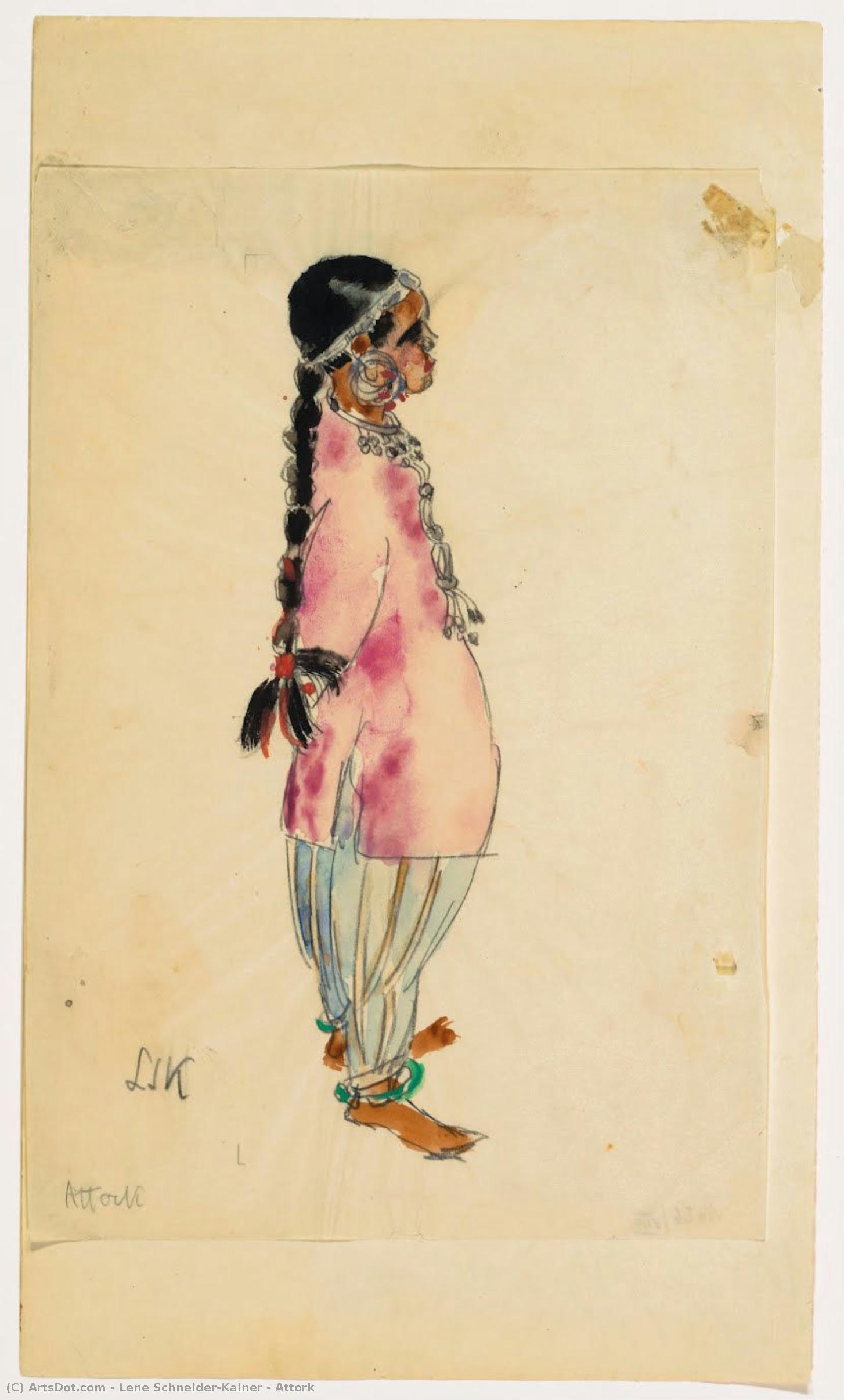
Perhaps the most breathtaking chapter of Schneider-Kainer’s life began in 1926. Commissioned by the Berliner Tageblatt, she embarked on an extraordinary journalistic and artistic expedition to retrace the legendary route of Marco Polo. Alongside the poet Bernhard Kellermann, she traversed the vast landscapes of the Middle East and Asia, journeying through Iran, Ladakh, India, Thailand, Vietnam, and China. This was not merely a trip of leisure, but a mission of documentation. As she moved through these diverse cultures, her sketchbook became a repository for the soul of the East. She captured the vibrant hues of Moroccan villages, the serene dignity of Persian mothers, and the quiet intensity of life in the High Atlas mountains.
Her work from this period serves as a poignant visual diary of a world on the brink of massive historical change. While much of her photographic record was tragically lost to time, her watercolors and drawings remain as enduring witnesses to her travels. These pieces possess a unique, ethnographic intimacy; they do not merely depict foreign landscapes but attempt to capture the warmth, the communal spirit, and the delicate textures of the lives she encountered. In these works, we see an artist using her brush to bridge the gap between the familiar comforts of Europe and the exotic, often overwhelming, beauty of the Orient.
Resilience Amidst the Shadows of History
The twentieth century, however, was a period of profound upheaval, and as a Jewish-Austrian artist, Schneider-Kainer’s life was irrevocably fractured by the rise of Nazism. The stability of her European existence dissolved as she was forced into a series of migrations that would define her later years. Settling briefly in Mallorca and Ibiza, she eventually found herself fleeing the escalating horrors of the Spanish Civil War to seek refuge in New York. In the bustling landscape of America, she demonstrated her remarkable adaptability, pivoting once again to find success as an illustrator of children’s books, proving that her ability to enchant an audience remained undiminished by displacement.
The final act of her life took place far from the vibrant streets of Vienna or the mystical paths of the Silk Road. In 1954, she relocated to Cochabamba, Bolivia, living under the name Elena Eleska. Even in this period of relative seclusion, her legacy of industriousness continued as she assisted her son in establishing a textile factory. When she passed away in 1971, she left behind a body of work that serves as a testament to human resilience. Her oeuvre is a mosaic of cultural encounters, a collection of memories that refuse to be erased by the tides of war and exile. To look upon a Schneider-Kainer painting is to witness a life lived with eyes wide open, capturing the ephemeral beauty of a world that was constantly shifting beneath her feet.


 Preview
 Switch to Print
 Send
Send Share
Share
 Details

 Download
 Similars
 X-Ray
X-Ray Diaporama


 Read More



