Early Life and Artistic Beginnings
Leonid Šejka, born in Belgrade, Serbia, in 1932, emerged as a pivotal figure in the Yugoslavian art scene of the mid-20th century. His life was tragically cut short in 1970, yet within that relatively brief span, he left an indelible mark on the landscape of abstract expressionism and Neo-Dada. From his earliest explorations, Šejka demonstrated a restless curiosity and a rejection of conventional artistic boundaries. He wasn’t merely interested in *representing* reality; he sought to dissect it, reassemble it, and present it through a lens of magical realism and unsettling objectivity. This early inclination led him to co-found the art group Mediala in 1957, a collective that became synonymous with experimental approaches and intellectual rigor. The formation of Mediala wasn’t simply an aesthetic choice; it was a deliberate attempt to forge a new path, one untethered from established artistic norms and deeply rooted in philosophical inquiry.
The Mediala Group and the Pursuit of Objectivity
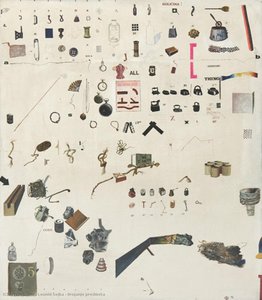
Mediala served as Šejka's primary platform for challenging prevailing artistic ideologies. The group’s core tenet revolved around achieving a “new objectivity,” an approach that consciously avoided both the stylistic tropes of modernism and the emerging trends of post-modernism. This wasn’t about replicating reality with photographic precision, but rather about stripping away subjective interpretation to reveal the inherent qualities of objects themselves. Šejka's work during this period—characterized by assemblages, collages, and paintings—often featured discarded materials, urban detritus, and fragmented forms. These weren’t random collections; they were carefully orchestrated compositions designed to evoke a sense of alienation, wonder, and the precariousness of existence. He sought to depict what he termed the “contingent object world,” a realm where meaning was fluid, unstable, and perpetually open to interpretation.
Themes and Techniques: Cityscapes, Junkyards, and Castles
Šejka’s artistic vocabulary coalesced around three recurring motifs: the ‘City’, the ‘Junk Yards,’ and the ‘Castle’. The ‘City’ represented the overwhelming complexity and anonymity of modern life, a labyrinthine space filled with both promise and despair. His cityscapes weren't idyllic portrayals; they were fragmented, distorted visions teeming with hidden narratives and unsettling juxtapositions. The ‘Junk Yards’, conversely, offered a raw, visceral exploration of decay, obsolescence, and the discarded remnants of consumer culture. These scenes weren’t simply about trash; they were meditations on mortality, memory, and the ephemeral nature of material possessions. Finally, the ‘Castle’ served as a symbolic refuge—a space of both protection and isolation, hinting at a longing for order amidst chaos.
- Assemblage and Collage: Šejka masterfully employed assemblage and collage techniques, incorporating found objects into his paintings to create layered, textured surfaces that challenged traditional notions of representation.
- Magical Realism: His work is imbued with a sense of magical realism, blending everyday objects with dreamlike imagery and unsettling perspectives.
- Color Palette: Šejka’s color palette often featured muted tones, earthy hues, and unexpected bursts of vibrant color, contributing to the overall atmosphere of mystery and intrigue.
Legacy and Historical Significance
Despite his untimely death, Leonid Šejka's influence on Yugoslavian art remains profound. He is now widely regarded as one of the country’s most original painters, a visionary artist who dared to challenge conventions and explore uncharted territories. His work anticipated many of the key themes that would come to define post-modernism—fragmentation, deconstruction, and the blurring of boundaries between high and low culture. Šejka's exploration of objectivity, his use of found objects, and his hauntingly evocative imagery continue to resonate with contemporary audiences. He wasn’t simply a painter; he was an architect of meaning, constructing worlds that were both familiar and profoundly alienating—a testament to the power of art to reflect, question, and ultimately transform our understanding of reality.
His legacy lies in his unwavering commitment to artistic experimentation and his ability to capture the anxieties and contradictions of the modern age.



 Preview
 Buy Painting
 Send
Send Share
Share
 Details

 Download
 Similars
 X-Ray
X-Ray Diaporama


 Read More






































 Glass option is only available in size under 110 CM