

Shown: · With its frame:
 Preview
 Send
Send Share
Share
 Details
 Guide
Guide

 Download
 Similars
 X-Ray
X-Ray Diaporama
 Q&A
Q&A Stats
Stats

$ 544
Hand Made Oil Reproduction
Hand-painted oil on canvas in your size and frame, made to order by our artists. ( Switch to Print Switch to Digital Image)
Size
·Standard
custom
CM
INCH
Pick from our preset sizes that match the artwork's original proportions.
Loading sizes...

width
height
Type the width and the height you need, to fit your frame or your wall. This is hand-painted, so for a size with a different shape the artist can paint a bit more around the picture, or cut a bit — you choose. We send you a digital mockup to approve before the painting starts. The picture shown on this page does not show the real result — only the mockup does.
 Read more
Finish
·
White $1

Blurside $1

Extended $1

P118B $10

P118H $10

P118W $10

P438Z $10

P508JH $12

P508YH $12

P805H $10

P805Z $10

P919BZ $10

P919G $10

P919XJ $10

P959ZH $10

P968JZ $12

W106C $8

W218G $10

W218JH $8

W218Y $10

W307PJ $10

W316G $10

W316PJ $8

W316Y $10

W398PJ $8

W4111J $10

W500HY $15

W500JH $15

W692G $12

W849H $8

W940BG $15

W953PJ $8

H24-GOLD $30

H24-SILVER $30

H36-GOLD $45

H36-SILVER $45
Shipped in a protective tube, ready for your own framer.
Above 105 cm the frame is shipped as a kit for a professional framer — read the details.
Extras
optionalWhat do the extras include?
Examples of what can be changed: Replace face with customer photo; Add pet (e.g., replace cat with dog); Include hidden message in background; Change background landscape or elements.
After order, TopImpressionists.com team will email client for instructions and provide a mockup preview
After order, TopImpressionists.com team will email client for instructions and provide a mockup preview
Worldwide Delivery () in 3/4 weeks instead of standard 5 weeks. (6 November). No compromise on quality.
Protective Varnish
Nameplate
Engraved Bronze Plaque Details
This elegant plaque features the artist's name and the title of the artwork, finely engraved for a timeless presentation.
It is made from bronze with a refined, elegant finish. The text is precisely laser-engraved for a sharp and permanent result. Measuring 9x2 cm, the plaque is compact yet easy to read. It's built to be durable and scratch-resistant, offering a professional, museum-quality look. Mounting is simple thanks to the included adhesive backing.
Transparent Acrylic Plaque Details
The plaque includes essential engraved details such as the artist's name, the title of the artwork, the date it was created, the type of media used-like oil on canvas or watercolor-a brief description of the piece, and a QR code that links to the complete artwork information.
It is crafted from clear acrylic, offering a sleek, modern appearance. The text is UV-engraved in black to ensure strong visual contrast. With a size of 10x15 cm, it ensures optimal readability. It comes equipped with two metal hooks for secure wall mounting. The plaque is designed to be weather-resistant, making it suitable for various environments, and it includes interactive features that work seamlessly with smartphone scanning.
Black Acrylic Plaque Details
This elegant plaque includes engraved information such as the artist's name, the title of the artwork, the date it was created, the type of media used (like oil on canvas or watercolor), a short description of the artwork, and a QR code for quick access to more information.
The plaque itself is made from refined black acrylic with a premium finish. The text is laser-engraved in white for high contrast and readability. Its size is 10x15 cm, designed to be easy to read. It comes with two metal hooks for professional mounting. The design is sleek and fits any interior style. It is also weather-resistant and durable, with built-in digital integration for mobile compatibility.
Glass option is only available in size under 110 CM
 Glass option is only available in size under 110 CM
- Free Worldwide Express Shipping
- High-Quality Linen Canvas
- Full Shipping Insurance
- Customs Tax Refund Guarantee
- True Color Matching Guarantee
- 100-Day Return Policy (Defects Only)
- 100% Money-Back Guarantee
- Bulk Discount Offer


Collectible Description
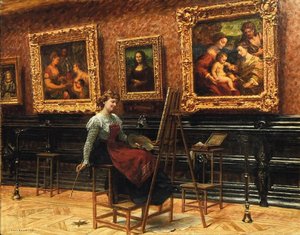
Explore 'A la gloire de Rubens' by Louis Beroud – a vibrant Baroque masterpiece inspired by Rubens! Capturing opulent revelry & sensual energy, this oil painting offers a glimpse into 19th-century Parisian art.
Artist Biography
Discover Louis Beroud (1852-1930), a French painter renowned for his detailed depictions of Parisian interiors & landmarks, including the Louvre & Opera Garnier.
About the painting
À la gloire de Rubens – A Celebration of Baroque Grandeur
Louis Béroud’s “À la gloire de Rubens” is more than just a depiction of a painting; it's an embodiment of the artistic spirit of its time—the fervent embrace of academic tradition alongside a keen observation of modern life that characterized Parisian art in the early 20th century. Painted in 1905, this monumental canvas captures the atmosphere of the Louvre Museum during a period marked by significant cultural renewal and intellectual curiosity. The artwork’s subject matter is deceptively simple: a young woman diligently sketching “The Coronation” by Peter Paul Rubens from his celebrated Marie de Medici cycle—a masterpiece that embodies the Baroque ideal of dramatic grandeur and emotional intensity.- Composition & Style: Béroud adheres to the stylistic conventions of the École de Beaux-Arts, prioritizing clarity of form and meticulous detail. The scene unfolds within a richly ornamented interior space reminiscent of Rubens’s own studio, emphasizing architectural perspective and creating a sense of spatial depth. However, unlike Rubens's canvases which aim for idealized beauty, Béroud presents a realistic portrayal of artistic practice—a testament to the artist’s commitment to capturing the essence of his subject matter.
- Technique: Employing oil paint on canvas with visible brushstrokes, Béroud utilizes impasto – thick application of pigment – particularly noticeable in areas depicting drapery and skin tones. This technique lends texture and luminosity to the painting, mirroring the dramatic chiaroscuro employed by Rubens himself. The artist’s careful attention to light and shadow contributes significantly to the overall theatrical quality of the composition.
- Historical Context: Béroud's work emerged during a period of artistic debate following Impressionism’s dominance. Artists like Béroud sought to reaffirm classical principles while acknowledging the influence of contemporary life—a dynamic tension that reflects broader cultural shifts occurring in France at the time. The painting’s inclusion within the Louvre’s collection underscores its significance as an exemplar of academic art and a celebration of Rubens's legacy.
- Symbolism: The central figure, sketching “The Coronation,” symbolizes the dedication to artistic craft and the pursuit of excellence—values deeply ingrained in the Beaux-Arts tradition. The inclusion of Rubens’s monumental painting serves as a visual reminder of the Baroque aesthetic’s ambition to inspire awe and convey profound emotion.
- Emotional Impact: “À la gloire de Rubens” evokes a feeling of reverence for artistic heritage combined with an appreciation for meticulous observation. It invites viewers to contemplate the role of art in capturing beauty, conveying emotion, and preserving cultural memory—themes that resonate powerfully across generations.
Detailed Description & Artistic Considerations
The painting’s palette is dominated by muted earth tones – ochre, umber, Sienna – reflecting the subdued lighting of the Louvre’s galleries. Béroud skillfully renders textures with remarkable precision, capturing the folds of fabric and the subtle nuances of skin tone. The artist's meticulous brushwork contributes to a palpable sense of movement—suggesting the dynamism inherent in artistic creation itself. Careful attention is paid to architectural elements – moldings, arches – reinforcing the spatial illusion and enhancing the grandeur of the setting. Béroud’s masterful technique elevates the depiction beyond mere representation, transforming it into an evocative meditation on art history and artistic practice.Provenance & Acquisition
“À la gloire de Rubens” entered the Louvre's collection in 1993 as a bequest from Micheline Héblot (1930-1990), honoring her parents’ memory. The painting was originally exhibited at the Salon of Société des Artistes français in 1905 and subsequently reproduced as prints during that era. Its inclusion in Musée Carnavalet's permanent collection provides invaluable insight into Parisian artistic culture at the turn of the century.Further Research & Artistic Influences
Louis Béroud’s artistic trajectory was profoundly shaped by his training at the École Supérieure des Beaux-Arts, where he absorbed the precepts of classical art and technique. His unwavering devotion to realism combined with an artist's sensitivity distinguishes him as a pivotal figure in late 19th-century French painting—a legacy that continues to inspire artists today. References: Musée Carnavalet; Louvre éditions / Somogy, 2008, p. 149, coul. n°178; Bresc-Bautier, Geneviève ; Foucart, Jacques, « Le tableau du mois n° 9 : trois nouveaux tableaux pour l’histoire du Louvre : Louis Béroud, Henri Coroënne », Tableau du mois, 9, du 7 septembre au 3 octobre 1994, 1994, 1-4, p. 1-4, n&b, p. 1, B; Musée du Louvre, Département des Peintures; Bresc-Bautier, Geneviève ; Foucart, Jacques, « Le tableau du mois n° 9 : trois nouveaux tableaux pour l’histoire du Louvre : Louis Béroud, Henri Coroënne », Tableau du mois, 9, du 7 septembre au 3 octobre 1994, 1994, 1-4, p. 1-4, n&b, p. 1, B; Musée Carnavalet; Louvre éditions / Somogy, 2008, p. 149, coul. n°178; Musée du Louvre, Département des Peintures; Bresc-Bautier, Geneviève ; Foucart, Jacques, « Le tableau du mois n° 9 : trois nouveaux tableaux pour l’histoire du Louvre : Louis Béroud, Henri Coroënne », Tableau du mois, 9, du 7 septembre au 3 octobre 1994, 1994, 1-4, p. 1-4, n&b, p. 1, B; Musée Carnavalet; Louvre éditions / Somogy, 2008, p. 149, coul. n°178Questions & Answers
How do I discover artworks close to "A la gloire de Rubens" by Louis Beroud?
Works similar to "A la gloire de Rubens" are listed on the artwork's Similars page.
How strong are the colors of "A la gloire de Rubens"?
The colors of "A la gloire de Rubens" by Louis Beroud show a balanced soft saturation with a balanced intensity.
What does "A la gloire de Rubens" by Louis Beroud depict?
"A la gloire de Rubens" by Louis Beroud depicts: mythological feast, nude figures, baroque revelry, sensual celebration, opulent interior, venus mythology, dynamic composition.
Quick facts and art quiz
About Louis Beroud
Louis Beroud
1852 - 1930, France
Artist Biography
Louis Beroud: A Parisian Visionary Capturing the Spirit of His Time
Louis Beroud (1852-1930) stands as a prominent figure in late 19th and early 20th century French art, celebrated for his meticulous depictions of Parisian interiors and landmarks—particularly the Louvre Museum and Opera Garnier. Born in Lyon, France, Beroud’s artistic journey unfolded against the backdrop of Impressionism's waning influence, establishing him firmly within the Academic tradition while simultaneously embracing a nuanced understanding of modern life. His canvases offer glimpses into a world steeped in grandeur, detail, and psychological observation—a testament to his unwavering commitment to realism combined with an artist’s sensitivity.- Early Life & Artistic Training: Beroud received his initial artistic education at the École Supérieure des Beaux-Arts in Paris, where he honed his skills under influential instructors who championed classical principles of composition and technique. This formative period instilled in him a profound respect for tradition while fostering an inquisitive spirit that would propel him to explore diverse subjects and styles.
- Notable Works & Artistic Style: Beroud’s oeuvre encompasses a remarkable range of subjects, from monumental architectural renderings—such as his celebrated depictions of the Louvre and Opera Garnier—to intimate portraits capturing the essence of Parisian life. His paintings are characterized by painstaking attention to detail, masterful use of light and shadow, and an ability to convey atmosphere with exceptional accuracy. He skillfully blended academic realism with expressive brushwork, creating images that resonate with both intellectual rigor and emotional depth.
The Louvre Incident: A Moment of Surreal Humor
Perhaps Beroud’s most enduring fame stems from an unforgettable episode during his visit to the Louvre Museum in August 1911. Seeking inspiration for a painting commemorating the museum's centenary, Beroud arrived to sketch “Mona Lisa au Louvre,” only to discover that Leonardo da Vinci’s iconic portrait was absent—replaced by four iron pegs securing it to the wall. This bizarre circumstance triggered an investigation into the theft of the masterpiece and captivated Parisian public opinion. The incident became a symbol of the anxieties surrounding artistic authenticity and the intrusion of modernity into venerable institutions.- Museum Commissions & Artistic Recognition: Beroud’s reputation as a painter gained considerable traction thanks to numerous commissions from prominent cultural organizations, including the Louvre itself. These projects allowed him to showcase his talent on a grand scale and solidified his position as one of France's foremost artists of his era.
- Influence & Legacy: Beroud’s artistic style—characterized by meticulous realism and psychological insight—influenced subsequent generations of painters, particularly those interested in capturing the complexities of urban life. His works continue to be admired for their technical brilliance and evocative portrayal of Parisian society during the Belle Époque, cementing his legacy as a pivotal figure in French art history.
Exploring Parisian Spaces: From Grand Halls to Quiet Corners
Beroud’s artistic focus centered on meticulously documenting Parisian environments—both monumental and domestic. He captured the grandeur of architectural spaces like Opera Garnier and the Louvre with breathtaking precision, employing techniques that mirrored those favored by Academic painters of his time. Simultaneously, he explored the subtleties of everyday life through intimate portraits and scenes depicting ordinary Parisians engaged in their daily routines. These canvases offer invaluable insights into the social and cultural landscape of the Belle Époque—a period marked by rapid industrialization, artistic innovation, and a burgeoning fascination with modernity.Notable Paintings & Museums Exhibitions
Among Beroud’s most celebrated works are “Avenue de la Gare in Nice” and “Le dôme central de la galerie des machines à l'exposition universelle de 1889,” which exemplify his commitment to capturing the spirit of his time. His paintings can be found in prestigious museums across France, including the Louvre Museum and Saint Louis Art Museum, where they continue to inspire viewers with their artistic merit and historical significance.Quick facts about Louis Beroud
- Full Name: Louis Beroud
- Nationality: French
- Date Of Birth: 1852
- Date Of Death: 1930
- Place Of Birth: Lyon, France
- Notable Artworks:
- Avenue de la Gare in Nice
- Le dôme central de la galerie des machines à l'exposition universelle de 1889
- Bureau du Baron Schlichting
- Artistic Movement Or Style: Academic Realism
- Artists Who Influenced This Artist: ['Gustave Moreau']
- Artists Or Movements Influenced By This Artist: ['Art Deco']
Explore artworks organized by themes, styles, and characteristics.


Louis Beroud
A la gloire de Rubens
() ·
With its frame: · Hand-painted in oil on linen
Total