

Shown: · With its frame:
 Preview
 Send
Send Share
Share
 Details
 Guide
Guide

 Download
 Similars
 X-Ray
X-Ray Diaporama
 Q&A
Q&A Stats
Stats 1932
1932 54.0 x 43.0 cm
$ 294
Hand Made Oil Reproduction
Hand-painted oil on canvas in your size and frame, made to order by our artists. ( Switch to Print Switch to Digital Image)
Size
·Standard
custom
CM
INCH
Pick from our preset sizes that match the artwork's original proportions.
Loading sizes...

width
height
Type the width and the height you need, to fit your frame or your wall. This is hand-painted, so for a size with a different shape the artist can paint a bit more around the picture, or cut a bit — you choose. We send you a digital mockup to approve before the painting starts. The picture shown on this page does not show the real result — only the mockup does.
 Read more
Finish
·
White $1

Blurside $1

Extended $1

P118B $10

P118H $10

P118W $10

P438Z $10

P508JH $12

P508YH $12

P805H $10

P805Z $10

P919BZ $10

P919G $10

P919XJ $10

P959ZH $10

P968JZ $12

W106C $8

W218G $10

W218JH $8

W218Y $10

W307PJ $10

W316G $10

W316PJ $8

W316Y $10

W398PJ $8

W4111J $10

W500HY $15

W500JH $15

W692G $12

W849H $8

W940BG $15

W953PJ $8

H24-GOLD $30

H24-SILVER $30

H36-GOLD $45

H36-SILVER $45
Shipped in a protective tube, ready for your own framer.
Above 105 cm the frame is shipped as a kit for a professional framer — read the details.
Extras
optionalWhat do the extras include?
Examples of what can be changed: Replace face with customer photo; Add pet (e.g., replace cat with dog); Include hidden message in background; Change background landscape or elements.
After order, TopImpressionists.com team will email client for instructions and provide a mockup preview
After order, TopImpressionists.com team will email client for instructions and provide a mockup preview
Worldwide Delivery () in 3/4 weeks instead of standard 5 weeks. (31 October). No compromise on quality.
Protective Varnish
Nameplate
Engraved Bronze Plaque Details
This elegant plaque features the artist's name and the title of the artwork, finely engraved for a timeless presentation.
It is made from bronze with a refined, elegant finish. The text is precisely laser-engraved for a sharp and permanent result. Measuring 9x2 cm, the plaque is compact yet easy to read. It's built to be durable and scratch-resistant, offering a professional, museum-quality look. Mounting is simple thanks to the included adhesive backing.
Transparent Acrylic Plaque Details
The plaque includes essential engraved details such as the artist's name, the title of the artwork, the date it was created, the type of media used-like oil on canvas or watercolor-a brief description of the piece, and a QR code that links to the complete artwork information.
It is crafted from clear acrylic, offering a sleek, modern appearance. The text is UV-engraved in black to ensure strong visual contrast. With a size of 10x15 cm, it ensures optimal readability. It comes equipped with two metal hooks for secure wall mounting. The plaque is designed to be weather-resistant, making it suitable for various environments, and it includes interactive features that work seamlessly with smartphone scanning.
Black Acrylic Plaque Details
This elegant plaque includes engraved information such as the artist's name, the title of the artwork, the date it was created, the type of media used (like oil on canvas or watercolor), a short description of the artwork, and a QR code for quick access to more information.
The plaque itself is made from refined black acrylic with a premium finish. The text is laser-engraved in white for high contrast and readability. Its size is 10x15 cm, designed to be easy to read. It comes with two metal hooks for professional mounting. The design is sleek and fits any interior style. It is also weather-resistant and durable, with built-in digital integration for mobile compatibility.
Glass option is only available in size under 110 CM
 Glass option is only available in size under 110 CM
- Free Worldwide Express Shipping
- High-Quality Linen Canvas
- Full Shipping Insurance
- Customs Tax Refund Guarantee
- True Color Matching Guarantee
- 100-Day Return Policy (Defects Only)
- 100% Money-Back Guarantee
- Bulk Discount Offer


Collectible Description
Artist Biography
Lucien Pissarro (1863-1944) was a French landscape painter & printmaker, son of Camille Pissarro. Explore his Impressionist & Neo-Impressionist works, fine book designs, and role in the Camden Town Group. Discover his British art scene contributions.
About the painting
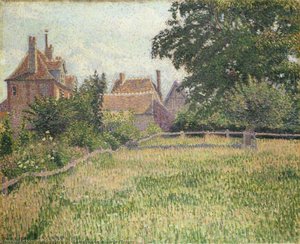
The Ulster Museum in Ireland is home to a stunning oil on canvas painting, Trippleton Farm, created by the renowned artist Lucien Pissarro in 1932. This beautiful piece measures 54 x 43 cm and showcases the artist's exceptional skill in capturing the essence of rural life.
A Glimpse into Rural Life
The painting depicts a serene farm scene, with a large house surrounded by trees and mountains in the background. The house features a distinctive red roof, which stands out against the lush green grassy field. Several people are scattered throughout the scene, adding to the lively atmosphere of the farm setting. A dog is also visible near the center of the painting, further enhancing the sense of tranquility. Key Features of the painting include:- The use of warm colors to create a cozy and inviting ambiance
- The attention to detail in capturing the textures of the natural surroundings
- The sense of movement and energy conveyed through the placement of figures and animals
Exploring the Artist's Style
Lucien Pissarro's work is characterized by his ability to capture the beauty of everyday life. His paintings often feature rural landscapes, figures, and animals, showcasing his deep appreciation for the natural world. To learn more about the artist and his style, visit Castle Ward Museum on TopImpressionists.com, which features a range of artworks and information on notable artists like Edward Taylor Dartnell.Questions & Answers
What color saturation does "Trippleton Farm" by Lucien Pissarro have?
The colors of "Trippleton Farm" by Lucien Pissarro have a muted saturation. Saturation describes how vivid or muted the colors are.
Toward which tone does "Trippleton Farm" lean?
"Trippleton Farm" leans toward a green to violet spectrum tone.
Where can I see a preview of "Trippleton Farm"?
The Preview page of "Trippleton Farm" lets you preview the artwork before ordering.
Quick facts and art quiz
About Lucien Pissarro

Lucien Pissarro
1863 - 1944
Artist Biography
Camille Pissarro: A Pioneer of Light and Life
Born Jacob Abraham Camille Pissarro on July 10, 1830, in Saint-Thomas, a Danish colony in the Caribbean, Pissarro’s artistic journey was one shaped by constant movement and a profound connection to the natural world. His early life, immersed in the vibrant colors and rhythms of island life – his father ran a general store – instilled within him an appreciation for observation and a sensitivity to light that would become hallmarks of his mature work. Unlike many artists who sought formal training early on, Pissarro’s artistic inclinations emerged later, spurred by a chance encounter with Fritz Melbye, a Danish painter, in 1850. This meeting ignited a passion within him, leading him to abandon his family's business and dedicate himself entirely to the pursuit of art.
Pissarro’s early years were spent primarily in Paris, a hub of artistic innovation during the mid-19th century. He initially struggled to find his footing, working as a copyist at the Louvre – a position that allowed him access to masterworks and invaluable study time – and supplementing his income with teaching drawing. It was through this period of apprenticeship that he began to develop his own style, influenced by the burgeoning Realist movement but quickly moving beyond its rigid constraints. He sought to capture not just the appearance of things, but also the *feeling* of being present in a particular place and time. This desire for immediacy would later define his approach to Impressionism.
The Hudson River School and Early Parisian Influences
Pissarro’s artistic development took a significant turn when he encountered the works of the Hudson River School painters, particularly Thomas Cole and Frederic Church. Their dramatic landscapes, imbued with Romantic ideals and a reverence for nature, profoundly impacted his vision. He was drawn to their ability to convey both the grandeur and the spiritual significance of the American wilderness. However, Pissarro’s artistic sensibilities were not simply imitative; he absorbed the School's techniques – particularly its use of atmospheric perspective and dramatic lighting – while simultaneously forging a distinct path.
Returning to Paris in 1855, Pissarro quickly became involved with the burgeoning Impressionist movement. He befriended Claude Monet, Pierre-Auguste Renoir, and Alfred Sisley, artists who were challenging the established conventions of the Salon system. Pissarro’s early Parisian works reflect this influence, characterized by loose brushstrokes, a focus on capturing fleeting moments of light, and an interest in depicting everyday life – scenes of market stalls, rural landscapes, and working-class communities. He was particularly interested in portraying the effects of weather and atmosphere, often painting en plein air (outdoors) to directly observe these phenomena.
The Impressionist Years: Experimentation and Collaboration
Pissarro’s involvement with the Impressionists extended beyond mere association; he played a crucial role in shaping their collective identity. He was one of the key organizers of the first eight Impressionist exhibitions in 1874, 1876, 1877, 1879, 1880, 1882, 1886 and 1889, providing a vital platform for these artists to showcase their work. During this period, Pissarro’s style underwent significant evolution. He experimented with various techniques – including pointillism, influenced by Georges Seurat and Paul Signac – seeking new ways to represent light and color. His paintings became increasingly vibrant and dynamic, capturing the energy of urban life and the beauty of the French countryside.
Notably, Pissarro’s relationship with Camille Pissarro (no relation) was a significant influence on his work during this time. They collaborated frequently, sharing ideas and techniques, and often painting the same subjects from slightly different perspectives. This collaborative spirit fostered innovation and helped to push the boundaries of Impressionist art.
Later Years and Legacy
As he aged, Pissarro’s style became more subdued and contemplative. He continued to paint prolifically throughout his long life, moving away from the bustling urban scenes of his youth to focus on quieter landscapes and portraits. His later works are characterized by a remarkable clarity of form and a deep sense of serenity. Despite facing periods of financial hardship and artistic uncertainty, Pissarro remained dedicated to his craft until his death in 1903 at the age of 73.
Camille Pissarro’s legacy is immense. He is considered one of the founding fathers of Impressionism, a pivotal figure in the development of modern art. His innovative use of color and light, his commitment to capturing the fleeting moments of everyday life, and his collaborative spirit have had a profound influence on generations of artists. His paintings continue to resonate with viewers today, offering a glimpse into the beauty and complexity of the world around us.
Quick facts about Lucien Pissarro
- Full Name: Camille Pissarro
- Nationality: Danish, French
- Date Of Birth: 1830
- Date Of Death: 1944
- Place Of Birth: Saint Thomas, Denmark
- Notable Artworks:
- Boulevard Montmartre
- La Grenouillère
- The Magpie
- Red Roofs at Chatouville
- Artistic Movement Or Style: Impressionism, Pointillism
- Artists Who Influenced This Artist:
- Fritz Melbye
- Düsseldorf School
- Artists Or Movements Influenced By This Artist:
- Paul Cézanne
- Impressionists
Explore artworks organized by themes, styles, and characteristics.







Lucien Pissarro
Trippleton Farm
() ·
With its frame: · Hand-painted in oil on linen
Total