

Shown: · With its frame:
 Preview
 Send
Send Share
Share
 Details
 Guide
Guide

 Download
 Similars
 X-Ray
X-Ray Diaporama
 Q&A
Q&A Stats
Stats
- 316.0 x 215.0 cm


$ 269
Hand Made Oil Reproduction
Hand-painted oil on canvas in your size and frame, made to order by our artists. ( Switch to Print Switch to Digital Image)
Size
·Standard
custom
CM
INCH
Pick from our preset sizes that match the artwork's original proportions.
Loading sizes...

width
height
Type the width and the height you need, to fit your frame or your wall. This is hand-painted, so for a size with a different shape the artist can paint a bit more around the picture, or cut a bit — you choose. We send you a digital mockup to approve before the painting starts. The picture shown on this page does not show the real result — only the mockup does.
 Read more
Finish
·
White $1

Blurside $1

Extended $1

P118B $10

P118H $10

P118W $10

P438Z $10

P508JH $12

P508YH $12

P805H $10

P805Z $10

P919BZ $10

P919G $10

P919XJ $10

P959ZH $10

P968JZ $12

W106C $8

W218G $10

W218JH $8

W218Y $10

W307PJ $10

W316G $10

W316PJ $8

W316Y $10

W398PJ $8

W4111J $10

W500HY $15

W500JH $15

W692G $12

W849H $8

W940BG $15

W953PJ $8

H24-GOLD $30

H24-SILVER $30

H36-GOLD $45

H36-SILVER $45
Shipped in a protective tube, ready for your own framer.
Above 105 cm the frame is shipped as a kit for a professional framer — read the details.
Extras
optionalWhat do the extras include?
Examples of what can be changed: Replace face with customer photo; Add pet (e.g., replace cat with dog); Include hidden message in background; Change background landscape or elements.
After order, TopImpressionists.com team will email client for instructions and provide a mockup preview
After order, TopImpressionists.com team will email client for instructions and provide a mockup preview
Worldwide Delivery () in 3/4 weeks instead of standard 5 weeks. (6 November). No compromise on quality.
Protective Varnish
Nameplate
Engraved Bronze Plaque Details
This elegant plaque features the artist's name and the title of the artwork, finely engraved for a timeless presentation.
It is made from bronze with a refined, elegant finish. The text is precisely laser-engraved for a sharp and permanent result. Measuring 9x2 cm, the plaque is compact yet easy to read. It's built to be durable and scratch-resistant, offering a professional, museum-quality look. Mounting is simple thanks to the included adhesive backing.
Transparent Acrylic Plaque Details
The plaque includes essential engraved details such as the artist's name, the title of the artwork, the date it was created, the type of media used-like oil on canvas or watercolor-a brief description of the piece, and a QR code that links to the complete artwork information.
It is crafted from clear acrylic, offering a sleek, modern appearance. The text is UV-engraved in black to ensure strong visual contrast. With a size of 10x15 cm, it ensures optimal readability. It comes equipped with two metal hooks for secure wall mounting. The plaque is designed to be weather-resistant, making it suitable for various environments, and it includes interactive features that work seamlessly with smartphone scanning.
Black Acrylic Plaque Details
This elegant plaque includes engraved information such as the artist's name, the title of the artwork, the date it was created, the type of media used (like oil on canvas or watercolor), a short description of the artwork, and a QR code for quick access to more information.
The plaque itself is made from refined black acrylic with a premium finish. The text is laser-engraved in white for high contrast and readability. Its size is 10x15 cm, designed to be easy to read. It comes with two metal hooks for professional mounting. The design is sleek and fits any interior style. It is also weather-resistant and durable, with built-in digital integration for mobile compatibility.
Glass option is only available in size under 110 CM
 Glass option is only available in size under 110 CM
- Free Worldwide Express Shipping
- High-Quality Linen Canvas
- Full Shipping Insurance
- Customs Tax Refund Guarantee
- True Color Matching Guarantee
- 100-Day Return Policy (Defects Only)
- 100% Money-Back Guarantee
- Bulk Discount Offer


Collectible Description
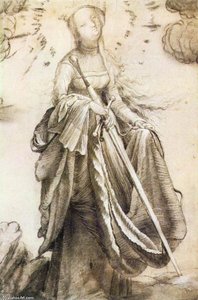
Admire Matthias Grünewald's 'St Catherine,' a captivating chalk drawing from 1520. Explore the Northern Renaissance master’s unique style, featuring a serene saint and symbolic details – available as a hand-painted replica.
Artist Biography
Explore Matthias Grünewald's dramatic German Renaissance art! Known for the Isenheim Altarpiece & emotionally charged religious paintings. Discover his unique style at TopImpressionists.
About the painting
The Enigmatic Saint: Matthias Grünewald’s St Catherine
Matthias Grünewald's 1520 chalk drawing, “St Catherine,” is more than just a portrait; it’s a profound meditation on faith, scholarship, and the enduring power of medieval symbolism. This remarkable work, currently residing in the Staatliche Museen zu Berlin, offers a captivating glimpse into the artist’s unique vision – a synthesis of late Gothic sensibilities with nascent Renaissance influences. Grünewald, a pivotal figure in German art, deliberately eschewed the prevailing Italian humanist trends, instead drawing deeply from the rich traditions of Central European religious painting, resulting in an intensely personal and emotionally resonant style.
The image depicts St Catherine from the waist up, her head tilted slightly downwards as if lost in contemplation. Her posture exudes a quiet dignity, while the subtle turn of her neck invites us into her inner world. She’s dressed in a gown with voluminous sleeves – a detail that speaks to both the formality of her status and the luxurious fabrics favored by wealthy patrons during the period. Crucially, she holds two objects: an open book or manuscript, symbolizing her role as a learned scholar, and a sword raised upright, representing her martyrdom and unwavering faith. These symbols aren’t merely decorative; they are potent visual statements about Catherine's life and devotion.
A Study in Northern Renaissance Technique
Grünewald’s masterful technique is immediately apparent. The drawing is executed with exquisite detail using chalk on paper, a medium that allowed for the delicate shading and fine lines characteristic of his work. Notice the subtle gradations of tone – the way light catches on her dress, the modeling of her face, and the atmospheric haze in the background. This meticulous attention to texture and form creates a remarkable sense of depth and realism, despite the relatively small scale of the piece. The artist’s use of chalk also lends a slightly ethereal quality to the image, contributing to its contemplative mood.
Furthermore, Grünewald's style deviates significantly from the prevailing Renaissance aesthetic. Unlike the idealized figures favored by artists like Albrecht Dürer, Catherine is rendered with a certain distortion – her proportions aren’t perfectly symmetrical, and her features possess an expressive intensity. This deliberate departure from classical ideals reflects Grünewald’s commitment to conveying emotional truth rather than purely visual accuracy. The background, deliberately minimalistic, consists of only a few suggestive lines—perhaps hinting at a cloudy sky or an abstract representation of the heavens – further emphasizing the saint's presence and drawing our focus entirely onto her.
Historical Context and Symbolic Resonance
Created in 1520, “St Catherine” exists within a fascinating transitional period in art history. Grünewald was working at a time when the influence of Italian Renaissance humanism was beginning to spread across Europe, yet he remained firmly rooted in the traditions of late medieval Central European painting. The saint herself holds significant religious importance – she is venerated as a martyr and patron saint of scholars, librarians, and translators. Her story, recounted in early Christian hagiographies, details her conversion after being saved from execution by St Peter, who recognized her divine calling.
Interestingly, the figure of Catherine has been associated with intellectual pursuits for centuries. Her association with learning stems from her devotion to scripture and her role as a translator of the Bible. The book she holds in the drawing symbolizes this scholarly dedication, while the sword represents her willingness to defend her faith against persecution. The combination of these symbols creates a powerful image of a woman who embodies both spiritual strength and intellectual prowess.
A Legacy of Emotion and Innovation
“St Catherine” is a testament to Matthias Grünewald’s artistic genius – a work that seamlessly blends technical skill with profound emotional depth. It's a poignant reminder of the artist’s ability to capture not just the likeness of his subject, but also her inner world. The drawing’s enduring appeal lies in its ability to evoke a sense of quiet contemplation and spiritual yearning. As a significant example of Northern Renaissance art, it continues to inspire artists and scholars alike, offering a valuable window into the artistic and intellectual landscape of 16th-century Germany.
Questions & Answers
What orientation does "St Catherine" by Matthias Grünewald have?
The format of "St Catherine" is portrait. This is useful when planning where a reproduction will be placed.
Which museum holds the original "St Catherine"?
You can see the original "St Catherine" at the Staatliche Museen zu Berlin, Berlin, Germany.
What is "St Catherine" made with?
Matthias Grünewald used the chalk technique for "St Catherine". The technique defines the material nature of the original work.
Quick facts and art quiz
About Matthias Grünewald

Matthias Grünewald
1480 - 1528, Germany
Artist Biography
Matthias Grünewald: Life and Legacy
Early Life and Artistic Beginnings
Matthias Grünewald, born Mathis Gothart Neithardt around 1470-1475 in Würzburg, Germany, was a pivotal figure of the German Renaissance. Despite living during a period increasingly influenced by Italian Renaissance ideals, Grünewald remained deeply rooted in the artistic traditions of late medieval Central Europe. Details about his early life are scarce, but it’s known he received training as an artist, likely within local workshops.
Artistic Development and Influences
Grünewald's artistic development was shaped by the prevailing Northern European traditions of realism, emotional intensity, and detailed observation. His work shows influences from artists like Albrecht Dürer and Martin Schongauer, but he forged a unique path characterized by dramatic expression and vivid color. He wasn’t directly involved with the humanist circles prevalent in Italy; instead, his art served primarily religious purposes, reflecting the spiritual anxieties of his time.
Major Works and Artistic Style
- The Isenheim Altarpiece (1512-1516): This masterpiece, housed at the Musée d'Unterlinden in Colmar, is considered Grünewald’s magnum opus. It depicts scenes from the life of Christ with harrowing realism, particularly focusing on suffering and redemption.
- The Crucifixion (c. 1502-1503): An early work demonstrating his developing style, showcasing intense emotion and anatomical detail.
- Virgin of the Annunciation (1512-14): A study for the Isenheim Altarpiece, revealing his meticulous planning process.
- Moses (1511): A drawing highlighting Grünewald’s skill in capturing expressive figures and dramatic poses.
Grünewald's style is distinguished by:
- Dramatic Composition: He employed dynamic arrangements to heighten emotional impact.
- Vivid Color Palette: His use of intense, often contrasting colors created a powerful visual experience.
- Realistic Depiction of Suffering: Grünewald didn’t shy away from portraying the physical and emotional pain associated with religious narratives.
- Expressive Figures: His figures are imbued with strong emotions and psychological depth.
Historical Significance and Legacy
Grünewald's work stands as a testament to the enduring power of medieval artistic traditions in Germany during the Renaissance. He bridged the gap between the late Gothic style and the emerging Renaissance, creating a unique visual language that resonated with his contemporaries. His influence can be seen in later German artists who continued to explore themes of religious fervor and emotional intensity. While largely forgotten for centuries after his death in 1528, Grünewald experienced a revival in the 19th century, and today he is recognized as one of the most important painters of the German Renaissance. His art continues to captivate viewers with its raw emotion, technical brilliance, and profound spiritual depth.
Further Exploration
Discover more about Matthias Grünewald’s life and works at: TopImpressionists
Quick facts about Matthias Grünewald
- Name: Matthias Grünewald
- Movement: German Renaissance, Late Medieval
- Birth Date: c. 1470–1475
- Death Date: 1528
- Birth Place: Würzburg, Germany
- Nationality: German
- Date Of Birth: 1480
- Date Of Death: 1528
- Notable Works: Isenheim Altarpiece, The Crucifixion
- Place Of Birth: Würzburg, Germany
Explore artworks organized by themes, styles, and characteristics.




Matthias Grünewald
St Catherine
() ·
With its frame: · Hand-painted in oil on linen
Total