
Shown: · With its frame:
 Preview
 Send
Send Share
Share
 Details
 Guide
Guide

 Download
 Similars
 X-Ray
X-Ray Diaporama
 Q&A
Q&A Stats
Stats


$ 394
Hand Made Oil Reproduction
Hand-painted oil on canvas in your size and frame, made to order by our artists. ( Switch to Print Switch to Digital Image)
This Artwork Is Under Copyright Protection
The artwork displayed on this page is protected by copyright law, which means we cannot legally create or sell an identical reproduction. This protection is enforced under international agreements such as the Berne Convention and by national laws, including those outlined by the U.S. Copyright Law - Title 17.
As a respectful and legal alternative, we offer custom, hand-painted artworks inspired by the original. Our skilled and professional artists carefully study the original's style, mood, and artistic essence to create a new, unique piece that evokes the same feeling - while remaining an original creation in its own right.
This method fully complies with copyright regulations because it does not involve copying or duplicating the protected artwork. Instead, it is a creative reinterpretation - a new painting that is influenced by the original but not identical to it.
 Read more
Size
·Standard
custom
CM
INCH
Pick from our preset sizes that match the artwork's original proportions.
Loading sizes...

width
height
Type the width and the height you need, to fit your frame or your wall. This is hand-painted, so for a size with a different shape the artist can paint a bit more around the picture, or cut a bit — you choose. We send you a digital mockup to approve before the painting starts. The picture shown on this page does not show the real result — only the mockup does.
Finish
·
White $1

Blurside $1

Extended $1

P118B $10

P118H $10

P118W $10

P438Z $10

P508JH $12

P508YH $12

P805H $10

P805Z $10

P919BZ $10

P919G $10

P919XJ $10

P959ZH $10

P968JZ $12

W106C $8

W218G $10

W218JH $8

W218Y $10

W307PJ $10

W316G $10

W316PJ $8

W316Y $10

W398PJ $8

W4111J $10

W500HY $15

W500JH $15

W692G $12

W849H $8

W940BG $15

W953PJ $8

H24-GOLD $30

H24-SILVER $30

H36-GOLD $45

H36-SILVER $45
Shipped in a protective tube, ready for your own framer.
Above 105 cm the frame is shipped as a kit for a professional framer — read the details.
Extras
optionalWhat do the extras include?
Examples of what can be changed: Replace face with customer photo; Add pet (e.g., replace cat with dog); Include hidden message in background; Change background landscape or elements.
After order, TopImpressionists.com team will email client for instructions and provide a mockup preview
After order, TopImpressionists.com team will email client for instructions and provide a mockup preview
Worldwide Delivery () in 3/4 weeks instead of standard 5 weeks. (6 November). No compromise on quality.
Protective Varnish
Nameplate
Engraved Bronze Plaque Details
This elegant plaque features the artist's name and the title of the artwork, finely engraved for a timeless presentation.
It is made from bronze with a refined, elegant finish. The text is precisely laser-engraved for a sharp and permanent result. Measuring 9x2 cm, the plaque is compact yet easy to read. It's built to be durable and scratch-resistant, offering a professional, museum-quality look. Mounting is simple thanks to the included adhesive backing.
Transparent Acrylic Plaque Details
The plaque includes essential engraved details such as the artist's name, the title of the artwork, the date it was created, the type of media used-like oil on canvas or watercolor-a brief description of the piece, and a QR code that links to the complete artwork information.
It is crafted from clear acrylic, offering a sleek, modern appearance. The text is UV-engraved in black to ensure strong visual contrast. With a size of 10x15 cm, it ensures optimal readability. It comes equipped with two metal hooks for secure wall mounting. The plaque is designed to be weather-resistant, making it suitable for various environments, and it includes interactive features that work seamlessly with smartphone scanning.
Black Acrylic Plaque Details
This elegant plaque includes engraved information such as the artist's name, the title of the artwork, the date it was created, the type of media used (like oil on canvas or watercolor), a short description of the artwork, and a QR code for quick access to more information.
The plaque itself is made from refined black acrylic with a premium finish. The text is laser-engraved in white for high contrast and readability. Its size is 10x15 cm, designed to be easy to read. It comes with two metal hooks for professional mounting. The design is sleek and fits any interior style. It is also weather-resistant and durable, with built-in digital integration for mobile compatibility.
Glass option is only available in size under 110 CM
 Glass option is only available in size under 110 CM
- Free Worldwide Express Shipping
- High-Quality Linen Canvas
- Full Shipping Insurance
- Customs Tax Refund Guarantee
- True Color Matching Guarantee
- 100-Day Return Policy (Defects Only)
- 100% Money-Back Guarantee
- Bulk Discount Offer


Collectible Description
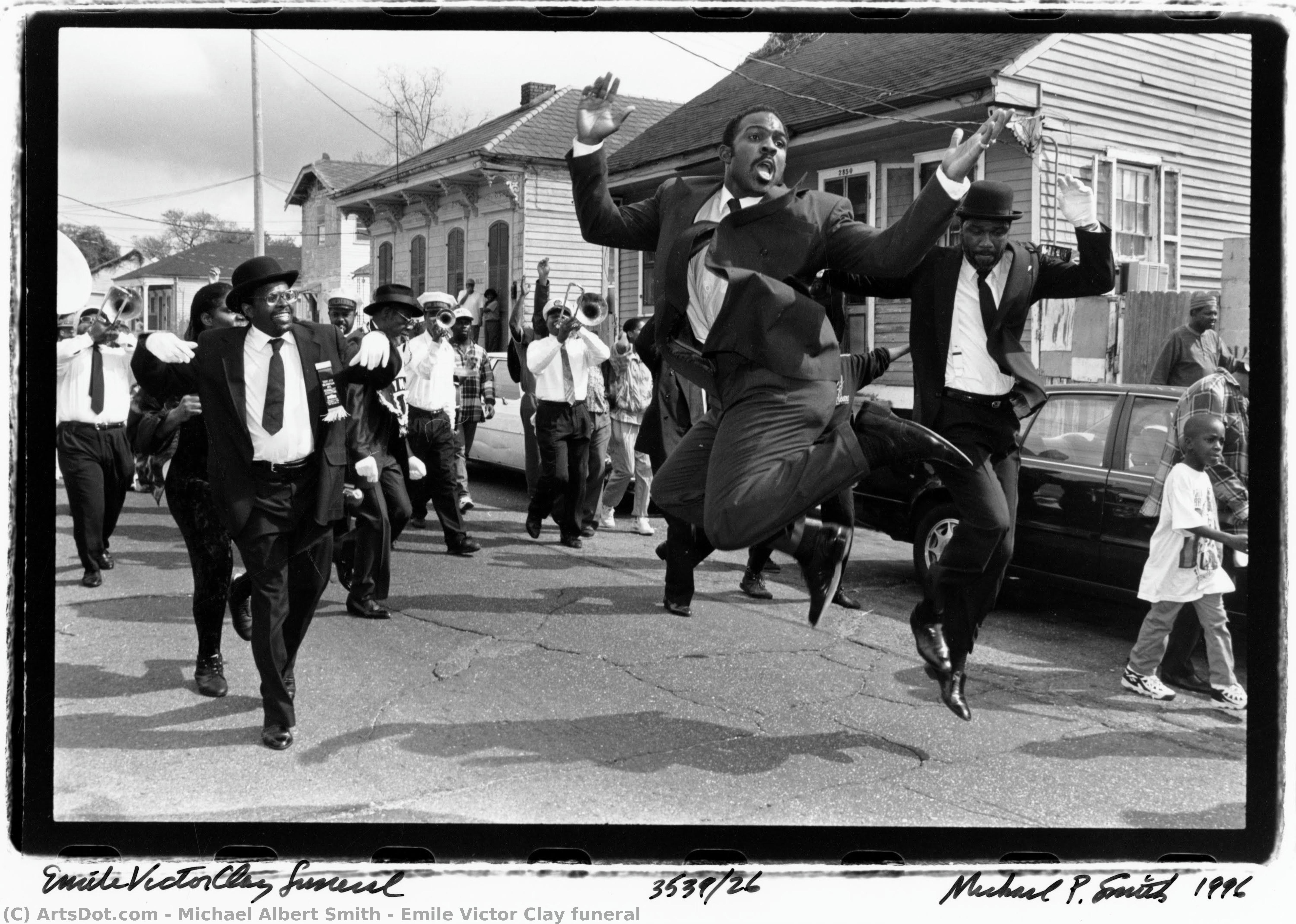
Witness a vibrant New Orleans jazz funeral through Michael Albert Smith’s striking black & white photo. Capturing community resilience, this 1996 image is a powerful document of cultural expression.
Artist Biography
Michael Albert Smith (b. 1963) is an American artist known for his evocative photography capturing New Orleans music culture & portraits of gospel legends. Also a former basketball player, golfer and painter.
About the painting
View of the jazz funeral for Emile Victor Clay. Seen are men dressed in suits, dancing and parading, including one man jumping into the air in the foreground on a residential street. The Pin Stripe Brass Band is seen performing and parading in the procession. Mourners and community onlookers are seen in the background. Emile Victor Clay was a chef and member of several New Orleans fraternal or benevolent associations, including Young Men Olympia, Knights of Peter Claver and the Elks Hall. He was 73 years old when he died on February 7, 1996. A mass was held for him on the morning of February 10 at Holy Ghost Catholic Church on Louisiana Avenue, which was followed by a jazz funeral. Majestic Mortuary was in charge of arrangements, with interment at Lafayette Cemetery No. 2.
Questions & Answers
How much light do the colors of "Emile Victor Clay funeral" appear to reflect?
The luminance recorded for "Emile Victor Clay funeral" by Michael Albert Smith is gentle luminance.
What kind of colors does "Emile Victor Clay funeral" use?
The palette of "Emile Victor Clay funeral" by Michael Albert Smith is described as neutrals. It is a compact description of the work's colors.
How strong is the contrast in "Emile Victor Clay funeral" by Michael Albert Smith?
The contrast level of "Emile Victor Clay funeral" by Michael Albert Smith is statement.
Quick facts and art quiz
About Michael Albert Smith

Michael Albert Smith
1963 - , United States of America
Artist Biography
Michael Albert Smith: A Chronicle of New Orleans Soul
Born in Rochester, New York, in 1963, Michael Albert Smith’s artistic journey is inextricably linked to the vibrant pulse of New Orleans. Initially a basketball player drafted by the Boston Celtics – a surprising detour from his creative pursuits – Smith ultimately found his true calling not on the court but through the lens of his camera. His work transcends mere documentation; it's an immersive exploration of culture, faith, and the human spirit within the unique landscape of Louisiana’s musical heartland. From the poignant black-and-white portraits of gospel legends to the dynamic captures of jazz funerals, Smith’s photographs resonate with a deep understanding of community, resilience, and the stories embedded within everyday life.
Smith's early career began in the late 1970s, marked by significant recognition from prestigious organizations. A National Endowment for the Arts Photography Fellowship in 1977 laid the foundation for his artistic development, followed by a commission from The Toledo Museum of Art in 1980 and an international award from the International Festival of Photography at Arles in France in 1981. These early accolades signaled a rising talent deeply attuned to visual storytelling. His work quickly gained attention through publications like *Crisis* magazine, where his images of Bishop I. Butler and Mahalia Jackson & Duke Ellington were prominently featured, solidifying his place within the broader narrative of Black cultural representation.
The Gospel Portraits: Faith and Community
Perhaps Smith’s most enduring legacy lies in his series of portraits of gospel musicians and church leaders. These images—including the iconic photograph of Bishop I. Butler, founder of Beauty of Holiness Church of the Lord Jesus Christ (1974)—are not simply representations; they are intimate studies of faith, leadership, and community. The stark black-and-white tones heighten the emotional impact, emphasizing the dignity and strength of these figures within their sacred spaces. Smith’s approach is deeply respectful, capturing not just appearances but also the essence of his subjects—their conviction, their warmth, and their connection to a rich spiritual tradition.
The 1996 photograph of Emile Victor Clay's funeral, a powerful document of New Orleans jazz funeral traditions, exemplifies Smith’s ability to capture pivotal moments in community life. The image is a testament to the city’s enduring cultural resilience—a celebration of life interwoven with mourning, a vibrant display of collective grief and communal support. It’s a scene brimming with color, movement, and deeply felt emotion, offering a glimpse into the soul of New Orleans.
New Orleans Jazz: A Photographic Symphony
Smith's fascination with New Orleans music is central to his artistic identity. His photographs of Mahalia Jackson & Duke Ellington at the First N.O. Jazz Fest in 1970 are particularly significant, capturing a historic moment that solidified the city’s reputation as a global center for jazz. These images aren’t just snapshots; they're windows into a vibrant musical ecosystem—a celebration of improvisation, collaboration, and the raw energy of live performance. The photographs convey the excitement and communal spirit of the festival, transporting the viewer to the heart of New Orleans’ musical heritage.
Beyond specific events, Smith’s broader body of work on New Orleans jazz reflects a deep appreciation for the city's unique musical culture. He consistently sought to document not just the performers but also the people who shaped and sustained that music—the musicians, the audiences, and the community as a whole. His images are imbued with a sense of reverence and respect for this vital cultural tradition.
Beyond New Orleans: A Broader Artistic Vision
While his work is most closely associated with New Orleans, Smith’s artistic interests extend beyond the city's borders. He has documented diverse communities across the United States, capturing portraits of individuals and scenes that offer insights into American life. His photography reflects a commitment to social justice and cultural understanding—a desire to tell stories that might otherwise go unheard.
Furthermore, Smith’s artistic practice encompasses other mediums, including painting and golf – demonstrating a multifaceted creative spirit. His background as a basketball player also informs his work, providing him with an appreciation for athleticism, competition, and the dynamics of human interaction.
Legacy and Influence
Michael Albert Smith’s photographs are more than just images; they're windows into the soul of New Orleans and the broader American experience. His work has been exhibited in museums and galleries across the United States and internationally, earning him critical acclaim and recognition as a leading figure in contemporary photography. His legacy lies not only in his stunning visual artistry but also in his commitment to documenting marginalized communities and preserving cultural traditions. Smith’s photographs continue to resonate with audiences today, offering a powerful reminder of the beauty, resilience, and complexity of the human spirit.
Quick facts about Michael Albert Smith
- Full Name: Michael Albert Smith
- Nationality: American
- Date Of Birth: 1963
- Place Of Birth: Rochester, United States of America
- Notable Artworks:
- Emile Victor Clay funeral
- Bishop I. Butler
- Mahalia Jackson & Duke Ellington
- Artistic Movement Or Style: Photography, Painting
Explore artworks organized by themes, styles, and characteristics.


Michael Albert Smith
Emile Victor Clay funeral
() ·
With its frame: · Hand-painted in oil on linen
Total