Preview
 Send
Send Share
Share
 Details
 Guide
Guide

 Download
 Similars
 X-Ray
X-Ray Diaporama
 Stats
StatsSt. Mark the Apostle


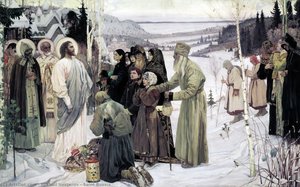
A profound portrait of St. Mark the Apostle by Russian Symbolist Mikhail Nesterov captures a spiritual moment of quiet devotion through soulful imagery that invites you to bring this timeless masterpiece into your collection.
 Read More
Explore the Symbolist art of Mikhail Nesterov (1862-1942), a renowned Russian painter known for his spiritual themes, portraits & iconic works like 'The Hermit'. Discover his influence on Russian art.
Giclée / Art Print
Museum-quality giclée or canvas print with fast production and flexible finish options. ( Buy Hand Made Painting Switch to Digital Image)




P118B $10

P118H $10

P118W $10

P438Z $10

P508JH $12

P508YH $12

P805H $10

P805Z $10

P919BZ $10

P919G $10

P919XJ $10

P959ZH $10

P968JZ $12

W106C $8

W218G $10

W218JH $8

W218Y $10

W307PJ $10

W316G $10

W316PJ $8

W316Y $10

W398PJ $8

W4111J $10

W500HY $15

W500JH $15

W692G $12

W849H $8

W940BG $15

W953PJ $8




Standard
custom
CM
INCH
Pick from our preset sizes that match the artwork's original proportions.
Loading sizes...

width
height
Type the width and the height you need, to fit your frame or your wall. A print can only be cut, never made bigger than the picture, so a size with a different shape loses a part of the image. We send you a digital mockup to approve before we print anything. The picture shown on this page does not show the real cut — only the mockup does.
Worldwide Delivery () in 2 weeks instead of standard 4/5 weeks. (23 October)

Free Worldwide Express Shipping

High-Quality Linen Canvas

Full Shipping Insurance

Customs Tax Refund Guarantee

True Color Matching Guarantee

100-Day Return Policy (Defects Only)

100% Money-Back Guarantee

Bulk Discount Offer
 Glass option is only available in size under 110 CM

St. Mark the Apostle
Giclée / Art Print
Reproduction Size
-


Total Price
$ 70
A Vision of Divine Serenity
In the quietude of Mikhail Nesterov’s 1909 masterpiece, St. Mark the Apostle, we are invited into a moment of profound spiritual contemplation. The painting presents a striking portrait of the Apostle, depicted with deep, soulful features and a dignified beard, seated in a state of meditative repose upon a rugged rock. Set against a lush, natural backdrop that suggests a secluded garden or a sacred grove, the composition breathes with the stillness of a prayer. Nester_ov, a master of the Russian Symbolist movement, transcends mere portraiture to capture the very essence of faith, using the landscape not just as a setting, but as an extension of the subject's internal sanctity.
The technique employed by Nesterov is nothing short of poetic. Through a delicate application of color and light, he creates a texture that feels both grounded in the earth and elevated by the divine. The presence of a vibrant red circle above the Saint serves as a symbolic halo, a bold stroke of color that anchors the viewer's gaze and immediately identifies his celestial status. This crimson orb contrasts beautifully with the organic greens and earthy tones of the surrounding nature, creating a visual tension between the mortal world and the eternal realm. The inclusion of subtle details, such as the two birds fluttering within the scene, adds a layer of living vitality to the composition, suggesting that all of creation participates in this silent moment of worship.
Symbolism and the Russian Soul
To understand this work is to understand the heart of Nesterov’s artistic mission. As a painter who sought to translate the spiritual depths of the Russian soul onto canvas, every element in St. Mark the Apostle carries weight. The book held firmly in the Saint's hand represents the Word and the enduring legacy of his teachings, while the tree and the rock symbolize the steadfastness of faith amidst the changing seasons of life. The painting is a testament to the Symbolist tradition, where the physical world serves as a veil for deeper, metaphysical truths. For the collector or the admirer, the piece offers more than just aesthetic beauty; it provides a window into a period of art history defined by an intense search for meaning and spiritual transcendence.
For those looking to integrate such a profound work into a curated space, this painting offers an unparalleled emotional resonance. Whether placed in a quiet study, a library, or a contemplative living area, the St. Mark the Apostle reproduction brings a sense of peace and historical gravity to any interior design scheme. It is a piece that demands slow looking, rewarding the viewer with a sense of tranquility and a connection to the timeless beauty of religious iconography. Owning a high-quality reproduction of this Nesterov treasure allows one to preserve this moment of 1909 stillness within the modern home, serving as a constant reminder of the beauty found in quiet devotion.
Questions & Answers
What stage of Mikhail Nesterov's development does "St. Mark the Apostle" represent?
Within Mikhail Nesterov's career, "St. Mark the Apostle" falls in the Mature Period. The phase helps compare it with the artist's other works.
What is the color identity of "St. Mark the Apostle" by Mikhail Nesterov?
"St. Mark the Apostle" by Mikhail Nesterov uses an earthy palette, with espresso (#42383f) as the dominant color.
What saturation and intensity does "St. Mark the Apostle" by Mikhail Nesterov show?
The color of "St. Mark the Apostle" is muted in saturation and monochromatic in intensity.
Artist Biography
A Life Immersed in Spirit and Symbolism
Mikhail Vasilyevich Nesterov, born on May 31st, 1862, in Ufa, Russia, was not merely a painter but a visual poet of the Russian soul. He emerged from a strongly patriarchal and merchant-based family where artistic inclinations were surprisingly nurtured; his father’s love for history and literature ignited within him a desire to translate stories and emotions onto canvas. This early encouragement led him to Moscow in 1874, enrolling at the Voskresensky Realschule—a pivotal step that set him on the path toward becoming one of Russia's most significant Symbolist painters. Formal artistic education began at the Moscow School of Painting, Sculpture and Architecture in 1877, where he studied under esteemed artists like Pavel Sorokin, Illarion Pryanishnikov, and Vasily Perov—the latter proving a particularly influential figure. Even during these formative years, Nesterov’s talent was evident as he began exhibiting his work with the school as early as 1879. A brief, unsatisfying period at the Imperial Academy of Fine Arts prompted a return to Moscow and further tutelage under Alexei Savrasov, solidifying his artistic foundation. These early experiences instilled in him a blend of realism and an emerging sensitivity to atmosphere and emotional depth that would characterize his mature style.
The Dawn of a Unique Vision
Nesterov’s breakthrough arrived with The Hermit (1889), a painting that immediately resonated with the public and critics alike. Its acquisition by Pavel Tretyakov, the renowned collector and founder of the Tretyakov Gallery, was not merely a financial transaction but a validation of Nesterov’s burgeoning artistic voice. This purchase afforded him the opportunity to travel extensively throughout Europe—Austria, Germany, France, and Italy—broadening his horizons and exposing him to diverse artistic traditions. However, it was upon his return to Russia that his true calling began to take shape. He became deeply engrossed in a monumental project: a series of works dedicated to the life of Saint Sergius of Radonezh, a spiritual figure who would dominate his creative energies for nearly half a century. This commitment wasn’t simply artistic; it was a profound exploration of Russian spirituality and asceticism—a yearning for meaning that permeated Russian culture at the time. Simultaneously, Nesterov navigated the complex currents of Russia's art scene, aligning himself with both the Peredvizhniki (The Wanderers), known for their realist depictions of social issues, and Mir Iskusstva (World of Art), a group championing aestheticism and symbolism. This dual affiliation reflects the inherent tension within his work—a blend of realism grounded in Russian life and an ethereal quality that hinted at deeper spiritual truths.
A Master of Religious and Portraiture
The commission to decorate St. Volodymyr’s Cathedral in Kiev in 1890 marked another turning point, immersing Nesterov in the world of Byzantine art and religious iconography. While he fulfilled his obligations, he often subtly infused his contributions with personal artistic expression—a testament to his independent spirit. This period saw him grapple with the constraints of commissioned work versus his own creative vision, a struggle that would continue throughout his career. Beyond religious themes, Nesterov excelled in portraiture, capturing the likenesses of prominent figures like Ivan Ilyin, Ivan Pavlov, and Sergei Yudin. His portrait of Ivan Pavlov (1935), for which he received the Stalin Prize in 1941, stands as a powerful testament to his ability to convey not just physical appearance but also intellectual depth and character. Throughout his career, Nesterov’s style evolved, moving from early realism towards a more lyrical and symbolic approach characterized by muted colors, soft brushstrokes, and an atmosphere of quiet contemplation. His landscapes often served as backdrops for spiritual narratives, blurring the lines between the earthly and the divine. He sought to capture not just what he saw but what lay beneath the surface—the inner lives and spiritual struggles of his subjects.
Legacy and Enduring Influence
Mikhail Nesterov passed away in Moscow on October 18th, 1942, leaving behind a rich artistic legacy that continues to inspire awe and reflection. His work represents a unique synthesis of Russian realism, Symbolism, and religious fervor. He wasn’t merely depicting scenes; he was attempting to capture the essence of the Russian soul—its yearning for spiritual meaning and its connection to the land. His paintings are not simply images to be admired but windows into a world of faith, contemplation, and profound emotional depth. Nesterov's influence can be seen in the works of subsequent generations of Russian artists who sought to explore similar themes of spirituality and national identity. His ability to imbue everyday scenes with symbolic weight and his masterful use of color and light continue to resonate with audiences today.
Key Works & Influences
Here are some pivotal pieces that define Nesterov’s artistic journey:
- The Hermit (1889): A defining work that launched Nesterov’s career, embodying the theme of spiritual solitude.
- The Vision to the Youth Bartholomew (series, 1889-1939): A lifelong project dedicated to the life of Saint Sergius, representing a profound exploration of Russian spirituality.
- Pavlov (1935): A masterful portrait that captures the intellectual and psychological depth of the renowned scientist.
Nesterov’s artistic development was shaped by several key influences: Vasily Perov, whose realist approach to social themes resonated with Nesterov's early work; Alexei Savrasov, who guided him in refining his technique and understanding of landscape painting; and Pavel Tretyakov, whose patronage provided crucial support and recognition. Ultimately, Mikhail Vasilyevich Nesterov stands as a towering figure in Russian art history—a painter who dared to explore the depths of the human spirit and translate those explorations into images of enduring beauty and power.

Mikhail Nesterov
1862 - 1942 , Russia
Quick Facts
- Full Name: Mikhail Vasilyevich Nesterov
- Nationality: Russian
- Date Of Birth: 1862
- Date Of Death: 1942
- Place Of Birth: Ufa, Russia
- Notable Artworks:
- The Hermit
- Pavlov
- Vision to Bartholomew
- Artistic Movement Or Style: Symbolism, Religious art
- Artists Who Influenced This Artist:
- Vasily Perov
- Alexei Savrasov
- Artists Or Movements Influenced By This Artist: Russian Symbolists
Related Articles

Mikhail Larionov: Rayonism, Primitivism & the Dawn of Russian Avant-Garde Painting
Explore the revolutionary art of Mikhail Larionov & the Russian Avant-Garde. Discover Rayonism, Primitivism's influence, and his lasting impact on modern painting. Expert insights for collectors.

Victor Vasnetsov: Myth, Nationalism & the Revival of Russian Fairy Tale Painting
Explore the captivating world of Victor Vasnetsov, a co-founder of Russian folklorist painting. Discover his iconic works, influence on national identity, and lasting legacy in this expert guide.

Ivan Bilibin: A Synthesis of Folklore, Modernism & National Identity in Russian Illustration
Explore the enchanting world of Ivan Bilibin, a master Russian illustrator who synthesized folklore, Art Nouveau & national identity. Discover his iconic fairy tale illustrations and legacy with TopImpressionists.

Mark Rothko's Masterpieces: 25 Paintings That Define Abstract Expressionism | TopImpressionists
Explore 25 iconic Mark Rothko paintings that define Abstract Expressionism. Discover the stories, colors & emotions behind these masterpieces. Find museum-quality art reproductions and curated decor ideas at TopImpressionists.com.

Mikhail Nesterov: Spiritual Quests & Symbolic Landscapes of Russian Symbolism
Explore the captivating world of Mikhail Nesterov, a pioneer of Russian Symbolism. Discover his spiritual themes, iconic paintings like 'The Hermit,' and lasting influence on Russian art history. Learn more at TopImpressionists.
Explore artworks organized by themes, styles, and characteristics.