

Shown: · With its frame:
 Preview
 Send
Send Share
Share
 Details
 Guide
Guide

 Download
 Similars
 X-Ray
X-Ray Diaporama
 Q&A
Q&A Stats
Stats Acrylic On Canvas
- WallArt
- Contemporary Realism
 1845
1845 46.0 x 38.0 cm
 The Louvre
$ 269
Hand Made Oil Reproduction
Hand-painted oil on canvas in your size and frame, made to order by our artists. ( Switch to Print Switch to Digital Image)
Size
·Standard
custom
CM
INCH
Pick from our preset sizes that match the artwork's original proportions.
Loading sizes...

width
height
Type the width and the height you need, to fit your frame or your wall. This is hand-painted, so for a size with a different shape the artist can paint a bit more around the picture, or cut a bit — you choose. We send you a digital mockup to approve before the painting starts. The picture shown on this page does not show the real result — only the mockup does.
 Read more
Finish
·
White $1

Blurside $1

Extended $1

P118B $10

P118H $10

P118W $10

P438Z $10

P508JH $12

P508YH $12

P805H $10

P805Z $10

P919BZ $10

P919G $10

P919XJ $10

P959ZH $10

P968JZ $12

W106C $8

W218G $10

W218JH $8

W218Y $10

W307PJ $10

W316G $10

W316PJ $8

W316Y $10

W398PJ $8

W4111J $10

W500HY $15

W500JH $15

W692G $12

W849H $8

W940BG $15

W953PJ $8

H24-GOLD $30

H24-SILVER $30

H36-GOLD $45

H36-SILVER $45
Shipped in a protective tube, ready for your own framer.
Above 105 cm the frame is shipped as a kit for a professional framer — read the details.
Extras
optionalWhat do the extras include?
Examples of what can be changed: Replace face with customer photo; Add pet (e.g., replace cat with dog); Include hidden message in background; Change background landscape or elements.
After order, TopImpressionists.com team will email client for instructions and provide a mockup preview
After order, TopImpressionists.com team will email client for instructions and provide a mockup preview
Worldwide Delivery () in 3/4 weeks instead of standard 5 weeks. (30 October). No compromise on quality.
Protective Varnish
Nameplate
Engraved Bronze Plaque Details
This elegant plaque features the artist's name and the title of the artwork, finely engraved for a timeless presentation.
It is made from bronze with a refined, elegant finish. The text is precisely laser-engraved for a sharp and permanent result. Measuring 9x2 cm, the plaque is compact yet easy to read. It's built to be durable and scratch-resistant, offering a professional, museum-quality look. Mounting is simple thanks to the included adhesive backing.
Transparent Acrylic Plaque Details
The plaque includes essential engraved details such as the artist's name, the title of the artwork, the date it was created, the type of media used-like oil on canvas or watercolor-a brief description of the piece, and a QR code that links to the complete artwork information.
It is crafted from clear acrylic, offering a sleek, modern appearance. The text is UV-engraved in black to ensure strong visual contrast. With a size of 10x15 cm, it ensures optimal readability. It comes equipped with two metal hooks for secure wall mounting. The plaque is designed to be weather-resistant, making it suitable for various environments, and it includes interactive features that work seamlessly with smartphone scanning.
Black Acrylic Plaque Details
This elegant plaque includes engraved information such as the artist's name, the title of the artwork, the date it was created, the type of media used (like oil on canvas or watercolor), a short description of the artwork, and a QR code for quick access to more information.
The plaque itself is made from refined black acrylic with a premium finish. The text is laser-engraved in white for high contrast and readability. Its size is 10x15 cm, designed to be easy to read. It comes with two metal hooks for professional mounting. The design is sleek and fits any interior style. It is also weather-resistant and durable, with built-in digital integration for mobile compatibility.
Glass option is only available in size under 110 CM
 Glass option is only available in size under 110 CM
- Free Worldwide Express Shipping
- High-Quality Linen Canvas
- Full Shipping Insurance
- Customs Tax Refund Guarantee
- True Color Matching Guarantee
- 100-Day Return Policy (Defects Only)
- 100% Money-Back Guarantee
- Bulk Discount Offer


Collectible Description
Step into the intimate studio of Nicolas Tassaert with 'Studio Interior,' a poignant 1845 painting capturing a moment of quiet industry and artistic reflection.
Artist Biography
Explore the poignant works of Nicolas Tassaert, a 19th-century French painter known for dramatic genre scenes & portraits depicting poverty & despair. Discover his lithographs and tragic life.
About the painting
A Glimpse into Parisian Industry: Octave Tassaert’s “Studio Interior”
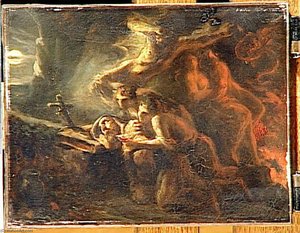
Octave Tassaert's "Studio Interior," painted in 1845, isn’t merely a depiction of a workspace; it’s a poignant snapshot of a rapidly transforming France. This oil-on-canvas painting offers a rare and deeply affecting glimpse into the life of an artist grappling with the burgeoning industrial age – a subject often overlooked by the grand narratives of progress. Tassaert, a master of genre scenes and known for his unflinching portrayals of poverty and hardship, here presents a scene both familiar and subtly unsettling: a solitary figure amidst the tools and detritus of his craft.
The composition immediately draws the eye to a young man, seated before a simple fireplace. His posture suggests absorption in work – perhaps sketching, or meticulously preparing materials – yet there’s an undeniable air of melancholy about him. He's dressed plainly, reflecting a life likely marked by modest means, and his gaze is directed downwards, hinting at introspection rather than outward ambition. Scattered around the room are the essential tools of his trade: easels, brushes, palettes, and a collection of books – symbols not just of artistic pursuit but also of intellectual engagement. A cat, curled up near the man’s feet, adds an element of domesticity, yet even this small comfort feels tinged with loneliness.
Beyond the immediate subject matter, “Studio Interior” is steeped in historical context. Painted during a period of immense industrial growth in France, the painting subtly critiques the social and economic shifts occurring at the time. The artist’s studio, once a haven for creativity and contemplation, now feels somewhat cluttered and neglected – a visual representation of the pressures faced by artists struggling to maintain their livelihoods amidst increasing competition and changing tastes. Tassaert's work reflects a growing awareness of the human cost of industrialization, portraying not just the spectacle of progress but also its potential to erode traditional ways of life.
A Masterclass in Atmospheric Realism
Tassaert’s technical skill is evident in his masterful use of light and shadow. The fireplace casts a warm, inviting glow across the room, contrasting sharply with the muted tones of the surrounding objects. This interplay of light creates a sense of depth and realism, drawing the viewer into the scene. He employs a technique reminiscent of Dutch Realism, prioritizing meticulous observation and accurate representation of everyday life. Note the careful rendering of textures – the rough surface of the wooden table, the worn fabric of the man’s clothing, the scattered pages of books – all contributing to the painting's palpable sense of authenticity.
The artist’s palette is deliberately restrained, dominated by earthy browns, grays, and ochres. This muted color scheme reinforces the painting’s somber mood, reflecting the subject’s difficult circumstances. Tassaert skillfully uses subtle variations in tone to create a sense of volume and form, giving each object a distinct presence within the composition. The layering of glazes – a hallmark of his technique – adds richness and luminosity to the surface, creating an almost velvety texture.
Symbolism and Emotional Resonance
“Studio Interior” is rich in symbolic meaning. The solitary figure represents the artist as a marginalized individual struggling to survive in a changing world. The books suggest a yearning for knowledge and intellectual fulfillment, while the fireplace symbolizes warmth, comfort, and perhaps even a desire for escape. The cat, often associated with independence and solitude, mirrors the man’s own state of isolation. The painting's overall mood is one of quiet melancholy – a poignant reminder of the human cost of progress.
Tassaert wasn’t simply documenting reality; he was imbuing it with emotion. His work resonated deeply with audiences who were increasingly concerned about social injustice and the impact of industrialization on traditional values. The painting's enduring appeal lies in its ability to evoke a sense of empathy for the artist’s plight, prompting viewers to contemplate their own place within the broader context of society.
A Timeless Reflection on Human Experience
“Studio Interior” remains a powerful and evocative work of art. It's more than just a painting; it’s a meditation on the challenges faced by artists in an era of rapid change, a poignant reminder of the human cost of progress, and a testament to Tassaert’s remarkable ability to capture the essence of everyday life with both precision and sensitivity. Reproductions of this piece offer a valuable opportunity to bring this evocative scene into any interior space, serving as a subtle yet profound commentary on the complexities of modern existence.
Questions & Answers
Where can I find a guide to "Studio Interior"?
The Guide page of "Studio Interior" by Nicolas François Octave Tassaert offers a printable two-sheet factsheet: the artwork with its identity table, a decade band placing it in the artist's lifetime, other works by the artist, the measured color palette, and ready-to-copy citations in four styles.
Who made "Studio Interior", and when?
The author of "Studio Interior" is Nicolas François Octave Tassaert, and the work is dated 1845.
How do the colors of "Studio Interior" relate to each other?
The color harmony of "Studio Interior" is recorded as strong color unity.
Quick facts and art quiz
About Nicolas François Octave Tassaert

Nicolas François Octave Tassaert
1800 - 1874, France
Artist Biography
The Shadow of Industry: Exploring the Art of William Frederick Lutkin (1800-1874)
William Frederick Lutkin, born in 1800 and tragically passing away in 1874, stands as a pivotal figure bridging the late Romantic era with the nascent Realism that would dominate much of the 19th century. While often overshadowed by his contemporaries – Turner, Constable, and the burgeoning Impressionists – Lutkin’s work offers a unique and compelling perspective on the rapidly changing landscape of Britain during a period of immense industrial growth and social upheaval. His canvases are not merely depictions of scenery; they are imbued with a palpable sense of atmosphere, a haunting awareness of humanity's relationship to both nature and the burgeoning machinery that reshaped their world.Early Life and Artistic Training
Lutkin’s early life remains somewhat shrouded in mystery, though it is known he received his initial artistic training from his father, William Lutkin Sr., a landscape painter who instilled in him a deep appreciation for the beauty of the English countryside. This foundational grounding in traditional Romanticism – characterized by dramatic light, sublime landscapes, and an emphasis on emotional response – profoundly shaped Lutkin’s early work. However, unlike many of his contemporaries who remained firmly rooted in this aesthetic, Lutkin demonstrated a growing fascination with the industrial world around him, particularly the ironworks and factories that were beginning to proliferate across the British landscape. This nascent interest would ultimately define his artistic trajectory.A Painter of Atmospheric Landscapes
Lutkin’s most celebrated works are undoubtedly his atmospheric landscapes, often depicting scenes of moorland, coastline, and dramatic weather conditions. He possessed a remarkable ability to capture the fleeting effects of light and shadow, creating paintings that possess an almost hallucinatory quality. His use of color is particularly noteworthy – he favored muted tones of grey, brown, and blue, layering them in subtle gradations to evoke a sense of mood and atmosphere. His technique involved meticulous observation combined with a willingness to experiment with unusual brushstrokes and glazing techniques, resulting in surfaces that shimmered with reflected light. He was deeply influenced by the works of J.M.W. Turner, particularly his ability to convey the power and drama of nature through atmospheric effects, but Lutkin developed a distinctly personal style, characterized by a greater emphasis on the human element within the landscape.- Notable Works: *The Moorland Scene*, *Storm Over the Coast*, *Evening on the Moors*, *The Ironworks at Coalbrookdale*
- Technique: Layered glazing, meticulous observation of light and shadow, use of muted color palettes.
The Influence of Industrialization and Social Commentary
As the 19th century progressed, Lutkin’s artistic focus shifted increasingly towards depicting the impact of industrialization on the English landscape. He wasn't simply documenting factories; he was exploring the psychological effects of this transformation – the sense of alienation, isolation, and loss that accompanied the decline of traditional rural life. His paintings of ironworks and coal mines are often imbued with a melancholic tone, reflecting his own anxieties about the social and environmental consequences of industrial progress. He frequently depicted solitary figures within these landscapes, suggesting a profound disconnect between humanity and its environment. This subtle yet powerful commentary on the era’s social changes distinguishes Lutkin from many of his contemporaries who largely ignored the dramatic shifts occurring around them.Legacy and Historical Significance
William Frederick Lutkin's work represents a fascinating transitional moment in British art history. He embodies the lingering influence of Romanticism while simultaneously foreshadowing the Realist movement that would soon emerge. His atmospheric landscapes, coupled with his subtle yet poignant depictions of industrialization, offer a valuable insight into the social and emotional landscape of 19th-century Britain. While he may not be as widely recognized as some of his more celebrated contemporaries, Lutkin’s paintings continue to resonate today, reminding us of the complex relationship between humanity and the natural world in an age of rapid technological change. His work serves as a poignant reminder that even amidst progress, beauty and melancholy can coexist.Quick facts about Nicolas François Octave Tassaert
- Nationality: WahooArt
- Date Of Birth: 1800
- Date Of Death: 1874
- Place Of Birth: Paris, France
- Artistic Movement Or Style: 19th Century Art
- Artists Who Influenced This Artist:
- Caspar David Friedrich
- J.M.W. Turner
- John Constable
- Artists Or Movements Influenced By This Artist: ['Later artists on WahooArt']
Related Artworks


Explore artworks organized by themes, styles, and characteristics.



Nicolas François Octave Tassaert
Studio Interior
() ·
With its frame: · Hand-painted in oil on linen
Total