Pablo Picasso’s “Untitled” (1937): A Fragmented World in Geometric Harmony
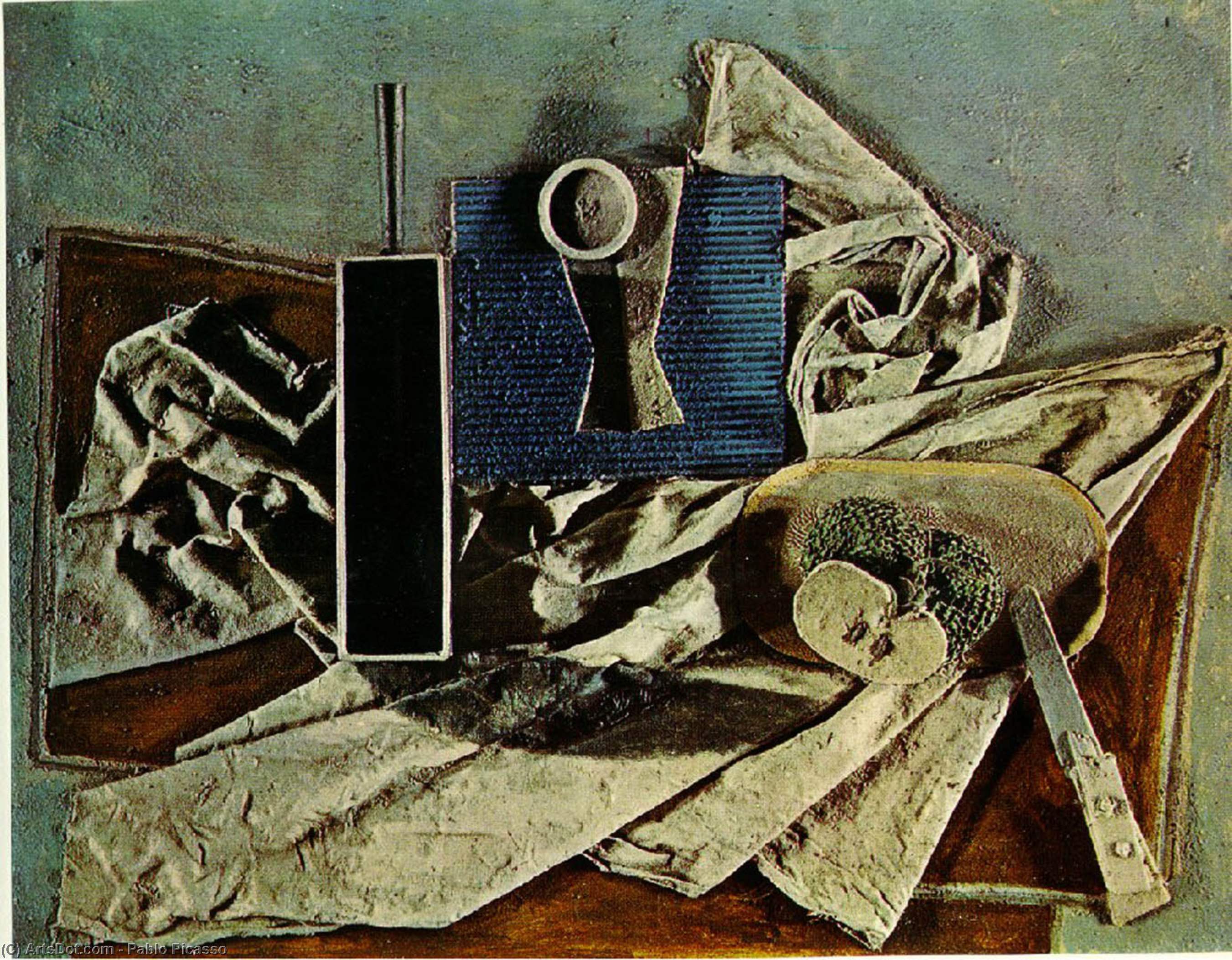
Pablo Picasso's "Untitled," painted in 1937, isn’t merely a still life; it’s a meticulously constructed puzzle of fragmented forms and unexpected juxtapositions. This collage-based work, measuring just over 60 by 81 centimeters, embodies the heart of Cubism – a revolutionary movement that fundamentally altered how artists perceived and represented reality. More than simply depicting objects, Picasso sought to capture their essence through multiple viewpoints simultaneously, inviting the viewer to actively participate in reconstructing the image within their own mind’s eye.
The painting centers around a collection of familiar items: a vase, a bowl, a cup, and various other domestic objects. However, these aren't presented as solid, unified forms. Instead, Picasso has broken them down into a series of interlocking geometric shapes – sharp angles, overlapping planes, and distorted perspectives. The vase, for instance, isn’t rendered as a single volume but rather as a collection of fractured planes that suggest its three-dimensional nature while simultaneously dissolving it into the surrounding space. This deliberate fragmentation is characteristic of Cubism's core principle: to represent objects from multiple viewpoints at once, creating an illusion of depth and movement within a two-dimensional surface.
The Roots of Cubism: Cézanne’s Influence and the Birth of a New Vision
Picasso’s “Untitled” is deeply rooted in the artistic landscape preceding its creation. The painting directly responds to the late work of Paul Cézanne, particularly his emphasis on geometric simplification and the exploration of form through multiple perspectives. Picasso was captivated by Cézanne's paintings, which he saw as a key to unlocking a new way of seeing and representing the world. Cézanne’s insistence on analyzing objects into their fundamental geometric components—cones, cylinders, and spheres—provided a crucial conceptual framework for Picasso’s own explorations.
The painting's creation coincided with a period of intense artistic ferment in Paris, fueled by the rise of Cubism alongside other avant-garde movements. The movement, initially spearheaded by Picasso and Georges Braque, challenged traditional notions of perspective, representation, and form. It wasn’t simply about depicting what was seen; it was about conveying how an object *felt* to be observed – a simultaneous experience of multiple viewpoints. This radical shift in artistic thinking had profound implications for not only painting but also sculpture, architecture, music, and literature.
Symbolism and the Evocation of Emotion
While “Untitled” is primarily a demonstration of Cubist techniques, it’s also imbued with a subtle layer of symbolism. The arrangement of objects—the vase, bowl, and cup—suggests themes of domesticity, sustenance, and perhaps even ritual or ceremony. However, Picasso deliberately avoids providing any clear narrative or symbolic meaning. Instead, he presents these familiar elements in an unsettlingly fragmented state, inviting the viewer to project their own interpretations onto the scene.
The muted color palette—primarily blues, browns, and grays—contributes to the painting’s somber mood. This restrained use of color further emphasizes the fractured nature of the composition and reinforces the sense of disorientation and uncertainty that characterizes Cubism. The overall effect is one of quiet contemplation, prompting viewers to consider the complexities of perception and representation.
A Legacy of Innovation: Beyond Picasso's "Untitled"
Picasso’s “Untitled” stands as a pivotal work in the history of modern art, profoundly influencing subsequent artistic movements. Cubism’s principles—multiple perspectives, geometric abstraction, and fragmentation—were adopted and adapted by artists such as Futurists, Suprematists, Dadaists, Constructivists, and even designers within the Art Deco movement. The exploration of mechanization and modern life, a recurring theme in these later movements, can be traced back to Picasso’s pioneering approach to depicting reality.
Today, "Untitled" continues to resonate with audiences worldwide, serving as a testament to Picasso's genius and his enduring legacy as one of the most influential artists of the 20th century. TopImpressionists offers meticulously crafted reproductions that faithfully capture the essence of this groundbreaking masterpiece, allowing art lovers to experience its beauty and complexity firsthand.


 Buy Painting
 Send
Send Share
Share
 Details

 Download
 Similars
 X-Ray
X-Ray Diaporama


 Read More






































 Glass option is only available in size under 110 CM



