

Shown: · With its frame:
 Preview
 Send
Send Share
Share
 Details
 Guide
Guide

 Download
 Similars
 X-Ray
X-Ray Diaporama
 Q&A
Q&A Stats
Stats

$ 269
Hand Made Oil Reproduction
Hand-painted oil on canvas in your size and frame, made to order by our artists. ( Switch to Print Switch to Digital Image)
Size
·Standard
custom
CM
INCH
Pick from our preset sizes that match the artwork's original proportions.
Loading sizes...

width
height
Type the width and the height you need, to fit your frame or your wall. This is hand-painted, so for a size with a different shape the artist can paint a bit more around the picture, or cut a bit — you choose. We send you a digital mockup to approve before the painting starts. The picture shown on this page does not show the real result — only the mockup does.
 Read more
Finish
·
White $1

Blurside $1

Extended $1

P118B $10

P118H $10

P118W $10

P438Z $10

P508JH $12

P508YH $12

P805H $10

P805Z $10

P919BZ $10

P919G $10

P919XJ $10

P959ZH $10

P968JZ $12

W106C $8

W218G $10

W218JH $8

W218Y $10

W307PJ $10

W316G $10

W316PJ $8

W316Y $10

W398PJ $8

W4111J $10

W500HY $15

W500JH $15

W692G $12

W849H $8

W940BG $15

W953PJ $8

H24-GOLD $30

H24-SILVER $30

H36-GOLD $45

H36-SILVER $45
Shipped in a protective tube, ready for your own framer.
Above 105 cm the frame is shipped as a kit for a professional framer — read the details.
Extras
optionalWhat do the extras include?
Examples of what can be changed: Replace face with customer photo; Add pet (e.g., replace cat with dog); Include hidden message in background; Change background landscape or elements.
After order, TopImpressionists.com team will email client for instructions and provide a mockup preview
After order, TopImpressionists.com team will email client for instructions and provide a mockup preview
Worldwide Delivery () in 3/4 weeks instead of standard 5 weeks. (1 November). No compromise on quality.
Protective Varnish
Nameplate
Engraved Bronze Plaque Details
This elegant plaque features the artist's name and the title of the artwork, finely engraved for a timeless presentation.
It is made from bronze with a refined, elegant finish. The text is precisely laser-engraved for a sharp and permanent result. Measuring 9x2 cm, the plaque is compact yet easy to read. It's built to be durable and scratch-resistant, offering a professional, museum-quality look. Mounting is simple thanks to the included adhesive backing.
Transparent Acrylic Plaque Details
The plaque includes essential engraved details such as the artist's name, the title of the artwork, the date it was created, the type of media used-like oil on canvas or watercolor-a brief description of the piece, and a QR code that links to the complete artwork information.
It is crafted from clear acrylic, offering a sleek, modern appearance. The text is UV-engraved in black to ensure strong visual contrast. With a size of 10x15 cm, it ensures optimal readability. It comes equipped with two metal hooks for secure wall mounting. The plaque is designed to be weather-resistant, making it suitable for various environments, and it includes interactive features that work seamlessly with smartphone scanning.
Black Acrylic Plaque Details
This elegant plaque includes engraved information such as the artist's name, the title of the artwork, the date it was created, the type of media used (like oil on canvas or watercolor), a short description of the artwork, and a QR code for quick access to more information.
The plaque itself is made from refined black acrylic with a premium finish. The text is laser-engraved in white for high contrast and readability. Its size is 10x15 cm, designed to be easy to read. It comes with two metal hooks for professional mounting. The design is sleek and fits any interior style. It is also weather-resistant and durable, with built-in digital integration for mobile compatibility.
Glass option is only available in size under 110 CM
 Glass option is only available in size under 110 CM
- Free Worldwide Express Shipping
- High-Quality Linen Canvas
- Full Shipping Insurance
- Customs Tax Refund Guarantee
- True Color Matching Guarantee
- 100-Day Return Policy (Defects Only)
- 100% Money-Back Guarantee
- Bulk Discount Offer


Collectible Description
Experience Paul Cézanne's 'Neried and Tritons' (1867) – a Romantic masterpiece of mythology, rendered in oil on canvas. Own a stunning reproduction from TopImpressionists.com!
Artist Biography
Post-Impressionist master Paul Cezanne bridged Impressionism and Cubism with Mont Sainte-Victoire. Explore his revolutionary works today.
About the painting
A Romantic Dive: Paul Cézanne’s “Neried and Tritons”
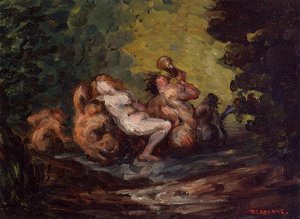
Paul Cézanne's "Neried and Tritons," painted in 1867, isn’t merely a depiction of classical mythology; it’s a profound exploration of human emotion rendered through the lens of Romanticism. This oil-on-canvas masterpiece, created during a pivotal period in Cézanne’s artistic development, reveals an artist grappling with form, light, and the very essence of visual experience – a journey that would ultimately lead him to the forefront of Post-Impressionism. The painting immediately draws the viewer into a world of hazy beauty and subtle tension, a testament to Cézanne's early experimentation with dramatic themes and his burgeoning desire to capture not just what he saw, but how it *felt*.
The scene unfolds within a twilight realm, dominated by cool blues and greens that evoke the depths of the sea. Three figures command attention: a reclining woman, identified as a Nereid – one of the sea nymphs of Greek mythology – occupies the left side of the composition, her body partially submerged in what appears to be water. Beside her sits another figure, seemingly engaged in conversation, while a third stands tall and alert on the right. These aren’t idealized figures; they possess a palpable sense of vulnerability and quiet contemplation. The arrangement isn't one of rigid formality but rather an organic flow, mirroring Cézanne’s evolving approach to spatial representation – a move away from traditional perspective towards a more subjective, internalized view of reality.
Composition and the Language of Form
Cézanne’s genius lies in his manipulation of form and color. He employs loose, expressive brushstrokes—a hallmark of his style—to build up surfaces with layers of pigment. The figures aren't sharply defined; instead, they are rendered as masses of color and shape, suggesting volume and movement without relying on precise detail. Notice how the water itself isn’t depicted as a smooth surface but rather as a collection of overlapping planes, each reflecting light in a unique way. This technique anticipates Cézanne’s later explorations of geometric forms, foreshadowing his pivotal role in paving the way for Cubism.
The inclusion of two smaller figures in the background—one on the left and another near the right—adds depth and complexity to the scene. These secondary elements aren't merely decorative; they contribute to the overall sense of mystery and intrigue, hinting at a hidden narrative or perhaps simply emphasizing the isolation of the central figures. The bowl placed towards the top-left corner and the book resting on the bottom right are not just incidental details but rather carefully chosen symbols that invite interpretation – perhaps representing sustenance, knowledge, or the passage of time.
Romanticism’s Echoes and Cézanne's Path Forward
"Neried and Tritons" firmly establishes Cézanne within the Romantic tradition. The subject matter—mythological figures imbued with emotion—and the dramatic lighting are characteristic of this movement, which prioritized feeling over reason. However, unlike many Romantic painters who sought to evoke grand narratives or heroic ideals, Cézanne focuses on capturing a fleeting moment of quiet contemplation. He uses the mythological setting as a springboard for exploring universal themes of human experience – loneliness, vulnerability, and the search for meaning.
Despite its roots in Romanticism, “Neried and Tritons” also signals a crucial shift towards Cézanne’s unique artistic vision. The painting demonstrates his early experimentation with capturing the essence of form through color and light, laying the groundwork for his later innovations. It's a pivotal work that reveals an artist grappling with the complexities of representation and searching for new ways to express himself visually – a journey that would ultimately redefine modern art. The influence of artists like Fujishima Takeji, who similarly blended Romanticism and Impressionism within the yōga movement, can be seen in Cézanne’s exploration of light and atmosphere.
Own a Piece of Art History
TopImpressionists offers meticulously crafted, handmade oil painting reproductions of “Neried and Tritons,” allowing art enthusiasts to experience this iconic masterpiece firsthand. These reproductions capture the richness of color, texture, and emotional depth of Cézanne’s original work, bringing it into your home or studio with exceptional fidelity. Consider visiting the Graves Art Gallery in Sheffield, UK, for a chance to view the original painting and appreciate its impact on art history.
Explore our collection today and bring the evocative beauty of “Neried and Tritons” into your world.
Questions & Answers
What does the 1867 date of "Neried and Tritons" correspond to in Paul Cézanne's career?
"Neried and Tritons", created in 1867, belongs to the Early Period of Paul Cézanne's career.
Where can I buy a hand-painted reproduction of "Neried and Tritons" by Paul Cézanne?
You can order a hand-painted reproduction of "Neried and Tritons" by Paul Cézanne directly on its Hand-Painted Reproduction page: a hand-painted oil reproduction on linen canvas, made to order.
What stage of Paul Cézanne's development does "Neried and Tritons" represent?
"Neried and Tritons" represents the Early Period of Paul Cézanne.
Quick facts and art quiz
About Paul Cézanne

Paul Cézanne
1839 - 1906, France
Artist Biography
The Architect of Form
Paul Cézanne was born in Aix-en-Provence, France, into a family with deep roots in the local banking industry. His father, Louis-Auguste Cézanne, helped found the Banque Cézanne et Cabassol, providing a level of financial stability that many of his contemporaries lacked. This security allowed Paul to move away from the legal studies his father had planned for him. Though he initially studied law at the University of Aix-en-Provence, he abandoned those studies in 1860 to focus entirely on painting. His early years were spent in the company of friends like Émile Zola, and together they shared a childhood of swimming and fishing along the banks of the Arc River.
The early works of Cézanne often carried the weight of Romanticism, utilizing dark palettes and heavy, expressive brushwork. He was influenced by the dramatic tonal contrasts found in the tradition of Eugène Delacroix. However, his approach began to shift as he moved toward Paris. He sought a way to move beyond the fleeting light captured by the Impressionists. Instead of merely recording a passing moment, he wanted to find the permanent structure within nature. He looked at a mountain or a piece of fruit and saw the underlying geometry—the cones, spheres, and cylinders that form the bones of the world.
A New Way of Seeing
Cézanne developed a technique characterized by small, repetitive, and constructive brushstrokes. He layered these patches of color to build up volume and texture, creating a sense of solidity. This method allowed him to explore spatial relationships without relying on traditional single-point perspective. In many of his compositions, objects appear independent within the space, often presented from multiple viewpoints at once. This rejection of classical perspective rules helped create a new pictorial language.
His subject matter was deeply tied to his surroundings in Provence. The Mont Sainte-Victoire became a recurring presence in his work, appearing in approximately eighty different paintings and watercolors over many years. He also found profound meaning in the simplest objects. His still lifes, featuring items like apples, jars, and cups, were not mere decorations but intense studies of light, shadow, and mass. Through these works, he demonstrated how color modulation could define shape without the need for traditional shading.
- The Bathers (Les Grandes Baigneuses)
- Mont Sainte-Victoire series
- Still Life with Apples and a Pot of Primroses
- Portrait of Émile Zola
- The Card Players
A Lasting Influence
By the time of his death in 1906, Cézanne had fundamentally altered the direction of modern painting. His emphasis on geometric form and multiple perspectives provided a foundation for the Cubist movement. Artists such as Pablo Picasso and Georges Braque drew heavily from his analytical approach to nature. His use of bold, non-naturalistic color also left an impression on the Fauvists, including Henri Matisse. He moved art away from the imitation of reality toward a construction of visual experience based on perception and structure.
Quick facts about Paul Cézanne
- Artistic Movement Or Style: Post-Impressionism
- Artists Or Movements Influenced By This Artist:
- Cubism
- Fauvism
- Pablo Picasso
- Henri Matisse
- Artists Who Influenced This Artist:
- Paul Gauguin
- Georges Seurat
- Full Name: Paul Cézanne
- Nationality: French
- Notable Artworks:
- The Pond at Jas de Bouffan
- Portrait of Émile Zola
- Mont Sainte-Victoire series
- Bathers
- Place Of Birth: Aix-en-Provence, France
- Date Of Birth: 1839
- Date Of Death: 1906
Related Artworks


Explore artworks organized by themes, styles, and characteristics.


Paul Cézanne
Neried and Tritons
() ·
With its frame: · Hand-painted in oil on linen
Total