


 Preview
 Send
Send Share
Share
 Details
 Guide
Guide

 Download
 Similars
 X-Ray
X-Ray Diaporama
 Stats
StatsThe Black Marble Clock
 Oil On Canvas
- WallArt
- Post-Impressionism
 1870
1870- Modern
 55.0 x 74.0 cm
Paul Cézanne's 'The Black Marble Clock' (1870) is a seminal still life, showcasing his innovative geometric approach & bridging Impressionism to Cubism. Explore its rich details and artistic significance with TopImpressionists’s hand-painted reproductions.
 Read More
Post-Impressionist master Paul Cezanne bridged Impressionism and Cubism with Mont Sainte-Victoire. Explore his revolutionary works today.
Hand Made Oil Reproduction
Hand-painted oil on canvas in your size and frame, made to order by our artists. ( Switch to Print Switch to Digital Image)




P118B $10

P118H $10

P118W $10

P438Z $10

P508JH $12

P508YH $12

P805H $10

P805Z $10

P919BZ $10

P919G $10

P919XJ $10

P959ZH $10

P968JZ $12

W106C $8

W218G $10

W218JH $8

W218Y $10

W307PJ $10

W316G $10

W316PJ $8

W316Y $10

W398PJ $8

W4111J $10

W500HY $15

W500JH $15

W692G $12

W849H $8

W940BG $15

W953PJ $8




Standard
custom
CM
INCH
Pick from our preset sizes that match the artwork's original proportions.
Loading sizes...

width
height
Type the width and the height you need, to fit your frame or your wall. This is hand-painted, so for a size with a different shape the artist can paint a bit more around the picture, or cut a bit — you choose. We send you a digital mockup to approve before the painting starts. The picture shown on this page does not show the real result — only the mockup does.
Examples of what can be changed: Replace face with customer photo; Add pet (e.g., replace cat with dog); Include hidden message in background; Change background landscape or elements.
After order, TopImpressionists.com team will email client for instructions and provide a mockup preview
After order, TopImpressionists.com team will email client for instructions and provide a mockup preview
Worldwide Delivery () in 3/4 weeks instead of standard 5 weeks. (21 October). No compromise on quality.

Free Worldwide Express Shipping

High-Quality Linen Canvas

Full Shipping Insurance

Customs Tax Refund Guarantee

True Color Matching Guarantee

100-Day Return Policy (Defects Only)

100% Money-Back Guarantee

Bulk Discount Offer
 Glass option is only available in size under 110 CM

The Black Marble Clock
Reproduction Medium
Reproduction Size
-


Total Price
$ 269
Paul Cézanne’s Timeless Still Life: The Black Marble Clock
Paul Cézanne's The Black Marble Clock, painted around 1870, isn’t merely a depiction of objects; it’s a carefully constructed meditation on time, form, and the quiet beauty of everyday life. This remarkable work, housed in a private collection, exemplifies Cézanne’s pivotal role as a bridge between Impressionism and the burgeoning movements that would reshape 20th-century art. It's a painting that invites prolonged contemplation, revealing layers of meaning through its deceptively simple arrangement.
Cézanne, deeply influenced by the Romantic landscape painters who preceded him, initially sought to capture fleeting moments of light and atmosphere – a characteristic of Impressionism. However, he soon began to move beyond mere representation, driven by an intense desire to understand the underlying structure of reality. He meticulously studied the solidity of objects, their geometric forms, and how they interacted with space. This pursuit led him to develop a unique style characterized by flattened perspectives, bold outlines, and a deliberate manipulation of color—a departure from the Impressionists’ focus on capturing transient effects.
Composition and the Language of Form
The painting itself is remarkably restrained in its palette – primarily muted grays, whites, and blacks punctuated by the vibrant yellow of the oranges. Against this subdued backdrop, Cézanne presents a carefully orchestrated still life: a gleaming black marble clock dominates the center, flanked by a delicate porcelain cup, a simple bowl, a vase holding what appears to be a single flower (though details are deliberately obscured), a book, and two perfectly ripe oranges. Notice how he doesn’t simply place these objects; he arranges them with an almost architectural precision, creating a sense of balance and harmony that feels both formal and deeply natural.
Cézanne's innovative approach to composition is key to understanding the painting’s significance. He breaks away from traditional perspective by depicting multiple viewpoints simultaneously—a technique that anticipates Cubism. The clock, for instance, appears to be viewed from several angles at once, suggesting a simultaneous awareness of time and space. The objects themselves are rendered with simplified forms, almost as if Cézanne is distilling them down to their essential geometric shapes. This deliberate reduction emphasizes the underlying structure of the scene rather than its superficial appearance.
A Reflection of Artistic Philosophy
The Black Marble Clock isn’t just a beautiful object; it's a manifesto for Cézanne’s artistic philosophy. He wasn’t interested in simply recording what he saw, but in exploring how he *perceived* the world. His work represents a shift from capturing fleeting impressions to constructing a more enduring and intellectually rigorous representation of reality. This painting is considered a cornerstone in the development of modern art, laying the groundwork for movements like Cubism by challenging traditional notions of perspective and form.
Symbolic Resonance and Enduring Appeal
While Cézanne himself rarely offered explicit interpretations of his paintings, The Black Marble Clock resonates with themes of time, mortality, and the beauty of the mundane. The black marble clock, a symbol of measured time, contrasts sharply with the vibrant oranges, representing life’s fleeting pleasures. The arrangement suggests a quiet contemplation—a moment to pause and appreciate the simple elegance of everyday objects. It's this ability to evoke such profound emotion from a seemingly straightforward subject that makes Cézanne’s work so enduringly captivating.
For art enthusiasts seeking a glimpse into the evolution of modern art, or for those looking to incorporate a touch of timeless elegance into their homes, TopImpressionists.com offers exceptional hand-painted reproductions of The Black Marble Clock by Paul Cézanne. Explore our collection today and bring this masterpiece into your space.
- The Black Marble Clock by Paul Cézanne on TopImpressionists.com.
- Sugar Bowl, Pears and Blue Cup by Paul Cézanne on TopImpressionists.com.
- Paul Cézanne on Wikipedia.
Questions & Answers
How strong are the colors of "The Black Marble Clock"?
The color of "The Black Marble Clock" is muted in saturation and monochromatic in intensity.
How old was Paul Cézanne when creating "The Black Marble Clock" in 1870?
When "The Black Marble Clock" was created in 1870, Paul Cézanne - born in 1839 - was 31 years old.
What size should I print "The Black Marble Clock" for my room?
The recommended pairing for "The Black Marble Clock" by Paul Cézanne: a medium print in a living room.
Related Artworks


Artist Biography
The Architect of Form
Paul Cézanne was born in Aix-en-Provence, France, into a family with deep roots in the local banking industry. His father, Louis-Auguste Cézanne, helped found the Banque Cézanne et Cabassol, providing a level of financial stability that many of his contemporaries lacked. This security allowed Paul to move away from the legal studies his father had planned for him. Though he initially studied law at the University of Aix-en-Provence, he abandoned those studies in 1860 to focus entirely on painting. His early years were spent in the company of friends like Émile Zola, and together they shared a childhood of swimming and fishing along the banks of the Arc River.
The early works of Cézanne often carried the weight of Romanticism, utilizing dark palettes and heavy, expressive brushwork. He was influenced by the dramatic tonal contrasts found in the tradition of Eugène Delacroix. However, his approach began to shift as he moved toward Paris. He sought a way to move beyond the fleeting light captured by the Impressionists. Instead of merely recording a passing moment, he wanted to find the permanent structure within nature. He looked at a mountain or a piece of fruit and saw the underlying geometry—the cones, spheres, and cylinders that form the bones of the world.
A New Way of Seeing
Cézanne developed a technique characterized by small, repetitive, and constructive brushstrokes. He layered these patches of color to build up volume and texture, creating a sense of solidity. This method allowed him to explore spatial relationships without relying on traditional single-point perspective. In many of his compositions, objects appear independent within the space, often presented from multiple viewpoints at once. This rejection of classical perspective rules helped create a new pictorial language.
His subject matter was deeply tied to his surroundings in Provence. The Mont Sainte-Victoire became a recurring presence in his work, appearing in approximately eighty different paintings and watercolors over many years. He also found profound meaning in the simplest objects. His still lifes, featuring items like apples, jars, and cups, were not mere decorations but intense studies of light, shadow, and mass. Through these works, he demonstrated how color modulation could define shape without the need for traditional shading.
- The Bathers (Les Grandes Baigneuses)
- Mont Sainte-Victoire series
- Still Life with Apples and a Pot of Primroses
- Portrait of Émile Zola
- The Card Players
A Lasting Influence
By the time of his death in 1906, Cézanne had fundamentally altered the direction of modern painting. His emphasis on geometric form and multiple perspectives provided a foundation for the Cubist movement. Artists such as Pablo Picasso and Georges Braque drew heavily from his analytical approach to nature. His use of bold, non-naturalistic color also left an impression on the Fauvists, including Henri Matisse. He moved art away from the imitation of reality toward a construction of visual experience based on perception and structure.

Paul Cézanne
1839 - 1906 , France
Quick Facts
- Artistic Movement Or Style: Post-Impressionism
- Artists Or Movements Influenced By This Artist:
- Cubism
- Fauvism
- Pablo Picasso
- Henri Matisse
- Artists Who Influenced This Artist:
- Paul Gauguin
- Georges Seurat
- Full Name: Paul Cézanne
- Nationality: French
- Notable Artworks:
- The Pond at Jas de Bouffan
- Portrait of Émile Zola
- Mont Sainte-Victoire series
- Bathers
- Place Of Birth: Aix-en-Provence, France
- Date Of Birth: 1839
- Date Of Death: 1906
Related Articles
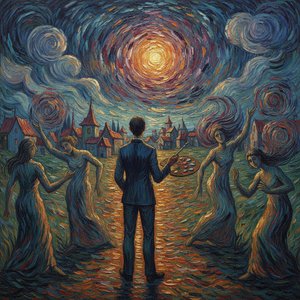
Beyond the Light: Capturing Emotion Through the Expressive Soul of Post-Impressionism
Explore the profound emotional depth of Post-Impressionism. Discover how masters like Van Gogh and Cézanne moved beyond light to capture raw feeling through color and texture. A journey into art history for the true connoisseur.
Explore artworks organized by themes, styles, and characteristics.


