

Shown: · With its frame:
 Preview
 Send
Send Share
Share
 Details
 Guide
Guide

 Download
 Similars
 X-Ray
X-Ray Diaporama
 Q&A
Q&A Stats
Stats

$ 269
Hand Made Oil Reproduction
Hand-painted oil on canvas in your size and frame, made to order by our artists. ( Switch to Print Switch to Digital Image)
Size
·Standard
custom
CM
INCH
Pick from our preset sizes that match the artwork's original proportions.
Loading sizes...

width
height
Type the width and the height you need, to fit your frame or your wall. This is hand-painted, so for a size with a different shape the artist can paint a bit more around the picture, or cut a bit — you choose. We send you a digital mockup to approve before the painting starts. The picture shown on this page does not show the real result — only the mockup does.
 Read more
Finish
·
White $1

Blurside $1

Extended $1

P118B $10

P118H $10

P118W $10

P438Z $10

P508JH $12

P508YH $12

P805H $10

P805Z $10

P919BZ $10

P919G $10

P919XJ $10

P959ZH $10

P968JZ $12

W106C $8

W218G $10

W218JH $8

W218Y $10

W307PJ $10

W316G $10

W316PJ $8

W316Y $10

W398PJ $8

W4111J $10

W500HY $15

W500JH $15

W692G $12

W849H $8

W940BG $15

W953PJ $8

H24-GOLD $30

H24-SILVER $30

H36-GOLD $45

H36-SILVER $45
Shipped in a protective tube, ready for your own framer.
Above 105 cm the frame is shipped as a kit for a professional framer — read the details.
Extras
optionalWhat do the extras include?
Examples of what can be changed: Replace face with customer photo; Add pet (e.g., replace cat with dog); Include hidden message in background; Change background landscape or elements.
After order, TopImpressionists.com team will email client for instructions and provide a mockup preview
After order, TopImpressionists.com team will email client for instructions and provide a mockup preview
Worldwide Delivery () in 3/4 weeks instead of standard 5 weeks. (9 November). No compromise on quality.
Protective Varnish
Nameplate
Engraved Bronze Plaque Details
This elegant plaque features the artist's name and the title of the artwork, finely engraved for a timeless presentation.
It is made from bronze with a refined, elegant finish. The text is precisely laser-engraved for a sharp and permanent result. Measuring 9x2 cm, the plaque is compact yet easy to read. It's built to be durable and scratch-resistant, offering a professional, museum-quality look. Mounting is simple thanks to the included adhesive backing.
Transparent Acrylic Plaque Details
The plaque includes essential engraved details such as the artist's name, the title of the artwork, the date it was created, the type of media used-like oil on canvas or watercolor-a brief description of the piece, and a QR code that links to the complete artwork information.
It is crafted from clear acrylic, offering a sleek, modern appearance. The text is UV-engraved in black to ensure strong visual contrast. With a size of 10x15 cm, it ensures optimal readability. It comes equipped with two metal hooks for secure wall mounting. The plaque is designed to be weather-resistant, making it suitable for various environments, and it includes interactive features that work seamlessly with smartphone scanning.
Black Acrylic Plaque Details
This elegant plaque includes engraved information such as the artist's name, the title of the artwork, the date it was created, the type of media used (like oil on canvas or watercolor), a short description of the artwork, and a QR code for quick access to more information.
The plaque itself is made from refined black acrylic with a premium finish. The text is laser-engraved in white for high contrast and readability. Its size is 10x15 cm, designed to be easy to read. It comes with two metal hooks for professional mounting. The design is sleek and fits any interior style. It is also weather-resistant and durable, with built-in digital integration for mobile compatibility.
Glass option is only available in size under 110 CM
 Glass option is only available in size under 110 CM
- Free Worldwide Express Shipping
- High-Quality Linen Canvas
- Full Shipping Insurance
- Customs Tax Refund Guarantee
- True Color Matching Guarantee
- 100-Day Return Policy (Defects Only)
- 100% Money-Back Guarantee
- Bulk Discount Offer


Collectible Description
Artist Biography
A pioneer of Abstract Expressionism known for his drip technique. Discover the raw energy of his iconic canvases today.
About the painting
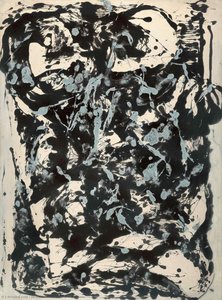
War: A Descent into Chaos – Jackson Pollock’s Post-Traumatic Masterpiece
Jackson Pollock's *War*, painted in 1947, isn’t merely a canvas splashed with color; it’s a visceral embodiment of the anxieties and turmoil gripping America in the aftermath of World War II. This monumental work, rendered in thick layers of black ink and colored pencil on paper, plunges the viewer into a maelstrom of fragmented figures, violent gestures, and unsettling symbols – a direct reflection of the psychological landscape of a nation grappling with unprecedented devastation and uncertainty. The painting’s power lies not in representational accuracy but in its raw emotional intensity, a hallmark of Jackson Pollock's pioneering approach to Abstract Expressionism. It’s a piece that demands attention, inviting contemplation on themes of conflict, loss, and the enduring scars of war.The Language of Drip: Technique and Process
Pollock’s signature “drip” technique is utterly central to *War*'s impact. He abandoned traditional brushwork, instead pouring, dripping, and splattering paint directly onto the canvas laid flat on the floor – a revolutionary act that liberated him from the constraints of easel painting. This method wasn't random; it was meticulously controlled chaos. The layering of ink creates a dense, almost sculptural surface, punctuated by sharp lines and frantic bursts of color—primarily black, red, and yellow—that seem to writhe with barely contained energy. Notice how he utilizes both linear strokes and areas of broad, diffused color, creating a dynamic tension between order and disorder. The sheer physicality of the process is evident in the visible texture and the sense that the painting was actively *made*, rather than passively observed. It’s as if Pollock wrestled with his demons onto the surface, channeling his anxieties into this monumental expression.Abstract Expressionism: A Reflection of a Fractured World
*War* stands as a pivotal example of Abstract Expressionism, an artistic movement that exploded in New York during the 1940s and 50s. Rejecting European traditions, American artists like Pollock sought to express raw emotion and subjective experience through non-objective forms. Unlike earlier movements focused on depicting reality, Abstract Expressionists aimed to capture the inner world—the anxieties, fears, and hopes—of the individual. *War* embodies this ethos perfectly, eschewing recognizable imagery in favor of a symbolic language that speaks directly to the viewer’s subconscious. It's deeply connected to the broader cultural context of the post-war era, a time marked by disillusionment, fear of nuclear annihilation, and a profound sense of societal upheaval.Decoding the Symbols: Figures of Conflict and Despair
The painting is populated with unsettling figures—human and animal—engaged in what appears to be a chaotic battle or ritualistic sacrifice. A hooded figure, reminiscent of Christ on the cross, dominates the right side of the composition, while a bull, often associated with primal instincts and aggression, looms over a pile of human debris. The fragmented nature of these forms suggests a breakdown of order and humanity, mirroring the devastation of war. The presence of the animal adds another layer of complexity, hinting at the brutal, instinctual forces that drive conflict. Some art historians have linked the imagery to Picasso’s *Guernica*, suggesting a dialogue between two artists grappling with the horrors of modern warfare. The overall effect is profoundly disturbing, forcing the viewer to confront the uncomfortable realities of violence and loss.A Legacy of Raw Emotion: Pollock's Enduring Impact
*War* remains a powerfully resonant work, not just for its historical significance but also for its enduring emotional impact. It’s a testament to Jackson Pollock’s innovative technique and his willingness to explore the darkest corners of the human psyche. Reproductions of *War*, offered by TopImpressionists.com, allow you to bring this monumental piece into your own space, experiencing its raw energy and unsettling beauty firsthand. Its continued relevance speaks volumes about the timeless nature of art's ability to capture and convey the complexities of the human experience—particularly in times of profound turmoil. Consider exploring other works by Pollock, Mark Rothko, or Lee Krasner – artists who similarly sought to express the emotional realities of their era through bold, innovative approaches to painting.Questions & Answers
Where do the visitors of "War" by Paul Jackson Pollock come from?
A Stats page exists for "War". It charts the monthly visits of the artwork and of the artist's other works, with country and language breakdowns.
What size should I print "War" for my room?
In a living room, "War" is suggested at a large print size.
Is "War" typical of what Paul Jackson Pollock usually created?
Paul Jackson Pollock's recurring themes include surrealism, regionalism, benton, drip technique, action painting, picasso, siqueiros, key pollock drawing; "War" focuses on war, conflict, chaos, drip painting, abstract, figures, turbulence, emotion.
Quick facts and art quiz
About Paul Jackson Pollock

Paul Jackson Pollock
1912 - 1956, United States of America
Artist Biography
Early Life, Family and Training
The story of Paul Jackson Pollock begins in the rugged landscape of Cody, Wyoming, where he was born on January 28, 1912. He was the youngest of five brothers, born to Stella May McClure and LeRoy Pollock. His father worked as a land surveyor, a profession that required constant movement across the vast American West. This nomadic existence meant that the young boy's early years were defined by frequent relocations, a restlessness that seemed to mirror the shifting horizons of his father's work. These early travels through the West provided him with a direct, unmediated encounter with the natural world and the spiritual resonance of Native American art, impressions that would quietly settle into his subconscious long before he ever held a brush.
As he grew, the search for a sense of place led him toward the urban energy of the coast. He enrolled at Manual Arts High School in Los Angeles, seeking a formal structure for his burgeoning impulses. However, the true shaping of his hand occurred much later, when he moved to New York City. It was there, at the Art Students League, that he began a long and transformative period of study. From 1929 to 1942, he labored under the guidance of Thomas Hart Benton. While Benton emphasized rhythmic compositions and the narrative weight of American life, the young student was already beginning to drift toward his own, more abstract, internal truths.
The Development of a Unique Technique
By 1947, a profound shift had taken hold in the way he approached the canvas. He moved away from the traditional easel, choosing instead to lay his canvases directly upon the floor. This change allowed him to stand over his work, becoming part of the creative act itself. He did not merely apply paint; he dripped, splashed, and flung it from above, letting the liquid fall in unpredictable patterns. This method turned the act of painting into a physical performance, where gravity and gesture dictated the final form.
His tools were as unconventional as his methods. He reached for sticks, knives, and even syringes to manipulate the fluid medium. Sometimes he used trowels or dripping fluid paint to achieve specific textures. He would often scratch into the surface or use strange objects to build up a thick crust of paint, adding a tactile, sculptural quality to the work. This process was less about controlled brushwork and more about a rhythmic, almost primal release of energy onto the surface.
Key Works and Artistic Expressions
As he moved away from the constraints of the easel, his canvases began to reflect a more visceral engagement with the medium. In 1943, he produced Mural, a massive work measuring 8-by-20-foot (2.4 by 6.1 m), which demonstrated his ability to command a vast surface. During this period, his explorations into the subconscious and the act of painting itself led to works like Eyes in the Heat, created about 1946. These pieces were not merely images but records of a physical presence, where the movement of his whole body dictated the placement of every splatter and pool of color.
The years that followed saw him perfecting the rhythmic, all-over compositions that would define his reputation. He sought to create a sense of boundless space, where no single point held dominance over the rest. This approach is evident in Number 1, 1949, a work that captures a raw outpouring of energy, and in Lavender Mist, Number 1, 1950, which remains a significant piece of his output. In these works, the interplay between control and chance creates a delicate balance, as if the paint were released rather than applied.
His later experiments continued to push the boundaries of how paint could be manipulated on a horizontal surface. He often used sticks, knives, or even the cans themselves to fling pigment, resulting in complex networks of lines. This method is clearly seen in Blue Poles, Number 11, 1952 and in the energetic Convergence. Through these works, he achieved a state where the painting seemed to possess a life of its own, emerging from a deep immersion in his own imagination.
Patrons, Workshop and Commissions
The path of his career was shaped by both public necessity and the generosity of a few vital supporters. Between 1938 and 1942, he found steady work as a painter for the WPA Federal Art Project, a period that provided a necessary rhythm to his developing practice. This stability gave way to a more personal and transformative alliance when Peggy Guggenheim offered him a gallery contract in July 1943. Her support proved to be more than professional; in 1945, she provided a $2,000 down payment to help him secure a home, a gesture that deeply intertwined his personal life with his artistic survival.
His creative life eventually found its center in East Hampton, New York. There, within the Pollock-Krasner House and Studio, he lived and worked alongside his wife, Lee Krasner. The studio was a place of intense physical movement, where the boundaries between the artist and the canvas dissolved. He often moved away from the traditional easel, preferring to lay his canvases upon the floor to engage with the paint from all sides. This workspace was not merely a room for production but a site of profound, restless energy where his most radical experiments took place.
Later Years and Death
The personal life of the artist was deeply intertwined with his creative struggles. In 1945, he married the artist Lee Krasner, a union that provided a significant presence in his life during his most transformative years. Yet, beneath the surface of his professional ascent, a persistent shadow remained. He struggled with an alcohol addiction throughout his entire life, a battle that often complicated his existence and his ability to navigate the pressures of his growing fame.
This internal and external turbulence reached a tragic end in East Hampton, New York, USA. On August 11, 1956, at the age of 44, his life was cut short in a sudden, violent accident. While driving, he was involved in a single-car collision caused by alcohol. The crash proved fatal, leaving behind a legacy that was as tumultuous as the paint he flung across his canvases.
Legacy and Influence on Modern Art
The ripples of his radical methods reached far beyond the studio walls of East Hampton. By breaking the traditional bond between the brush and the easel, he became a central figure in the Abstract Expressionist movement, a shift that fundamentally altered the trajectory of American creativity. His presence helped solidify New York City's position as a global center for modern art, moving the heart of the avant-garde away from European dominance. He was among the first American painters to be recognized as a peer of the great 20th-century European masters, proving that a new, visceral language could emerge from the soil of the United States.
His influence acted as a catalyst for many subsequent art movements that followed in his wake. The way he engaged with the canvas—treating it as an arena for physical action rather than a mere surface for representation—opened doors for many who sought to express the subconscious through gesture. This emphasis on the process of creation itself left a permanent mark on the history of modern art, ensuring that the spontaneous and the unplanned would forever hold a place in the artist's toolkit.
- Number 1, 1949
- Blue Poles: Number 11, 1952
- Convergence
- Autumn Rhythm. Number 30, 1950
Where to See the Works Today
To witness the physical traces of his movement, one must travel to the great institutions that preserved his radical energy. In New York City, the Museum of Modern Art holds several of his canvases, allowing viewers to stand before the sprawling, uncentered compositions that defined his era. The National Gallery of Art in Washington D.C. also maintains his works, offering a space to observe the intricate networks of color he achieved through his unique methods. Across the Atlantic, the Tate Gallery in London keeps his presence alive within its collections, ensuring his influence reaches far beyond American shores.
For those seeking a more intimate connection to his process, the Pollock-Krasner House and Studio in East Hampton offers a profound sense of place. This site, a National Historic Landmark, was the space where he and his wife, Lee Krasner, lived and worked. The property remains a vital link to his life, preserving the environment that nurtured his transition from traditional forms to the spontaneous, floor-based methods that changed the course of modern painting. Walking through these spaces provides a sense of the scale and the physical reality of his creative struggle.
- Number 1, 1949
- Blue Poles: Number 11, 1952
- Mural (1943)
- Convergence
Quick facts about Paul Jackson Pollock
- Artistic Movement Or Style: Abstract Expressionism
- Artists Or Movements Influenced By This Artist:
- Color Field painting
- Abstract expressionism
- Artists Who Influenced This Artist:
- Thomas Hart Benton
- José Clemente Orozco
- David Alfaro Siqueiros
- Full Name: Paul Jackson Pollock
- Nationality: American
- Notable Artworks:
- Number 1, 1950 (Lavender Mist)
- One: Number 31, 1950
- Blue Poles: Number 11, 1952
- Convergence
- Place Of Birth: Cody, United States of America
- Date Of Birth: 1912
- Date Of Death: 1956
Explore artworks organized by themes, styles, and characteristics.



Paul Jackson Pollock
War
() ·
With its frame: · Hand-painted in oil on linen
Total