
Shown: · With its frame:
 Preview
 Send
Send Share
Share
 Details
 Guide
Guide

 Download
 Similars
 X-Ray
X-Ray Diaporama
 Q&A
Q&A Stats
Stats
- 38.0 x 28.0 cm


$ 269
Hand Made Oil Reproduction
Hand-painted oil on canvas in your size and frame, made to order by our artists. ( Switch to Print Switch to Digital Image)
Size
·Standard
custom
CM
INCH
Pick from our preset sizes that match the artwork's original proportions.
Loading sizes...

width
height
Type the width and the height you need, to fit your frame or your wall. This is hand-painted, so for a size with a different shape the artist can paint a bit more around the picture, or cut a bit — you choose. We send you a digital mockup to approve before the painting starts. The picture shown on this page does not show the real result — only the mockup does.
 Read more
Finish
·
White $1

Blurside $1

Extended $1

P118B $10

P118H $10

P118W $10

P438Z $10

P508JH $12

P508YH $12

P805H $10

P805Z $10

P919BZ $10

P919G $10

P919XJ $10

P959ZH $10

P968JZ $12

W106C $8

W218G $10

W218JH $8

W218Y $10

W307PJ $10

W316G $10

W316PJ $8

W316Y $10

W398PJ $8

W4111J $10

W500HY $15

W500JH $15

W692G $12

W849H $8

W940BG $15

W953PJ $8

H24-GOLD $30

H24-SILVER $30

H36-GOLD $45

H36-SILVER $45
Shipped in a protective tube, ready for your own framer.
Above 105 cm the frame is shipped as a kit for a professional framer — read the details.
Extras
optionalWhat do the extras include?
Examples of what can be changed: Replace face with customer photo; Add pet (e.g., replace cat with dog); Include hidden message in background; Change background landscape or elements.
After order, TopImpressionists.com team will email client for instructions and provide a mockup preview
After order, TopImpressionists.com team will email client for instructions and provide a mockup preview
Worldwide Delivery () in 3/4 weeks instead of standard 5 weeks. (1 November). No compromise on quality.
Protective Varnish
Nameplate
Engraved Bronze Plaque Details
This elegant plaque features the artist's name and the title of the artwork, finely engraved for a timeless presentation.
It is made from bronze with a refined, elegant finish. The text is precisely laser-engraved for a sharp and permanent result. Measuring 9x2 cm, the plaque is compact yet easy to read. It's built to be durable and scratch-resistant, offering a professional, museum-quality look. Mounting is simple thanks to the included adhesive backing.
Transparent Acrylic Plaque Details
The plaque includes essential engraved details such as the artist's name, the title of the artwork, the date it was created, the type of media used-like oil on canvas or watercolor-a brief description of the piece, and a QR code that links to the complete artwork information.
It is crafted from clear acrylic, offering a sleek, modern appearance. The text is UV-engraved in black to ensure strong visual contrast. With a size of 10x15 cm, it ensures optimal readability. It comes equipped with two metal hooks for secure wall mounting. The plaque is designed to be weather-resistant, making it suitable for various environments, and it includes interactive features that work seamlessly with smartphone scanning.
Black Acrylic Plaque Details
This elegant plaque includes engraved information such as the artist's name, the title of the artwork, the date it was created, the type of media used (like oil on canvas or watercolor), a short description of the artwork, and a QR code for quick access to more information.
The plaque itself is made from refined black acrylic with a premium finish. The text is laser-engraved in white for high contrast and readability. Its size is 10x15 cm, designed to be easy to read. It comes with two metal hooks for professional mounting. The design is sleek and fits any interior style. It is also weather-resistant and durable, with built-in digital integration for mobile compatibility.
Glass option is only available in size under 110 CM
 Glass option is only available in size under 110 CM
- Free Worldwide Express Shipping
- High-Quality Linen Canvas
- Full Shipping Insurance
- Customs Tax Refund Guarantee
- True Color Matching Guarantee
- 100-Day Return Policy (Defects Only)
- 100% Money-Back Guarantee
- Bulk Discount Offer


Collectible Description
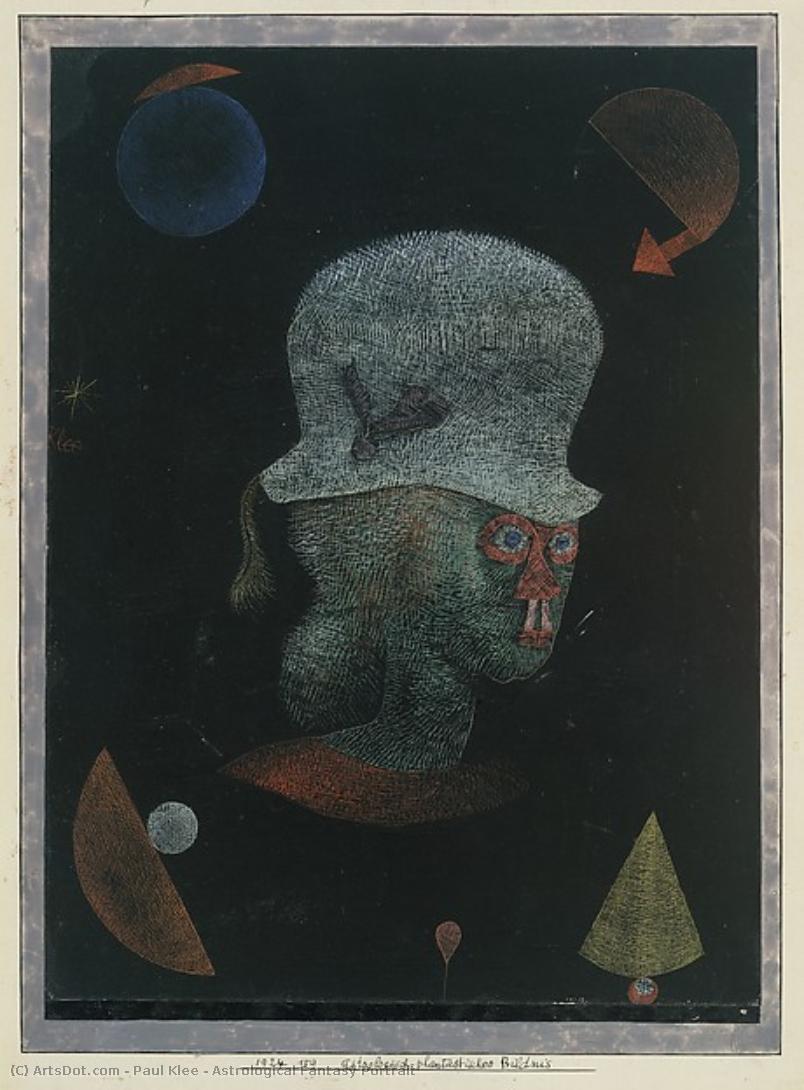
Discover Paul Klee’s ‘Astrological Fantasy Portrait,’ a surreal 1924 masterpiece! Explore its dreamlike quality, geometric shapes & unique style – an intriguing artwork by a renowned artist.
Artist Biography
Paul Klee blended Expressionism and Cubism in works like Ships in the Dark. Discover his vibrant world of color and form today.
About the painting
A Celestial Dreamscape: The Enigma of Paul Klee
In the vast, silent expanse of 1924, Paul Klee birthed a vision that continues to haunt and enchant the modern imagination. Astrological Fantasy Portrait is not merely a painting; it is a window into a subconscious universe where the boundaries between the terrestrial and the cosmic dissolve. Set against an abyssal black background, the work presents a surreal and unsettling tableau that feels both ancient and avant-garde. At its heart lies a large, amorphous gray figure, crowned by a hat upon which a small, delicate bird perches—a poignant symbol of life clinging to the edge of the unknown. This central presence is adrift in a sea of geometric constellations, where crimson circles, golden triangles, and pale crescent moons float like forgotten memories in a dream.
The piece serves as a profound meditation on the human condition, capturing the delicate tension between isolation and wonder. To gaze upon this work is to feel the weight of the infinite; the way Klee utilizes flattened perspective and minimal lighting creates an atmosphere of quiet introspection. The star-like object flickering in the upper corner acts as a lonely beacon, guiding the viewer through a composition that feels both chaotic and meticulously orchestrated. For the collector or interior designer, this artwork offers a sophisticated focal point, bringing a sense of intellectual depth and cosmic mystery to any curated space.
The Alchemy of Line and Color
Klee’s mastery lies in his ability to marry the spontaneous impulse of Expressionism with the disciplined precision of graphic design. Executed with gouache on paper and bordered with delicate ink, the technique reveals a remarkable layering process. Upon closer inspection, one discovers a subtle stippling—a fine, rhythmic application of tiny dots that imparts a tactile, almost breathing texture to the forms. This meticulous attention to detail creates a fascinating contrast: while the subject matter appears dreamlike and irrational, the execution is grounded in a rigorous, almost musical sense of rhythm and structure.
The color palette is a masterclass in controlled vibrancy. Klee avoids the overwhelming brightness of pure Impressionism, opting instead for muted, earthy tones of red, yellow, and blue that emerge from the darkness like embers in the night. These hues do not merely decorate the shapes; they define their weight and presence within the void. The use of ink to delineate edges provides a structural skeleton to the fluid, organic forms, ensuring that even the most abstract elements possess a sense of permanence. This interplay of light and shadow, of soft stippling and sharp lines, makes the reproduction of such a piece a true triumph of texture and depth.
A Legacy of Cosmic Uncertainty
To understand the emotional resonance of this portrait, one must consider the turbulent era from which it emerged. Created in the years preceding the global upheaval of World War II, the artwork reflects the broader anxieties of a world navigating the fractured landscapes of post-war Europe. Klee taps into the burgeoning movements of Surrealism and Expressionism, utilizing distorted forms to communicate inner states of unease and existential longing. The "astrological" elements are not merely decorative; they represent a search for order within a universe that felt increasingly unpredictable and indifferent.
For those seeking to adorn their surroundings with art that speaks to the soul, Astrological Fantasy Portrait offers an unparalleled opportunity. It is a piece that invites conversation, prompting viewers to contemplate their own place within the vastness of time and space. Whether placed in a contemporary gallery setting or a quiet study, Klee’s masterpiece remains a timeless testament to the power of the human spirit to find beauty, symmetry, and meaning amidst the dark mysteries of the cosmos.
Questions & Answers
What stage of Paul Klee's career does "Astrological Fantasy Portrait" (1924) belong to?
The 1924 date places "Astrological Fantasy Portrait" in the Early Period of Paul Klee's development.
What does "Astrological Fantasy Portrait" by Paul Klee depict, and in what mood?
"Astrological Fantasy Portrait" shows astrology, fantasy, geometric shapes, surreal imagery, abstract figure, dark background, symbolic art, dreamlike scene, and its recorded mood is dramatic.
What type of artwork is "Astrological Fantasy Portrait" by Paul Klee?
"Astrological Fantasy Portrait" is a wall art piece.
Quick facts and art quiz
About Paul Klee

Paul Klee
1879 - 1940, Switzerland
Artist Biography
A Life of Line and Lyricism
Born in Münchenbuchsee, Switzerland, on December 18, 1879, Paul Klee entered a world shaped by the rhythms of music. His father, Hans Wilhelm Klee, was a German music teacher, and his mother, Ida Marie, was a Swiss singer. This early immersion in sound provided a foundation for a visual language that often mirrored musical arrangement. While he initially pursued the violin with great talent, eventually deciding that modern music lacked the creative pull he craved, he turned his focus toward the Academy of Fine Arts in Munich. His studies there between 1898 and 1901 were marked by an early mastery of drawing, though he famously struggled with color during those first cold winters.
The transition from a draftsman to an abstract thinker was not immediate. Klee’s early years involved exploring the boundaries of Symbolism and Art Nouveau, often working in black and white or through experimental techniques like needle drawing on blackened glass. A significant shift occurred in 1914 during a visit to Tunisia. The intense light of North Africa allowed him to detach color from physical description, using it instead as an independent force. This period provided the necessary push toward abstraction, moving his work away from mere representation and toward a more personal, symbolic vocabulary.
The Bauhaus Years and Political Shadows
Klee’s career reached a period of intense theoretical and creative activity during his time at the Bauhaus. From 1920 to 1930, he joined the faculty of this influential school of design and architecture, working alongside figures like Wassily Kandinsky. It was here that much of his prolific output occurred, particularly small-scale watercolors and drawings on paper. His teaching allowed him to explore the relationship between color and form with scientific precision, a subject he documented extensively in his notebooks. These writings, which examined the mechanics of design, are now regarded as essential texts for understanding modern composition.
The stability of this era was abruptly interrupted by the rise of National Socialism. In 1933, Klee was dismissed from his position at the Academy of Fine Arts in Düsseldorf because the Nazi regime classified his work as “degenerate.” Forced to return to his native Bern, his later years were marked by a shift in tone. As political turmoil grew and his own health declined, his lines became heavier, turning into black bars, and his forms grew more generalized. The whimsicality of his earlier years gave way to a more somber, melancholic perspective, reflecting the gravity of the era.
A Lasting Visual Language
The breadth of Klee’s output is immense, totaling some 10,000 works that range from delicate sketches to larger, more structured compositions. His ability to blend influences from Cubism, Expressionism, and Surrealism resulted in a style that felt both childlike and deeply intellectual. He utilized a variety of media, including:
- Zinc-plate etchings
- Watercolor on gauze and paper
- Lithographs
- Charcoal and pencil drawings
His work remains a study in balance, where titles often provided the necessary context for his often cryptic imagery. Whether through the use of simple stick figures or complex, colorful grids, he sought to express the inner world of ideas rather than the surface of reality. He died on June 29, 1940, in Muralto, Switzerland, leaving behind a body of work that bridged the gap between the figurative and the abstract.
Quick facts about Paul Klee
- Artistic Movement Or Style:
- Expressionism
- Cubism
- Surrealism
- Artists Who Influenced This Artist:
- Pablo Picasso
- Georges Braque
- Robert Delaunay
- Vincent van Gogh
- Paul Cézanne
- Full Name: Paul Klee
- Nationality: German and Swiss
- Notable Artworks:
- Hammamet with Its Mosque
- Ships in the Dark
- Walpurgis Night
- The Protector
- Place Of Birth: Münchenbuchsee, Switzerland
- Date Of Birth: 1879
- Date Of Death: 1940
Explore artworks organized by themes, styles, and characteristics.


Paul Klee
Astrological Fantasy Portrait
() ·
With its frame: · Hand-painted in oil on linen
Total