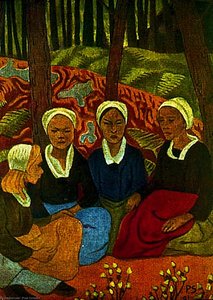
Preview
 Send
Send Share
Share
 Details
 Guide
Guide

 Download
 Similars
 X-Ray
X-Ray Diaporama
 Stats
StatsThe Wall


Experience Sérusier's vibrant Synthetism in The Wall (1890), a Post-Impressionist mosaic echoing Gauguin's bold color theory; discover this masterpiece today.
 Read More
Explore the art of Paul Sérusier (1864-1927), a French Post-Impressionist painter & pioneer of abstract art. Discover his Cloisonnism style, influence on Les Nabis, and key works like 'The Talisman'.
Giclée / Art Print
Museum-quality giclée or canvas print with fast production and flexible finish options. ( Buy Hand Made Painting Switch to Digital Image)




P118B $10

P118H $10

P118W $10

P438Z $10

P508JH $12

P508YH $12

P805H $10

P805Z $10

P919BZ $10

P919G $10

P919XJ $10

P959ZH $10

P968JZ $12

W106C $8

W218G $10

W218JH $8

W218Y $10

W307PJ $10

W316G $10

W316PJ $8

W316Y $10

W398PJ $8

W4111J $10

W500HY $15

W500JH $15

W692G $12

W849H $8

W940BG $15

W953PJ $8




Standard
custom
CM
INCH
Pick from our preset sizes that match the artwork's original proportions.
Loading sizes...

width
height
You may enter your own dimensions to fit a specific frame or space. If your selected size does not match the original image's proportions, we will either crop the artwork or extend the image with a mirrored or solid-fill edge. A digital mockup will be sent for your approval before production begins.
Please note that the on-screen preview does not reflect the actual cropping or extension. Only the mockup will accurately show the final composition.
While custom sizes are available, we recommend selecting a dimension from the predefined list to preserve the original proportions.
Worldwide Delivery () in 2 weeks instead of standard 4/5 weeks. (12 October)

Free Worldwide Express Shipping

High-Quality Linen Canvas

Full Shipping Insurance

Customs Tax Refund Guarantee

True Color Matching Guarantee

100-Day Return Policy (Defects Only)

100% Money-Back Guarantee

Bulk Discount Offer
 Glass option is only available in size under 110 CM

The Wall
Giclée / Art Print
Reproduction Size
-


Total Price
$ 70
A Visionary Echo of Gauguin's Influence
Paul Sérusier’s “The Wall,” painted in 1890, stands as a testament to the burgeoning spirit of abstraction within Post-Impressionism and represents a crucial juncture in artistic history. Executed during his formative years alongside Vincent van Gogh and Paul Gauguin at Pont-Aven, Brittany, this unassuming landscape transcends mere depiction; it embodies a deliberate quest for expressive simplification—a technique championed by Gauguin himself—that would profoundly shape the trajectory of modern art.
- Subject Matter: The painting captures a tranquil rural scene featuring a man seated beside a weathered fence, framed against a backdrop of lush greenery and scattered trees.
- Style: Sérusier’s style aligns squarely with Synthetism, an avant-garde movement born from Gauguin's exploration of pure color and form. It eschews meticulous realism in favor of conveying emotion and spiritual resonance through flattened planes of pigment.
Technique: Cloisonnism – A Bold Departure From Tradition
Sérusier’s masterful application of cloisonnism—a technique popularized by Gauguin—is immediately apparent. Unlike traditional oil painting, where colors blend seamlessly, cloisonnism employs thin layers of pigment separated by lines of white gesso or bole. This method creates a mosaic-like effect, emphasizing distinct areas of color and enhancing the textural quality of the artwork. The deliberate use of white adds luminosity and contributes to the overall sense of serenity.
Historical Context: Gauguin’s Pont-Aven Circle & The Seeds of Abstraction
“The Wall” emerged from the influential Pont-Aven circle, where Sérusier collaborated closely with Gauguin on groundbreaking artistic experiments. Gauguin's unwavering belief in the power of color and symbolic representation served as a catalyst for artists like Sérusier to push beyond Impressionistic conventions. This painting represents not merely a beautiful landscape but also an active engagement with philosophical ideas concerning spirituality and the relationship between humanity and nature—themes central to the broader artistic discourse of the period.
Symbolism & Emotional Resonance: Beyond Representation
The composition itself speaks volumes about Sérusier’s intentions. The solitary figure, positioned near the fence, suggests contemplation and introspection. While seemingly simple in its visual elements, “The Wall” vibrates with emotional depth—a quiet stillness punctuated by the vibrant hues of the surrounding landscape. It invites viewers to consider not what is seen but what is felt; a subtle echo of Gauguin’s desire to capture the essence of experience rather than merely reproducing it.
A Legacy of Influence
"The Wall" solidified Sérusier's position as one of the foremost figures in Synthetism and profoundly impacted subsequent generations of artists. Its understated beauty combined with its innovative technique continues to inspire admiration and serves as a poignant reminder of the transformative potential inherent within artistic exploration—a legacy that resonates powerfully even today.
Questions & Answers
Where can I download "The Wall" by Paul Sérusier?
"The Wall" by Paul Sérusier can be downloaded from the artwork's Download page, as a high-resolution digital image download.
What space matches the colors of "The Wall" by Paul Sérusier?
The dark colors of "The Wall" by Paul Sérusier match its recommended space: a living room.
How do I preview a reproduction of "The Wall" by Paul Sérusier?
The Preview page of "The Wall" lets you preview the artwork before ordering.
Can I order an oil reproduction of "The Wall"?
"The Wall" is available as a hand-painted oil reproduction on linen canvas. The order can be placed on this page, with a choice of sizes.
What is a reproduction of "The Wall" by Paul Sérusier recommended for?
The recommended use of a print of "The Wall" is accent.
What was Paul Sérusier's age when "The Wall" was created?
Paul Sérusier was 26 years old when creating "The Wall" in 1890. The age is computed from the artist's birth year, 1864.
Where should a reproduction of "The Wall" by Paul Sérusier be hung?
Format (landscape) and recommended space (living room) are the two placement facts recorded for "The Wall" by Paul Sérusier.
Is "The Wall" by Paul Sérusier a light or a dark artwork?
The recorded values for "The Wall" by Paul Sérusier are: balanced brightness, gentle luminance luminance.
Related Artworks




Artist Biography
early life and education
paul sérusier, a french painter, was born on november 9, 1864, in paris. he studied at the académie julian, where he became a monitor in the mid-1880s. this marked the beginning of his artistic journey, which would eventually lead him to pioneer abstract art and inspire the avant-garde nabis movement, synthetism, and cloisonnism.artistic career
in the summer of 1888, sérusier traveled to pont-aven, where he joined a small group of artists centered around paul gauguin. under gauguin's close supervision, sérusier painted "the talisman," an extreme exercise in cloisonnism that approximated pure abstraction. this piece showcased his innovative style and willingness to experiment with new techniques. as a post-impressionist painter, sérusier was part of the group les nabis, alongside pierre bonnard, édouard vuillard, and maurice denis. although not as widely recognized as some of his peers, sérusier's contributions to the development of abstract art are undeniable.notable works and legacy
some of sérusier's notable works include:- l'averse (1893), musée d'orsay, paris
- portrait of paul ranson (1890), musée d'orsay, paris
- melancholy (1890)
- the snake eaters (1894), muzeum narodowe, warsaw
artistic movement and influence
sérusier's work was influenced by cloisonnism, a style characterized by bold and flat forms separated by dark contours. this movement, which emerged in the late 19th century, played a significant role in shaping the development of modern art.- explore more on cloisonnism: the cloisonnism art movement
- discover sérusier's work: paul serusier | TopImpressionists.com
- learn about the nabis movement: the nabis art movement

Paul Sérusier
1864 - 1927 , France
Quick Facts
- Full Name: Louis-Paul-Henri Sérusier
- Nationality: French
- Date Of Birth: 1864
- Date Of Death: 1927
- Place Of Birth: Paris, France
- Notable Artworks:
- The Talisman
- Landscape at the Bois d’Amour
- Artistic Movement Or Style: Post-Impressionism
- Artists Who Influenced This Artist:
- Paul Gauguin
- Maurice Denis
Related Articles

Modern Soul, Timeless Light: Bringing the Magic of Impressionist Masterpieces into Contemporary Interiors
Discover how to infuse contemporary spaces with the luminous magic of Impressionism. From Monet's light to Renoir's warmth, learn expert tips for styling hand-painted masterpieces and custom art reproductions in your modern home.

Capturing Contemplation: The Most Thoughtful Impressionist Masterpieces
Explore the profound emotional depth of Impressionist and Post-Impressionist masterpieces. From Renoir's tranquil landscapes to Van Gogh's vibrant soul, discover how these legendary artists captured the essence of contemplation through light, color, and texture.

The Art of Connection: Capturing Beautiful Gatherings through Impressionist Masterpieces
Explore the profound beauty of human connection through Impressionist and Post-Impressionist masterpieces. Discover how masters like Renoir and Van Gogh captured light, emotion, and communal joy in timeless works of art designed to inspire your home.

Capturing the Soul: The Most Emotionally Moving Impressionist and Post-Impressionist Masterpieces
Discover the profound emotional depth of Impressionist and Post-Impressionist masterpieces. Explore how legends like Monet, Van Gogh, and Gauguin captured light and soul through evocative landscapes and vibrant brushwork for a timeless connection to art history.

Beyond the Light: Discovering the Soul and Emotional Depth of Post-Impressionism
Embark on a cultural journey through Post-Impressionism. Discover the profound emotional depth of masters like Van Gogh and Cézanne, exploring how they moved beyond light to capture the very soul of human experience through vibrant color and symbolic form.
Explore artworks organized by themes, styles, and characteristics.