
Shown: · With its frame:
 Preview
 Send
Send Share
Share
 Details
 Guide
Guide

 Download
 Similars
 X-Ray
X-Ray Diaporama
 Q&A
Q&A Stats
Stats
- 24.0 x 33.0 cm


$ 269
Hand Made Oil Reproduction
Hand-painted oil on canvas in your size and frame, made to order by our artists. ( Switch to Print Switch to Digital Image)
Size
·Standard
custom
CM
INCH
Pick from our preset sizes that match the artwork's original proportions.
Loading sizes...

width
height
Type the width and the height you need, to fit your frame or your wall. This is hand-painted, so for a size with a different shape the artist can paint a bit more around the picture, or cut a bit — you choose. We send you a digital mockup to approve before the painting starts. The picture shown on this page does not show the real result — only the mockup does.
 Read more
Finish
·
White $1

Blurside $1

Extended $1

P118B $10

P118H $10

P118W $10

P438Z $10

P508JH $12

P508YH $12

P805H $10

P805Z $10

P919BZ $10

P919G $10

P919XJ $10

P959ZH $10

P968JZ $12

W106C $8

W218G $10

W218JH $8

W218Y $10

W307PJ $10

W316G $10

W316PJ $8

W316Y $10

W398PJ $8

W4111J $10

W500HY $15

W500JH $15

W692G $12

W849H $8

W940BG $15

W953PJ $8

H24-GOLD $30

H24-SILVER $30

H36-GOLD $45

H36-SILVER $45
Shipped in a protective tube, ready for your own framer.
Above 105 cm the frame is shipped as a kit for a professional framer — read the details.
Extras
optionalWhat do the extras include?
Examples of what can be changed: Replace face with customer photo; Add pet (e.g., replace cat with dog); Include hidden message in background; Change background landscape or elements.
After order, TopImpressionists.com team will email client for instructions and provide a mockup preview
After order, TopImpressionists.com team will email client for instructions and provide a mockup preview
Worldwide Delivery () in 3/4 weeks instead of standard 5 weeks. (9 November). No compromise on quality.
Protective Varnish
Nameplate
Engraved Bronze Plaque Details
This elegant plaque features the artist's name and the title of the artwork, finely engraved for a timeless presentation.
It is made from bronze with a refined, elegant finish. The text is precisely laser-engraved for a sharp and permanent result. Measuring 9x2 cm, the plaque is compact yet easy to read. It's built to be durable and scratch-resistant, offering a professional, museum-quality look. Mounting is simple thanks to the included adhesive backing.
Transparent Acrylic Plaque Details
The plaque includes essential engraved details such as the artist's name, the title of the artwork, the date it was created, the type of media used-like oil on canvas or watercolor-a brief description of the piece, and a QR code that links to the complete artwork information.
It is crafted from clear acrylic, offering a sleek, modern appearance. The text is UV-engraved in black to ensure strong visual contrast. With a size of 10x15 cm, it ensures optimal readability. It comes equipped with two metal hooks for secure wall mounting. The plaque is designed to be weather-resistant, making it suitable for various environments, and it includes interactive features that work seamlessly with smartphone scanning.
Black Acrylic Plaque Details
This elegant plaque includes engraved information such as the artist's name, the title of the artwork, the date it was created, the type of media used (like oil on canvas or watercolor), a short description of the artwork, and a QR code for quick access to more information.
The plaque itself is made from refined black acrylic with a premium finish. The text is laser-engraved in white for high contrast and readability. Its size is 10x15 cm, designed to be easy to read. It comes with two metal hooks for professional mounting. The design is sleek and fits any interior style. It is also weather-resistant and durable, with built-in digital integration for mobile compatibility.
Glass option is only available in size under 110 CM
 Glass option is only available in size under 110 CM
- Free Worldwide Express Shipping
- High-Quality Linen Canvas
- Full Shipping Insurance
- Customs Tax Refund Guarantee
- True Color Matching Guarantee
- 100-Day Return Policy (Defects Only)
- 100% Money-Back Guarantee
- Bulk Discount Offer


Collectible Description
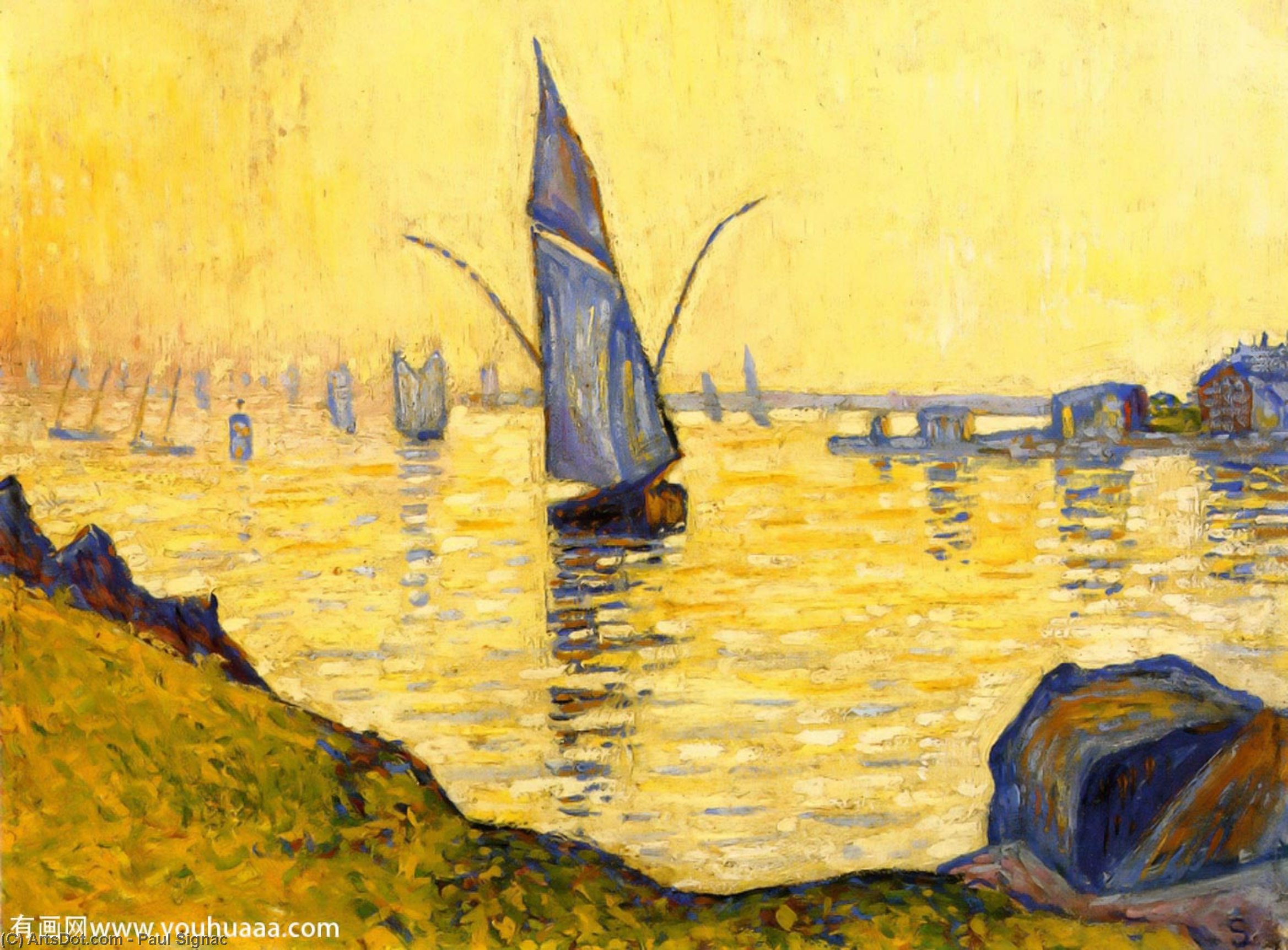
Discover Paul Signac’s ‘Concarneau (study)’ – a luminous Impressionistic coastal scene in oil. Explore Pointillism & vibrant hues of this 1891 masterpiece.
Artist Biography
A Neo-Impressionist master of Pointillism, Signac captured vibrant coastal scenes. Explore his luminous works and discover his legacy today.
About the painting
A Luminous Study in Coastal Light
To gaze upon this study of Concarneau is to be transported to a moment suspended between dawn and afternoon—a breath of salty air captured on canvas. The painting immerses the viewer in an atmosphere saturated with warm, golden hues, creating a luminous haze that seems to emanate from the water itself. It is not merely a depiction of a seaside vista; it is an evocation of light’s ephemeral dance upon liquid surfaces. The composition guides the eye across the calm expanse where sailboats drift like painted dreams toward a distant, softened horizon. Here, the artist masterfully prioritizes the feeling of movement and the play of reflected color over any need for sharp, photographic detail.
The Science and Soul of Impressionism
This work stands as a beautiful testament to the enduring spirit of Impressionism, filtered through the thoughtful lens of Paul Signac. While the scene speaks with the immediacy of Monet’s later works, the underlying structure hints at the systematic approach that defined his career. The visible brushstrokes—short, broken dabs of pure color—are not mere stylistic flourishes; they are records of perception itself. They capture how light fractures upon water and rock, giving texture to what might otherwise appear smooth. Notice the foreground: the rocky shoreline and large boulders are rendered with a palpable impasto, allowing one to almost feel the grit beneath the fingertips. This tactile quality is central to the painting’s power.
Rhythm, Reflection, and Form
The interplay between horizontal lines—the vast sweep of the water and sky—and the vertical accents provided by the masts and shoreline anchors the piece in a profound sense of rhythm. The sailboats themselves become rhythmic punctuation marks against the expansive canvas. Signac’s handling here suggests that the subject matter, while maritime, is deeply concerned with optical experience. The way the light catches the sails, making them glow against the deeper tones of the water, speaks to an understanding of color theory as a structural element. It is a study in atmospheric perspective, where distance softens edges until the cityscape recedes into a gentle wash of color.
Symbolism of Passage and Freedom
Beyond its technical brilliance, this painting resonates with universal themes. The sea, eternally restless yet momentarily calm, has always symbolized the journey of life itself. These graceful sailboats are potent symbols of freedom, of passage, and of humanity’s enduring connection to nature's vast, beautiful indifference. For the collector or designer, owning this piece means bringing into a space not just a painting, but a mood—a sense of open possibility and tranquil escape. It invites contemplation on journeys taken and those yet to come.
Questions & Answers
How is the mood of "Concarneau (study)" by Paul Signac described?
The overall mood of "Concarneau (study)" by Paul Signac is serene. The mood describes the general atmosphere of the work.
What stage of Paul Signac's development does "Concarneau (study)" represent?
"Concarneau (study)" belongs to the Mature Period of Paul Signac's career. This classification relates the work to the artist's development.
How harmonious are the colors of "Concarneau (study)" by Paul Signac?
"Concarneau (study)" by Paul Signac displays a unified palette color harmony.
Quick facts and art quiz
About Paul Signac

Paul Signac
1863 - 1935, France
Artist Biography
The Life and Identity of Paul Signac
Born in Paris on 11 November 1863, Paul Signac entered a world that was beginning to shift under the weight of new visual ideas. He was the son of Jules Jean-Baptiste Signac and Héloïse Anaïs-Eugénie Deudon, a family that provided the foundation for a life dedicated to the pursuit of light. While his parents once envisioned a different path for him, the pull of the canvas proved stronger than any other calling. He would eventually become a central figure in the Neo-Impressionist movement, a man whose very identity was tied to the way color and light interacted upon a surface.
His existence was marked by a deep connection to the sea and the shifting colors of the coast. He was a sailor at heart, a man who found his true rhythm amidst the waves and the sun-drenched harbors of the Mediterranean. This love for the water was not merely a hobby but a way of seeing the world, one that he translated into his paintings through a disciplined, almost scientific application of pigment. He sought to find order within the chaos of light, using his brushes to reconstruct the world through a meticulous, rhythmic method.
By the time he passed away in 1935 at the age of 72, he had left behind a body of work that challenged the traditional boundaries of how we perceive color. His life was a long, steady pursuit of a specific kind of harmony, one that sought to marry the precision of science with the deep feelings of the artist. He lived through a period of immense change, remaining a steadfast advocate for his chosen methods until his final days in Paris.
Early Life, Family and Training
Born in Paris, the young Signac grew up in a household shaped by the commerce of the city. His father managed a shop on the Rue Frochot, where he sold luxury horse saddles and harnesses to a discerning clientele. This environment of craftsmanship and material detail provided a backdrop to a childhood that would soon shift toward the artistic heart of the capital. As his family moved into the Montmartre area, the boy found himself immersed in an urban center teeming with creative energy and the evolving spirit of the age.
His early education was marked by a structured interest in form and construction. He spent his time studying architecture at the Collège Rollin in Montmartre until 1880. This training in the logic of space and structure would linger in his mind long after he turned his attention toward the canvas. By 1882, his path led him to the École des Arts-Décoratifs in Paris, where he sought to refine his technical abilities. It was during these formative years that the pull of the Seine and the light of the outdoors began to compete with the rigid lines of his architectural studies.
The Development of Neo-Impressionism
The seeds of Signac's transformation were sown during a visit to an exhibition in 1880, where the works of Claude Monet left a lasting impression upon him. This encounter stirred a curiosity that would eventually lead him away from the fleeting impressions of his youth toward a more structured way of seeing. By 1884, his path crossed with Georges Seurat, a meeting that would alter the course of his life and the history of painting. Together, they sought to move beyond the spontaneous brushwork of their predecessors, looking instead toward a method that combined art with the logic of light.
This partnership focused on the development of Pointillism, a technique where tiny, distinct dots of pure color were applied to the canvas. They believed that by placing these dots side by side, the eye of the viewer would perform the work of mixing them, creating a luminosity that traditional blending could not achieve. While Seurat provided much of the initial theoretical weight, Signac became the movement's most vital voice. Following the death of his collaborator in 1891, Signac emerged as the principal spokesman for Divisionism, ensuring that their scientific approach to color and light would endure and influence the generations that followed.
Technique and the Science of Color
Signac sought to bring a sense of order to the canvas, treating the act of painting as a rigorous investigation into how the human eye perceives light. He moved away from the traditional method of mixing pigments on a palette, which he believed could dull the true intensity of color. Instead, he adopted a technique known as Pointillism, or Divisionism, where he applied tiny, distinct dots of pure color directly onto the surface. By placing complementary colors side by side, he relied on the viewer's own eye to perform the optical blending, creating a shimmering effect that felt more alive than a pre-mixed hue. This was a disciplined, almost mathematical approach to the canvas.
His commitment to these principles was not merely a matter of habit but a deeply held intellectual conviction. He spent years studying the scientific laws of light and color, seeking to ground his art in the truths of physics. In 1899, he articulated these complex theories in his writing, From Eugène Delacroix to Neo-Impressionism. Through his work, he demonstrated that the artist could achieve a new kind of luminosity by respecting the purity of each pigment. As his career progressed, his application of these dots became more fluid and expressive, yet he never abandoned the fundamental science that governed his vision.
Artistic Activity in Paris and Asnières
The streets of Paris in the mid-1880s offered a restless energy that pulled Signac toward new ways of seeing. In 1886, he participated in the 8th Impressionist exhibition, contributing eighteen works that largely focused on city views and seascapes. His style at this time was caught in a transition, blending the loose, rapid brushstrokes of the Impressionists with the emerging, more disciplined application of color that would soon define his reputation. It was during this period of intense experimentation that he encountered Vincent van Gogh. The two men found a shared language in the light of the French landscape, and by 1887, they began to frequent Asnières-sur-Seine together. In the quietude of the riverbanks, they sought to capture the shifting atmosphere of the outskirts of the capital.
As his ideas matured, Signac moved closer to the radical theories of his contemporaries. He found himself standing alongside figures such as Degas, Pissarro, Gauguin, and Seurat during the IX Impressionist Exhibition. These gatherings were more than mere social meetings; they were the crucibles where the future of modern painting was forged. While his early years were marked by a fascination with the river landscapes of the Seine, his time in Asnières allowed him to refine the rhythmic, mosaic-like application of paint that would eventually move away from the fleeting impressions of the past toward a more structured, scientific harmony.
Coastal Life and the Mediterranean
The pull of the sea eventually drew the artist away from the urban landscapes of the north. In 1892, he sailed the Garonne River southeast through France, seeking the light of the Mediterranean Sea. He dropped anchor in Saint-Tropez aboard his yacht, the Olympia, and found there a landscape that would become a major theme across his paintings. The shimmering waters and sun-drenched harbors offered a new rhythm for his brush, far removed from the riverbanks of the Seine.
He found such deep inspiration in this southern light that he established a home in Saint-Tropez. This coastal retreat became a sanctuary where he could observe the interplay of color and tide. His technique began to change as he moved through these maritime settings; the strict, meticulous dots of his earlier years gradually gave way to a more fluid and expressive application of paint. The movement of the waves and the brightness of the Mediterranean air encouraged a broader palette and a more spontaneous touch.
- The Red Buoy, Saint-Tropez (1895)
- The Pine Tree at St. Tropez (1909)
Key Works of the Artist
In the early years of his experimentation, Signac sought to capture the pulse of the city through a rigorous, scientific lens. His 1886 work, Boulevard de Clichy, captures a winter scene in Paris, where the snowy boulevard is rendered through the meticulous application of small dots of pure color. This approach allowed him to translate the urban landscape into a rhythmic arrangement of light and shadow. By 1887, his focus shifted toward the quietude of domestic life. In Breakfast (The Dining Room), he applied thousands of tiny, distinct points of color to a scene of Belle Époque elegance, where sunlight streams through a window to illuminate a breakfast table with a vibrating energy.
As his life moved toward the sea, his brushwork began to change, finding a new freedom in the light of the south. The 1895 painting The Red Buoy, Saint-Tropez demonstrates this evolution, using his mastery of Pointillism to catch the dynamic energy of the Mediterranean coast. The colors in these maritime scenes became more fluid and expressive, moving away from the strict, tiny dots of his earlier years toward a broader, more mosaic-like touch. Even when turning his attention to the people around him, his technique remained precise. His 1890 Portrait of Felix Feneon used this meticulous construction to explore light and color, presenting the subject with a clarity born from his revolutionary method.
- Boulevard de Clichy, 1886
- Breakfast (The Dining Room), 1887
- Portrait of Felix Feneon, 1890
- The Red Buoy, Saint-Tropez, 1895
Leadership and the Avant-Garde
Beyond the quietude of his coastal studies, Signac moved through the social circles of Paris with a firm sense of purpose. He was a well known Anarchist, a conviction that mirrored his desire to break away from the rigid, established structures of the art world. This spirit of rebellion found a practical outlet through his leadership within the Société des Artistes Indépendants. He held the presidency of this influential group from 1908 until his death in 1935, ensuring that the spirit of independence remained a guiding force for those who sought to challenge the status quo.
His influence extended far beyond his own canvases, as he acted as a patron for those who dared to experiment. He possessed a keen eye for the new, recognizing the potential in the radical shifts of the coming century. By providing a platform for emerging talents, he helped foster the rise of movements that would change the course of modern art. He was among the first to offer his support to the pioneers of Fauvism and Cubism, welcoming their departures from tradition. Through his guidance, artists like Henri Matisse and André Derain found the space necessary to develop their own unique visions.
Legacy and Influence on Modern Art
The ripples of Signac’s experiments with light and color reached far beyond the quiet harbors of the Mediterranean. He acted as a bridge between the structured theories of the late nineteenth century and the explosive freedom of the next. By championing the idea that color could be applied with a rhythmic, almost musical intensity, he provided a foundation for those who sought to break away from traditional representation. His presence in the art world was felt not only through his brush but through his intellect, as he became a leading figure who helped define the direction of modern expression.
This influence was particularly evident in the emergence of Fauvism. Signac’s approach to the canvas inspired artists like Henri Matisse and André Derain, who would later push the boundaries of color even further. He showed that the way an artist handles pigment can change the very way a viewer perceives reality. His commitment to the evolution of new styles ensured that his ideas remained a vital part of the artistic conversation, influencing a whole generation of painters who looked to his work to understand the potential of pure hue and light.
Where to See the Works Today
To witness the light that Signac so carefully studied, one must travel to the great halls of Paris. The Musée d'Orsay holds nine of his works, offering a significant gathering of his vision. It is there that the meticulous application of color becomes most apparent to the observer. In the same city, other treasures can be found, though the largest concentration remains in the French capital.
Across the Atlantic, the Metropolitan Museum of Art in New York preserves five of his paintings, allowing those in the Americas to encounter his specific method of optical mixing. The reach of his influence extends even further, finding its way to the Kröller-Müller Museum in Otterlo, which maintains four of his pieces. These works allow us to see how his style evolved from the strict dots of his early years toward a more fluid touch.
The presence of his art is truly global, reaching as far as the National Gallery of Victoria in Melbourne, where two of his works reside. These scattered collections ensure that his experiments with light and color remain accessible to those seeking to understand the science of his brushwork. Some of the specific pieces held in these various institutions include:
- Boulevard de Clichy 1886
- The Red Buoy, Saint-Tropez (1895)
- Portrait of Felix Feneon (1890)
- Breakfast (The Dining Room) (1887)
- The Jetty, Cassis, Opus 198
Quick facts about Paul Signac
- Artistic Movement Or Style: Neo-Impressionism, Pointillism
- Artists Or Movements Influenced By This Artist:
- Henri Matisse
- André Derain
- Fauvism
- Cubism
- Artists Who Influenced This Artist:
- Claude Monet
- Georges Seurat
- Eugène Delacroix
- Full Name: Paul Victor Jules Signac
- Nationality: French
- Notable Artworks:
- Boulevard de Clichy
- The Red Buoy, Saint-Tropez
- The Jetty, Cassis, Opus 198
- Portrait of Felix Feneon
- Breakfast (The Dining Room)
- Place Of Birth: Paris, France
- Date Of Birth: 1863
- Date Of Death: 1935
Related Artworks




Explore artworks organized by themes, styles, and characteristics.



Paul Signac
Concarneau (study)
() ·
With its frame: · Hand-painted in oil on linen
Total