

Shown: · With its frame:
 Preview
 Send
Send Share
Share
 Details
 Guide
Guide

 Download
 Similars
 X-Ray
X-Ray Diaporama
 Q&A
Q&A Stats
Stats

$ 269
Hand Made Oil Reproduction
Hand-painted oil on canvas in your size and frame, made to order by our artists. ( Switch to Print Switch to Digital Image)
Size
·Standard
custom
CM
INCH
Pick from our preset sizes that match the artwork's original proportions.
Loading sizes...

width
height
Type the width and the height you need, to fit your frame or your wall. This is hand-painted, so for a size with a different shape the artist can paint a bit more around the picture, or cut a bit — you choose. We send you a digital mockup to approve before the painting starts. The picture shown on this page does not show the real result — only the mockup does.
 Read more
Finish
·
White $1

Blurside $1

Extended $1

P118B $10

P118H $10

P118W $10

P438Z $10

P508JH $12

P508YH $12

P805H $10

P805Z $10

P919BZ $10

P919G $10

P919XJ $10

P959ZH $10

P968JZ $12

W106C $8

W218G $10

W218JH $8

W218Y $10

W307PJ $10

W316G $10

W316PJ $8

W316Y $10

W398PJ $8

W4111J $10

W500HY $15

W500JH $15

W692G $12

W849H $8

W940BG $15

W953PJ $8

H24-GOLD $30

H24-SILVER $30

H36-GOLD $45

H36-SILVER $45
Shipped in a protective tube, ready for your own framer.
Above 105 cm the frame is shipped as a kit for a professional framer — read the details.
Extras
optionalWhat do the extras include?
Examples of what can be changed: Replace face with customer photo; Add pet (e.g., replace cat with dog); Include hidden message in background; Change background landscape or elements.
After order, TopImpressionists.com team will email client for instructions and provide a mockup preview
After order, TopImpressionists.com team will email client for instructions and provide a mockup preview
Worldwide Delivery () in 3/4 weeks instead of standard 5 weeks. (11 November). No compromise on quality.
Protective Varnish
Nameplate
Engraved Bronze Plaque Details
This elegant plaque features the artist's name and the title of the artwork, finely engraved for a timeless presentation.
It is made from bronze with a refined, elegant finish. The text is precisely laser-engraved for a sharp and permanent result. Measuring 9x2 cm, the plaque is compact yet easy to read. It's built to be durable and scratch-resistant, offering a professional, museum-quality look. Mounting is simple thanks to the included adhesive backing.
Transparent Acrylic Plaque Details
The plaque includes essential engraved details such as the artist's name, the title of the artwork, the date it was created, the type of media used-like oil on canvas or watercolor-a brief description of the piece, and a QR code that links to the complete artwork information.
It is crafted from clear acrylic, offering a sleek, modern appearance. The text is UV-engraved in black to ensure strong visual contrast. With a size of 10x15 cm, it ensures optimal readability. It comes equipped with two metal hooks for secure wall mounting. The plaque is designed to be weather-resistant, making it suitable for various environments, and it includes interactive features that work seamlessly with smartphone scanning.
Black Acrylic Plaque Details
This elegant plaque includes engraved information such as the artist's name, the title of the artwork, the date it was created, the type of media used (like oil on canvas or watercolor), a short description of the artwork, and a QR code for quick access to more information.
The plaque itself is made from refined black acrylic with a premium finish. The text is laser-engraved in white for high contrast and readability. Its size is 10x15 cm, designed to be easy to read. It comes with two metal hooks for professional mounting. The design is sleek and fits any interior style. It is also weather-resistant and durable, with built-in digital integration for mobile compatibility.
Glass option is only available in size under 110 CM
 Glass option is only available in size under 110 CM
- Free Worldwide Express Shipping
- High-Quality Linen Canvas
- Full Shipping Insurance
- Customs Tax Refund Guarantee
- True Color Matching Guarantee
- 100-Day Return Policy (Defects Only)
- 100% Money-Back Guarantee
- Bulk Discount Offer


Collectible Description
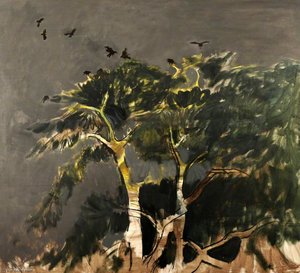
The painting depicts trees with branches and leaves, showcasing vibrant green foliage interspersed with scattered bird plumage. A building stands in the background, adding depth to the tranquil outdoor scene.
Artist Biography
Piet Mondrian pioneered Neoplasticism with works like Broadway Boogie Woogie. Discover the beauty of his geometric abstractions today.
About the painting
The Essence of Nature Through a Modern Lens
In the evocative masterpiece Trees, we witness a profound moment in the evolution of Piet Mondrian, a period where the boundaries between the natural world and the burgeoning language of abstraction began to blur. This work serves as a breathtaking bridge between his early roots in the Hague School and the radical geometric precision that would later define his legacy. The painting presents a lush, vibrant scene where verdant leaves dance across branches, creating a rhythmic tapestry of green. Amidst this botanical splendor, small birds are perched delicately upon the limbs, breathing life and movement into the composition. A subtle architectural presence in the background provides a sense of depth, grounding this ethereal woodland setting within a touch of human context, suggesting a serene sanctuary where nature and civilization exist in quiet coexistence.
To behold this piece is to experience the transition from observation to essence. While the subject matter remains rooted in the landscape, Mondrian’s technique begins to whisper of his future explorations into Neo-Plasticism. The brushwork, though still retaining a sense of organic texture and Impressionistic vitality, hints at a desire to distill the chaotic beauty of the forest into something more structured and harmonious. For the discerning collector or interior designer, this painting offers a unique duality: it possesses the warmth and life of a traditional landscape, yet carries the intellectual weight of a modernist pioneer. It is a work that invites the eye to wander through its leafy depths while simultaneously prompting the mind to contemplate the underlying order of the universe.
A Symphony of Color and Symbolic Harmony
The emotional impact of Trees lies in its ability to evoke a sense of tranquil vitality. The palette is dominated by rich, pulsating greens that suggest the peak of summer, yet there is an underlying balance that speaks to Mondrian’s deep-seated spiritual convictions. As his journey progressed, Mondrian sought a visual vocabulary that reflected the universal truths found in systems like Zen Buddhism and Kabbalah—principles centered on equilibrium and the unity of all things. In this painting, we see the early stages of that quest; the way the light filters through the canopy and the rhythmic placement of the birds suggest a world that is not merely seen, but felt as a balanced, living organism.
For those looking to adorn a sophisticated living space or a curated gallery, this reproduction offers more than mere decoration. It serves as a focal point of contemplative beauty. The interplay of light and organic form provides a refreshing burst of color that can breathe life into minimalist interiors, while its historical significance adds a layer of academic prestige to any collection. Owning a piece that captures the very moment an artist begins to strip away the superficial to find the eternal is a rare privilege, making Trees an indispensable treasure for lovers of art history and seekers of aesthetic harmony.
Questions & Answers
What luminance does "Trees" by Piet Mondrian have?
The colors of "Trees" show a gentle luminance luminance.
How do the colors of "Trees" by Piet Mondrian relate to its emotion?
"Trees" by Piet Mondrian combines an earthy palette with a calm tone.
Where is the portrait format of "Trees" recommended to be displayed?
The portrait format of "Trees" by Piet Mondrian is recommended for a living room. Format and space together guide the placement of a reproduction.
Quick facts and art quiz
About Piet Mondrian

Piet Mondrian
1872 - 1944, Netherlands
Artist Biography
The Life and Identity of Piet Mondrian
The man who would reshape the visual language of the twentieth century began his life as Pieter Cornelis Mondriaan, Jr. He was born on March 7, 1872, in Amersfoort, Netherlands. For years, he operated under this formal name, but a shift occurs in 1911 when he adopts the name Piet Mondrian. He is a Dutch painter and art theoretician, a man whose intellect sought to map the very structures of existence through paint and theory.
His life moves from the quietude of the Netherlands to the frantic energy of the global stage. The final chapter of his life unfolds in New York, New York, U.S. He dies there on February 1, 1944, from pneumonia. The transition from the naturalistic landscapes of his youth to the rigid, rhythmic grids of his later years marks a total transformation of purpose.
Early Life, Family and Training
Amersfoort, Netherlands, provides the setting for his beginnings. He is born into a strict Protestant family. His father, Pieter Cornelius Mondriaan, Sr., works as a head teacher and amateur draftsman. This environment is shaped by a disciplined, religious structure. Art is present in the household through his uncle, Frits Mondriaan, a landscape painter. The boy draws from an early age, guided by these familial connections to the visual arts.
The path toward professional training is direct. By 1892, he is already qualified as a drawing teacher. He moves to Amsterdam to enroll at the Rijksakademie van Beeldende Kunsten, where he remains from 1892 to 1897. The academy provides the technical foundation for his developing vision. During this formative period, he also joins the art society Kunstliefde in Utrecht.
The Dutch Period and Impressionist Roots
The Dutch landscape provides the initial canvas. In the quietude of the Netherlands, Mondrian captures the heavy clouds and wind-swept mills of his surroundings. These early works are naturalistic, focusing on the rivers and polders that define the region. He works within the traditions of the Hague School and Dutch Impressionism, utilizing a palette that reflects the soft, muted light of the Dutch countryside. In pieces like The Red Mill, the subject remains clearly recognizable, rooted in the physical reality of the land.
A shift begins in 1908. As he engages with the theosophical movement, a search for a hidden, universal order starts to pull at his brushstrokes. He moves away from mere representation. He experiments with the structured dots of Pointillism and the bold, non-naturalistic colors of Fauvism. The focus shifts from the surface of the object to its underlying structure. By 1909, his presence in the Dutch art scene is established through a major exhibition at the Stedelijk Museum in Amsterdam.
- The Red Mill
- Evening (Avond) (1908)
The Parisian Awakening and Cubism
Paris, 1912. The city pulses with a new, aggressive energy. Mondrian arrives from the Netherlands, shedding the old Dutch spelling of his name to become Mondrian. He enters a landscape where the traditional rules of representation are being dismantled. The encounter with Cubism changes the trajectory of his work. He watches the experiments of Georges Braque and Pablo Picasso, observing how they deconstruct objects into geometric components. The focus shifts from what the eye sees to how the eye perceives structure. He begins to move away from the depiction of reality, seeking instead to analyze form through planes and lines.
This period marks a radical departure from his earlier landscapes. He is no longer interested in the soft light of the Dutch countryside. Instead, he develops an independent abstract style, stripping away the accidental to find a more fundamental visual language. The transition is not a sudden leap but a steady, disciplined reduction. He is searching for a way to express the underlying structure of existence through pure abstraction. The organic curves of his youth are replaced by the tension of intersecting planes.
- Composition in gray-blue, 1913
The Birth of Neoplasticism and De Stijl
The search for a universal truth reaches a breaking point. By 1917, the deconstruction of form has moved beyond the mere fragmentation of objects. Mondrian co-founds the De Stijl movement alongside Theo van Doesburg, seeking a visual language that transcends the accidental details of nature. He moves toward a non-representational form he terms Neoplasticism. This is a radical departure from the tangible. He argues that art should be higher than reality, existing in a realm of pure, spiritual order rather than mirroring the chaotic surface of the physical world.
The visual vocabulary becomes absolute. The artist strips away all curves and diagonals, leaving only the tension of horizontal and vertical lines. Color is no longer used to describe light or shadow on a landscape; instead, it is reduced to its most essential components. He limits his palette to the three primary colors: red, blue, and yellow. To balance these, he employs the three primary values: black, white, and gray. The result is a rigid, geometric equilibrium that seeks to manifest a hidden, structural harmony.
- 1917: Composition in colour A
- 1925: Lozenge Composition with Red, Black, Blue and Yellow
- 1930: Composition with Red, Blue and Yellow
New York and the Final Rhythm
The war forces a final movement. After a brief period in London in 1938, Mondrian arrives in New York in October 1940. The rigid, geometric order of his previous years meets the frantic, syncopated energy of Manhattan. He joins the American Abstract Artists, finding a new environment for his evolving vision. The city's pulse is everywhere. It is in the grid of the streets and the staccato rhythm of jazz music. This urban dynamism begins to break his strict adherence to solid blocks of color.
The lines begin to dance. In these final years, the heavy black bars of his earlier Neoplasticism give way to something more fragmented and rhythmic. The compositions lose their static weight, replaced by a flickering movement that mirrors the city's own electrical life. He captures the essence of the metropolis not through its buildings, but through its tempo. This shift is most evident in his late works, where the grid transforms into a series of small, pulsing squares of color.
- Broadway Boogie Woogie, about 1943
Technique and Artistic Style
The canvas becomes a site of absolute reduction. Mondrian strips away the accidental details of the physical world to reach for a structural truth. His technique relies on precise, clean lines and flat areas of color that refuse to suggest depth or texture. There is no brushwork to distract the eye, only the intersection of form and space. He seeks to express universal truths through pure abstraction, moving past the imitation of nature toward a visual language of essential order.
This order is governed by a rigid geometry. In his mature period, the vocabulary is limited to the simplest combinations of straight lines and right angles. He operates within a strict framework of horizontal and vertical directions. This commitment to the grid is so absolute that he famously avoids the use of diagonal lines, viewing them as a deviation from the fundamental equilibrium he spent his life pursuing. The tension in his work arises not from movement, but from the calculated balance of these intersecting planes.
- Composition with Red, Blue and Yellow
- Composition with Red, Black, Blue, Yellow and Grey
- Broadway Boogie Woogie
Legacy and Influence on Modern Culture
The grid extends far beyond the canvas. The logic of the right angle and the primary palette moves through the streets of the modern city, manifesting in the structural clarity of architecture and the precise arrangements of typography and graphic design. This visual language remains a constant in the contemporary landscape, appearing in the clean layouts of modern packaging and the bold compositions of advertising.
In 1965, this aesthetic crossed into the realm of high fashion. Yves Saint Laurent translated the geometric principles of the movement into the Mondrian Collection. Six cocktail dresses emerged from this vision, utilizing pre-dyed fabrics to create blocks of color and graphic black lines. These garments were not merely prints; they were constructed from individual pieces of fabric to ensure the lines integrated into the seams, maintaining a sense of structural integrity even in movement.
The influence persists in the way we organize visual information. The tension between the heavy black bars and the primary colors of red, blue, and yellow continues to dictate the rhythm of much of modern visual culture.
Where to See the Works Today
The search for Mondrian’s visual logic leads to several key institutions across Europe and North America. In the Netherlands, the Kröller-Müller Museum in Otterlo maintains a significant presence with six works. Nearby, the Kunstmuseum Den Haag preserves pieces that capture his earlier, more figurative transitions, including Devotion.
The evolution toward pure abstraction finds a home in the United States as well. The Kimbell Art Museum in Fort Worth holds three works, while the Metropolitan Museum of Art in New York also contains pieces from his development. These collections offer a way to trace the movement from the naturalistic landscapes of his youth to the rigid, rhythmic grids of his final years.
- Devotion
- Composition with Red, Blue and Yellow
- Broadway Boogie Woogie
Related Artworks




Explore artworks organized by themes, styles, and characteristics.


Piet Mondrian
Trees
() ·
With its frame: · Hand-painted in oil on linen
Total