

Shown: · With its frame:
 Preview
 Send
Send Share
Share
 Details
 Guide
Guide

 Download
 Similars
 X-Ray
X-Ray Diaporama
 Q&A
Q&A Stats
Stats
$ 269
Hand Made Oil Reproduction
Hand-painted oil on canvas in your size and frame, made to order by our artists. ( Switch to Print Switch to Digital Image)
Size
·Standard
custom
CM
INCH
Pick from our preset sizes that match the artwork's original proportions.
Loading sizes...

width
height
Type the width and the height you need, to fit your frame or your wall. This is hand-painted, so for a size with a different shape the artist can paint a bit more around the picture, or cut a bit — you choose. We send you a digital mockup to approve before the painting starts. The picture shown on this page does not show the real result — only the mockup does.
 Read more
Finish
·
White $1

Blurside $1

Extended $1

P118B $10

P118H $10

P118W $10

P438Z $10

P508JH $12

P508YH $12

P805H $10

P805Z $10

P919BZ $10

P919G $10

P919XJ $10

P959ZH $10

P968JZ $12

W106C $8

W218G $10

W218JH $8

W218Y $10

W307PJ $10

W316G $10

W316PJ $8

W316Y $10

W398PJ $8

W4111J $10

W500HY $15

W500JH $15

W692G $12

W849H $8

W940BG $15

W953PJ $8

H24-GOLD $30

H24-SILVER $30

H36-GOLD $45

H36-SILVER $45
Shipped in a protective tube, ready for your own framer.
Above 105 cm the frame is shipped as a kit for a professional framer — read the details.
Extras
optionalWhat do the extras include?
Examples of what can be changed: Replace face with customer photo; Add pet (e.g., replace cat with dog); Include hidden message in background; Change background landscape or elements.
After order, TopImpressionists.com team will email client for instructions and provide a mockup preview
After order, TopImpressionists.com team will email client for instructions and provide a mockup preview
Worldwide Delivery () in 3/4 weeks instead of standard 5 weeks. (31 October). No compromise on quality.
Protective Varnish
Nameplate
Engraved Bronze Plaque Details
This elegant plaque features the artist's name and the title of the artwork, finely engraved for a timeless presentation.
It is made from bronze with a refined, elegant finish. The text is precisely laser-engraved for a sharp and permanent result. Measuring 9x2 cm, the plaque is compact yet easy to read. It's built to be durable and scratch-resistant, offering a professional, museum-quality look. Mounting is simple thanks to the included adhesive backing.
Transparent Acrylic Plaque Details
The plaque includes essential engraved details such as the artist's name, the title of the artwork, the date it was created, the type of media used-like oil on canvas or watercolor-a brief description of the piece, and a QR code that links to the complete artwork information.
It is crafted from clear acrylic, offering a sleek, modern appearance. The text is UV-engraved in black to ensure strong visual contrast. With a size of 10x15 cm, it ensures optimal readability. It comes equipped with two metal hooks for secure wall mounting. The plaque is designed to be weather-resistant, making it suitable for various environments, and it includes interactive features that work seamlessly with smartphone scanning.
Black Acrylic Plaque Details
This elegant plaque includes engraved information such as the artist's name, the title of the artwork, the date it was created, the type of media used (like oil on canvas or watercolor), a short description of the artwork, and a QR code for quick access to more information.
The plaque itself is made from refined black acrylic with a premium finish. The text is laser-engraved in white for high contrast and readability. Its size is 10x15 cm, designed to be easy to read. It comes with two metal hooks for professional mounting. The design is sleek and fits any interior style. It is also weather-resistant and durable, with built-in digital integration for mobile compatibility.
Glass option is only available in size under 110 CM
 Glass option is only available in size under 110 CM
- Free Worldwide Express Shipping
- High-Quality Linen Canvas
- Full Shipping Insurance
- Customs Tax Refund Guarantee
- True Color Matching Guarantee
- 100-Day Return Policy (Defects Only)
- 100% Money-Back Guarantee
- Bulk Discount Offer


Artist Biography
Explore the still lifes of Raphaelle Peale (1774-1825), America's first professional still-life painter! Discover his meticulous depictions of food & trompe l'oeil works, influenced by Spanish masters. A key figure in 19th-century American art.
About the painting
Quick facts and art quiz
About Raphaelle Peale

Raphaelle Peale
1774 - 1825, United States of America
Artist Biography
The Pioneer of the American Still Life
In the burgeoning landscape of early nineteenth-century American art, where portraiture reigned supreme as the primary vehicle for status and legacy, Raphaelle Peale dared to turn his gaze toward the quiet, often overlooked beauty of the inanimate. Born in Annapolis in 1774, Peale was not merely a painter but a pioneer who carved out a specialized niche that had previously been neglected in the young nation's artistic repertoire. As the son of the legendary Charles Willson Peale, his very existence was intertwined with the pulse of American scientific and artistic discovery. Growing up within the orbit of one of America’s most influential artistic dynasties, Raphaelle was immersed in an environment where meticulous observation was considered both a fine art and a scientific necessity.
His early training was deeply rooted in this dual tradition of naturalism and craftsmanship. Under the watchful eye of his father, Peale learned to see the world through a lens of profound detail, a skill that would later become the hallmark of his mature style. While his siblings often pursued paths in medicine or natural history, Raphaelle channeled this inherited passion for documentation into the medium of oil on canvas. He did not merely seek to represent objects; he sought to elevate them. By focusing on the textures of fruit, the sheen of porcelain, and the subtle decay of organic matter, he brought a sense of permanence to the ephemeral, transforming simple kitchen items into subjects of high art.
Mastery of Texture and Trompe l'oeil
The true brilliance of Peale’s work lies in his technical command over light and surface. He became a master of trompe l'oeil—a technique designed to "deceive the eye"—creating illusions so convincing that viewers were often tempted to reach out and touch the depicted objects. His compositions, such as those featuring peaches, raisins, or fish, are studies in tactile reality. One can almost sense the velvety skin of a ripening peach or the cool, smooth surface of a ceramic jug through his masterful application of glaze and shadow.
Peale’s stylistic development was significantly shaped by an awareness of European traditions, particularly the influence of Spanish masters who had long perfected the art of the still life. By blending this Old World sophistication with a uniquely American sensibility, he created works that felt both globally informed and locally grounded. His paintings often feature:
- Meticulous Detail: An unwavering commitment to capturing the minute imperfections of nature, from tiny blemishes on an apple to the delicate veins in a leaf.
- Dramatic Lighting: The use of chiaroscuro to pull subjects forward from dark, atmospheric backgrounds, lending each object a sculptural presence.
- Compositional Balance: A careful arrangement of elements that guides the viewer's eye through a silent, contemplative narrative of abundance and mortality.
A Lasting Legacy in American Art
Though his career was relatively brief, ending with his death in 1825, Raphaelle Peale’s impact on the trajectory of American art cannot be overstated. He broke the monopoly of portraiture, proving that the domestic and the naturalistic were worthy of the highest level of artistic devotion. In doing so, he laid the groundwork for generations of American still-life painters who would follow in his footsteps, exploring themes of abundance, decay, and the beauty of the everyday.
Today, Peale is remembered not just as a member of a famous family, but as a singular talent who possessed the courage to find greatness in the small. His works remain vital testaments to a period of American history when the nation was still defining its visual identity. Through his brushes, the simple contents of a basket or the humble arrangement of a tabletop became enduring symbols of a burgeoning culture's ability to observe, appreciate, and immortalize the world around it.
Quick facts about Raphaelle Peale
- Full Name: Raphaelle Peale
- Nationality: American
- Date Of Birth: 1774
- Date Of Death: 1825
- Place Of Birth: Annapolis, United States of America
- Notable Artworks:
- Still Life with Raisins, Yellow and Red Apples in Porcelain Basket
- Still Life with Jug and Fish
- Artistic Movement Or Style: Still Life
- Artists Who Influenced This Artist: ['Charles Willson Peale']
- Artists Or Movements Influenced By This Artist: ['Spanish Masters']
Explore artworks organized by themes, styles, and characteristics.


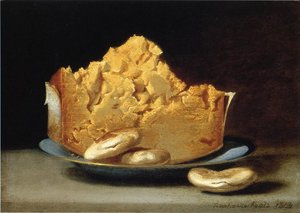
Raphaelle Peale
Cheese and Three Crakers
() ·
With its frame: · Hand-painted in oil on linen
Total