

Shown: · With its frame:
 Preview
 Send
Send Share
Share
 Details
 Guide
Guide

 Download
 Similars
 X-Ray
X-Ray Diaporama
 Q&A
Q&A Stats
Stats

$ 269
Hand Made Oil Reproduction
Hand-painted oil on canvas in your size and frame, made to order by our artists. ( Switch to Print Switch to Digital Image)
Size
·Standard
custom
CM
INCH
Pick from our preset sizes that match the artwork's original proportions.
Loading sizes...

width
height
Type the width and the height you need, to fit your frame or your wall. This is hand-painted, so for a size with a different shape the artist can paint a bit more around the picture, or cut a bit — you choose. We send you a digital mockup to approve before the painting starts. The picture shown on this page does not show the real result — only the mockup does.
 Read more
Finish
·
White $1

Blurside $1

Extended $1

P118B $10

P118H $10

P118W $10

P438Z $10

P508JH $12

P508YH $12

P805H $10

P805Z $10

P919BZ $10

P919G $10

P919XJ $10

P959ZH $10

P968JZ $12

W106C $8

W218G $10

W218JH $8

W218Y $10

W307PJ $10

W316G $10

W316PJ $8

W316Y $10

W398PJ $8

W4111J $10

W500HY $15

W500JH $15

W692G $12

W849H $8

W940BG $15

W953PJ $8

H24-GOLD $30

H24-SILVER $30

H36-GOLD $45

H36-SILVER $45
Shipped in a protective tube, ready for your own framer.
Above 105 cm the frame is shipped as a kit for a professional framer — read the details.
Extras
optionalWhat do the extras include?
Examples of what can be changed: Replace face with customer photo; Add pet (e.g., replace cat with dog); Include hidden message in background; Change background landscape or elements.
After order, TopImpressionists.com team will email client for instructions and provide a mockup preview
After order, TopImpressionists.com team will email client for instructions and provide a mockup preview
Worldwide Delivery () in 3/4 weeks instead of standard 5 weeks. (10 November). No compromise on quality.
Protective Varnish
Nameplate
Engraved Bronze Plaque Details
This elegant plaque features the artist's name and the title of the artwork, finely engraved for a timeless presentation.
It is made from bronze with a refined, elegant finish. The text is precisely laser-engraved for a sharp and permanent result. Measuring 9x2 cm, the plaque is compact yet easy to read. It's built to be durable and scratch-resistant, offering a professional, museum-quality look. Mounting is simple thanks to the included adhesive backing.
Transparent Acrylic Plaque Details
The plaque includes essential engraved details such as the artist's name, the title of the artwork, the date it was created, the type of media used-like oil on canvas or watercolor-a brief description of the piece, and a QR code that links to the complete artwork information.
It is crafted from clear acrylic, offering a sleek, modern appearance. The text is UV-engraved in black to ensure strong visual contrast. With a size of 10x15 cm, it ensures optimal readability. It comes equipped with two metal hooks for secure wall mounting. The plaque is designed to be weather-resistant, making it suitable for various environments, and it includes interactive features that work seamlessly with smartphone scanning.
Black Acrylic Plaque Details
This elegant plaque includes engraved information such as the artist's name, the title of the artwork, the date it was created, the type of media used (like oil on canvas or watercolor), a short description of the artwork, and a QR code for quick access to more information.
The plaque itself is made from refined black acrylic with a premium finish. The text is laser-engraved in white for high contrast and readability. Its size is 10x15 cm, designed to be easy to read. It comes with two metal hooks for professional mounting. The design is sleek and fits any interior style. It is also weather-resistant and durable, with built-in digital integration for mobile compatibility.
Glass option is only available in size under 110 CM
 Glass option is only available in size under 110 CM
- Free Worldwide Express Shipping
- High-Quality Linen Canvas
- Full Shipping Insurance
- Customs Tax Refund Guarantee
- True Color Matching Guarantee
- 100-Day Return Policy (Defects Only)
- 100% Money-Back Guarantee
- Bulk Discount Offer


Collectible Description
Remedios Varo’s surreal ‘Icon’ presents a captivating castle scene brimming with symbolic detail and intricate craftsmanship, reflecting the artist's unique blend of science and mysticism from the Surrealist period – discover this enigmatic artwork.
Artist Biography
A para-surrealist master known for her mystical alchemy. Explore her dreamlike visions and find hand-painted reproductions today.
About the painting
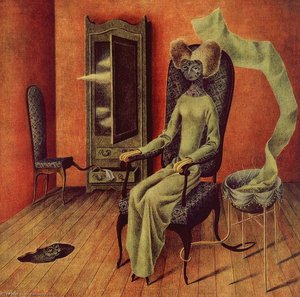
Visual Composition of Icon 1
The painting is a surrealist piece that features a castle with a large, open doorway. Inside the castle, several people are visible, including one person standing near the center of the scene and others scattered throughout the area. The composition includes various objects such as a clock located on the left side and a bird flying above the scene.
The sky is dispersed with multiple stars, contributing to the overall depth of the artwork. The painting depicts a surreal world through its arrangement of figures, architecture, and celestial elements.
Questions & Answers
How do the colors of "Icon 1" by Remedios Varo relate to its emotion?
The earthy palette of "Icon 1" by Remedios Varo goes together with its mysterious emotional tone. Color is one of the ways a work conveys feeling.
What kind of piece is "Icon 1"?
"Icon 1" is a wall art piece.
What is the color identity of "Icon 1" by Remedios Varo?
"Icon 1" by Remedios Varo uses an earthy palette, with black (#090807) as the dominant color.
Quick facts and art quiz
About Remedios Varo

Remedios Varo
1865 - 1911, Spain
Artist Biography
The Precision of the Unseen
In the quiet corners of her studio, Remedios Varo worked with a meticulousness that mirrored the technical drawings of her father, a hydraulic engineer. This early exposure to the mechanics of the world left a mark on her hand, a preference for the fine line and the precise detail. She did not merely paint; she constructed. Her canvases are populated by intricate apparatuses, gears, and hybrid creatures that seem to operate under their own internal logic. There is a certain stillness in her work, the kind found in a laboratory or a sanctuary, where every movement is deliberate and every object has a purpose.
Her upbringing in Anglès, Spain, provided a foundation of duality. From her father, she learned the discipline of observation and the structure of technical drafting. From her mother, she inherited a sense of the spiritual. This tension between the measurable and the mysterious became the engine of her creativity. She moved through the world with a curious eye, absorbing the landscapes of her frequent relocations and the formal training she received at the Real Academia de Bellas Artes de San Fernando in Madrid. It was here that her technical skill met the burgeoning interest in the subconscious, though her path would always remain her own.
A Life in Motion
The movement of her life was dictated by the shifts of history. The Spanish Civil War and the subsequent occupation of France forced her into a series of displacements, eventually leading her to Mexico City. This relocation was not merely a change of scenery; it was a shift in the very substance of her work. In Mexico, she found a community of thinkers and artists, including Leonora Carrington, who shared her interest in the esoteric. She never became a Mexican citizen, maintaining her Spanish identity even as her vision expanded to include the philosophies and indigenous ideas found in her new home.
Her work moved away from the simple portraits of her early years toward a language of symbols. She became interested in alchemy, not as a pursuit of gold, but as a metaphor for the refinement of the self. Her paintings often feature solitary women engaged in mysterious, scientific, or spiritual tasks. These figures are not passive. They are inventors and seekers, often surrounded by machines that seem to bridge the gap between the physical and the metaphysical. In works like Creation of birds, the act of making becomes a cosmic event, a blending of the biological and the magical.
The Architecture of Dreams
Varo’s style is often described as para-surrealism, a term that captures her departure from the standard Surrealist focus on the subconscious. While others sought to release the chaotic impulses of the mind, she sought to organize them. Her paintings are highly structured, using the precision of an illustrator to depict the impossible. She used oil on masonite to achieve a level of detail that demands a close, unhurried gaze. One can see the fine threads of fate being woven or the subtle movement of celestial energy through her brushwork.
Her legacy is found in the way she merged the scientific with the mystical. She looked at the universe through the lens of an engineer and the heart of a seeker. Her paintings remain a study in how the human spirit attempts to map the unknown. Through her intricate depictions of transformation and connection, she created a visual language for the parts of existence that cannot be measured by a ruler or a clock, yet feel entirely real to those who observe them closely.
Quick facts about Remedios Varo
- Full Name: Remedios Varo
- Nationality: Spanish-Mexican
- Date Of Birth: 1865
- Date Of Death: 1911
- Place Of Birth: Angles, Spain
- Notable Artworks:
- Star Catcher
- Icon
- Face
- Dead Leaves
- Scorpions
- Artistic Movement Or Style: Para-Surrealism
- Artists Who Influenced This Artist:
- Hieronymus Bosch
- Francisco Goya
- El Greco
- Artists Or Movements Influenced By This Artist: ['Future generations of artists']
Explore artworks organized by themes, styles, and characteristics.




Remedios Varo
Icon 1
() ·
With its frame: · Hand-painted in oil on linen
Total