

Shown: · With its frame:
 Preview
 Send
Send Share
Share
 Details
 Guide
Guide

 Download
 Similars
 X-Ray
X-Ray Diaporama
 Q&A
Q&A Stats
Stats

$ 269
Hand Made Oil Reproduction
Hand-painted oil on canvas in your size and frame, made to order by our artists. ( Switch to Print Switch to Digital Image)
Size
·Standard
custom
CM
INCH
Pick from our preset sizes that match the artwork's original proportions.
Loading sizes...

width
height
Type the width and the height you need, to fit your frame or your wall. This is hand-painted, so for a size with a different shape the artist can paint a bit more around the picture, or cut a bit — you choose. We send you a digital mockup to approve before the painting starts. The picture shown on this page does not show the real result — only the mockup does.
 Read more
Finish
·
White $1

Blurside $1

Extended $1

P118B $10

P118H $10

P118W $10

P438Z $10

P508JH $12

P508YH $12

P805H $10

P805Z $10

P919BZ $10

P919G $10

P919XJ $10

P959ZH $10

P968JZ $12

W106C $8

W218G $10

W218JH $8

W218Y $10

W307PJ $10

W316G $10

W316PJ $8

W316Y $10

W398PJ $8

W4111J $10

W500HY $15

W500JH $15

W692G $12

W849H $8

W940BG $15

W953PJ $8

H24-GOLD $30

H24-SILVER $30

H36-GOLD $45

H36-SILVER $45
Shipped in a protective tube, ready for your own framer.
Above 105 cm the frame is shipped as a kit for a professional framer — read the details.
Extras
optionalWhat do the extras include?
Examples of what can be changed: Replace face with customer photo; Add pet (e.g., replace cat with dog); Include hidden message in background; Change background landscape or elements.
After order, TopImpressionists.com team will email client for instructions and provide a mockup preview
After order, TopImpressionists.com team will email client for instructions and provide a mockup preview
Worldwide Delivery () in 3/4 weeks instead of standard 5 weeks. (5 November). No compromise on quality.
Protective Varnish
Nameplate
Engraved Bronze Plaque Details
This elegant plaque features the artist's name and the title of the artwork, finely engraved for a timeless presentation.
It is made from bronze with a refined, elegant finish. The text is precisely laser-engraved for a sharp and permanent result. Measuring 9x2 cm, the plaque is compact yet easy to read. It's built to be durable and scratch-resistant, offering a professional, museum-quality look. Mounting is simple thanks to the included adhesive backing.
Transparent Acrylic Plaque Details
The plaque includes essential engraved details such as the artist's name, the title of the artwork, the date it was created, the type of media used-like oil on canvas or watercolor-a brief description of the piece, and a QR code that links to the complete artwork information.
It is crafted from clear acrylic, offering a sleek, modern appearance. The text is UV-engraved in black to ensure strong visual contrast. With a size of 10x15 cm, it ensures optimal readability. It comes equipped with two metal hooks for secure wall mounting. The plaque is designed to be weather-resistant, making it suitable for various environments, and it includes interactive features that work seamlessly with smartphone scanning.
Black Acrylic Plaque Details
This elegant plaque includes engraved information such as the artist's name, the title of the artwork, the date it was created, the type of media used (like oil on canvas or watercolor), a short description of the artwork, and a QR code for quick access to more information.
The plaque itself is made from refined black acrylic with a premium finish. The text is laser-engraved in white for high contrast and readability. Its size is 10x15 cm, designed to be easy to read. It comes with two metal hooks for professional mounting. The design is sleek and fits any interior style. It is also weather-resistant and durable, with built-in digital integration for mobile compatibility.
Glass option is only available in size under 110 CM
 Glass option is only available in size under 110 CM
- Free Worldwide Express Shipping
- High-Quality Linen Canvas
- Full Shipping Insurance
- Customs Tax Refund Guarantee
- True Color Matching Guarantee
- 100-Day Return Policy (Defects Only)
- 100% Money-Back Guarantee
- Bulk Discount Offer


Collectible Description
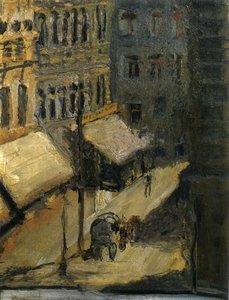
Discover 'Liechtenstein Palace' by Richard Gerstl (1907). An atmospheric Impressionist painting of Vienna’s urban landscape. Explore Austrian Expressionism & a poignant artist's life.
Artist Biography
Explore Richard Gerstl (1883-1908), the tragic Austrian Expressionist! Discover his intense portraits, scandalous life & groundbreaking art anticipating modernism.
About the painting
Quick facts and art quiz
About Richard Gerstl

Richard Gerstl
1883 - 1908, Austria
Artist Biography
Richard Gerstl: A Tragic Pioneer of Expressionism
- Born: Vienna, Austria (1883)
- Died: Vienna, Austria (1908)
Richard Gerstl was an Austrian painter and draughtsman whose brief but intense career placed him at the forefront of early Expressionism. Despite achieving little recognition during his lifetime, he is now considered a pivotal figure in Viennese modern art, known for his psychologically insightful portraits and landscapes that anticipated later developments in German Expressionism. His life was tragically cut short by suicide following a scandalous affair, an event which profoundly impacted his contemporary Arnold Schoenberg.
Early Life and Artistic Development
Born into a prosperous Jewish merchant family, Gerstl’s early life took an unexpected turn when he declared his intention to become an artist. This decision was met with disapproval from his father, leading to a degree of familial tension. After struggling in the traditional Viennese Piaristengymnasium and being expelled for disciplinary issues, Gerstl received private tutoring while pursuing his artistic ambitions. In 1898, at fifteen, he entered the Academy of Fine Arts Vienna under the demanding Christian Griepenkerl. Gerstl quickly grew disillusioned with the academic style and the prevailing trends of the Vienna Secession, famously provoking a harsh rebuke from Griepenkerl.
Artistic Influences and Style
Following his departure from the Academy, Gerstl embarked on a period of self-directed study. Summers spent under Simon Hollósy in Nagybánya exposed him to more liberal artistic approaches. However, further clashes with authority, including a refusal to participate in an imperial procession, led to his expulsion from Hollósy’s studio as well. Gerstl's style was characterized by a raw intensity and psychological depth that set him apart. He rejected the decorative aesthetic of the Secession, opting instead for bold colors, distorted forms, and expressive brushwork. His portraits, in particular, reveal a keen understanding of human psychology, capturing not just physical likeness but also underlying emotional states. Influences can be seen in earlier masters, but Gerstl developed a uniquely personal style that foreshadowed Expressionism’s focus on subjective experience.
Relationships with Schoenberg and the Tragic End
Around 1907, Gerstl became associated with composers Arnold Schoenberg and Alexander von Zemlinsky, who lived in the same building. A close friendship developed between Gerstl and Schoenberg, with Gerstl reportedly instructing Schoenberg in art. This period saw Gerstl produce a series of portraits of Schoenberg, his family, and friends, including several striking depictions of Schoenberg’s wife, Mathilde. A passionate affair ensued between Gerstl and Mathilde, culminating in her departure from Schoenberg in the summer of 1908. Devastated by this loss and facing isolation and a lack of artistic recognition, Gerstl destroyed most of his personal papers and artwork in a desperate act. He subsequently hanged himself in front of a mirror, also inflicting a stab wound upon himself.
Legacy and Historical Significance
Gerstl’s suicide had a profound impact on Schoenberg, inspiring his “drama with music,” Die glückliche Hand (The Lucky Hand). For many years after his death, Gerstl's work remained largely unknown. It was not until 1930 or 1931 that art dealer Otto Kallir organized a posthumous exhibition of his paintings at the Neue Galerie in Vienna. Despite facing challenges from the rising Nazi presence in Austria, Gerstl’s reputation gradually grew, and his importance as a precursor to Expressionism became increasingly recognized. Today, approximately sixty-six paintings and eight drawings are attributed to him. His work is now celebrated for its innovative approach to portraiture and landscape painting, and his tragic life continues to fascinate art historians and enthusiasts alike. Gerstl's legacy lies in his pioneering spirit and his contribution to the development of a new artistic language that prioritized emotional expression over traditional aesthetic conventions.
Quick facts about Richard Gerstl
- Full Name: Richard Gerstl
- Nationality: Austrian
- Date Of Birth: 1883
- Date Of Death: 1908
- Place Of Birth: Vienna, Austria
- Notable Artworks:
- Portrait of Mother
- Self-Portrait Laughing
- Study of tree
- Small street (Nußdorferstraße)
- Waldemar Unger II
- Artistic Movement Or Style: Expressionism
- Artists Or Movements Influenced By This Artist:
- German Expressionism
- Oskar Kokoschka
Related Artworks



Explore artworks organized by themes, styles, and characteristics.


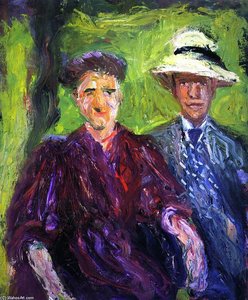


Richard Gerstl
Liechtenstein Palace
() ·
With its frame: · Hand-painted in oil on linen
Total