


 Preview
 Send
Send Share
Share
 Details
 Guide
Guide

 Download
 Similars
 X-Ray
X-Ray Diaporama
 Stats
StatsThe Street
 Oil On Canvas
- WallArt
- Pop Art
 1963
1963- Modern
 182.0 x 182.0 cm
A vibrant 1963 painting by Richard Lindner capturing a lively urban gathering of figures and a dog with striking mechanical energy, perfect for collectors seeking a unique piece of mid-century modern art.
 Read More
Explore the unique urban eroticism of Richard Lindner's robot-like figures & 60s/70s art. A German-American painter known for his powerful, symbolic imagery – a visual journey.
The artwork displayed on this page is protected by copyright law, which means we cannot legally create or sell an identical reproduction. This protection is enforced under international agreements such as the Berne Convention and by national laws, including those outlined by the U.S. Copyright Law - Title 17.
As a respectful and legal alternative, we offer custom, hand-painted artworks inspired by the original. Our skilled and professional artists carefully study the original's style, mood, and artistic essence to create a new, unique piece that evokes the same feeling - while remaining an original creation in its own right.
This method fully complies with copyright regulations because it does not involve copying or duplicating the protected artwork. Instead, it is a creative reinterpretation - a new painting that is influenced by the original but not identical to it.
Hand Made Oil Reproduction
Hand-painted oil on canvas in your size and frame, made to order by our artists. ( Switch to Print Switch to Digital Image)




P118B $10

P118H $10

P118W $10

P438Z $10

P508JH $12

P508YH $12

P805H $10

P805Z $10

P919BZ $10

P919G $10

P919XJ $10

P959ZH $10

P968JZ $12

W106C $8

W218G $10

W218JH $8

W218Y $10

W307PJ $10

W316G $10

W316PJ $8

W316Y $10

W398PJ $8

W4111J $10

W500HY $15

W500JH $15

W692G $12

W849H $8

W940BG $15

W953PJ $8




Standard
custom
CM
INCH
Pick from our preset sizes that match the artwork's original proportions.
Loading sizes...

width
height
Type the width and the height you need, to fit your frame or your wall. This is hand-painted, so for a size with a different shape the artist can paint a bit more around the picture, or cut a bit — you choose. We send you a digital mockup to approve before the painting starts. The picture shown on this page does not show the real result — only the mockup does.
Examples of what can be changed: Replace face with customer photo; Add pet (e.g., replace cat with dog); Include hidden message in background; Change background landscape or elements.
After order, TopImpressionists.com team will email client for instructions and provide a mockup preview
After order, TopImpressionists.com team will email client for instructions and provide a mockup preview
Worldwide Delivery () in 3/4 weeks instead of standard 5 weeks. (21 October). No compromise on quality.

Free Worldwide Express Shipping

High-Quality Linen Canvas

Full Shipping Insurance

Customs Tax Refund Guarantee

True Color Matching Guarantee

100-Day Return Policy (Defects Only)

100% Money-Back Guarantee

Bulk Discount Offer
 Glass option is only available in size under 110 CM

The Street
Reproduction Medium
Reproduction Size
-


Total Price
$ 269
A Cinematic Encounter in Urban Shadow
In the sprawling, neon-lit psyche of mid-century modernism, few works capture the electric tension of metropolitan life as vividly as Richard Lindner’s The Street. Painted in 1963, this monumental piece serves as a window into a stylized, almost theatrical urban landscape where the boundaries between reality and artifice begin to blur. The composition presents a dense gathering of figures, a choreographed assembly of souls caught in a moment of profound social intersection. As one gazates upon the canvas, there is an immediate sense of being a silent observer on a crowded sidewalk, witnessing a tableau that feels simultaneously like a frozen frame from a film noir and a vibrant, living pulse of the city. The presence of a solitary dog and the subtle placement of a handbag amidst the crowd add layers of domesticity to the otherwise imposing urban scale, grounding the surreal atmosphere in the recognizable fragments of daily life.
Lindner’s unique aesthetic language is on full display here, characterized by his signature blend of mechanical precision and eroticized form. The figures in The Street are not merely people; they are archetypes of the modern era, rendered with a striking, almost sculptural quality that emphasizes their silhouettes against the backdrop of the city. His technique utilizes bold, decisive lines and a flattened perspective that evokes the energy of pop art while maintaining the psychological depth of expressionism. The way the light interacts with the surfaces—suggesting the sheen of silk ties or the hard edges of architectural shadows—creates a rhythmic visual movement that guides the eye through the crowd. This mastery of form allows the artist to explore themes of anonymity and connection, where each individual is both a distinct character and a vital component of the larger, breathing organism of the street.
For the discerning collector or interior designer, The Street offers more than just visual splendor; it provides a profound emotional resonance. The painting captures that specific, bittersweet feeling of being alone in a crowd—the simultaneous sensation of intense social connection and existential isolation. Its large-scale presence (182 x 182 cm) makes it an authoritative centerpiece for any sophisticated space, capable of anchoring a room with its complex narrative and commanding geometry. Whether placed in a contemporary gallery setting or a curated residential lounge, the work invites continuous re-examination. It is a piece that does not merely decorate a wall but transforms an environment, infusing it with the restless, captivating spirit of 20th-century urbanity and the timeless allure of the human drama.
Questions & Answers
Where can I download "The Street" by Richard Lindner?
The image of "The Street" by Richard Lindner can be downloaded from the artwork's Download page: a high-resolution digital image download.
What mood and emotion does "The Street" by Richard Lindner express?
"The Street" by Richard Lindner conveys an energetic feeling within an overall bold mood.
How does the style of "The Street" relate to its creator's era?
"The Street" belongs to the Pop Art movement, and its creator worked in the Modern era.
Artist Biography
The Architect of Urban Eroticism
Richard Lindner, born in Hamburg, Germany, in 1901, remains one of the most singular and arresting figures in twentieth-century art. A German-American painter whose vision pulsed with a restless, mechanical energy, his work offers an unsettling yet captivating blend of urban eroticism and stylized form. His artistic journey was shaped by a profound duality, rooted in European traditions yet profoundly transformed by the vibrant, often contradictory landscape of New York City. Lindner did not merely paint scenes; he constructed psychological landscapes where the boundaries between human flesh and industrial precision seemed to dissolve, creating a visual language that continues to provoke and fascinate contemporary viewers.
The foundations of his aesthetic were laid in the disciplined environments of Germany. Following his family's move to Nuremberg, Lindner received a rigorous education at the Kunstgewerbeschule, where he honed his skills in design and craftsmanship. This early training in structure and form would later manifest in the almost architectural precision of his figures. His subsequent studies at the Kunstakademie in Munich exposed him to the Neue Sachlichkeit movement, a style defined by its stark realism and critical engagement with the social realities of the era. While Lindner eventually moved toward a more stylized, surrealist-inflected approach, the underlying tension between objective reality and symbolic distortion remained a permanent fixture of his creative psyche.
A Journey Through Displacement and Discovery
Lindner’s life was marked by the seismic shifts of mid-century history. His move to Berlin in 1927 placed him at the heart of a burgeoning avant-garde, but the rising tide of Nazism forced a pivotal exodus. Fleeing to Paris in 1933, Lindner entered a period of profound observation. Working as a commercial artist provided him with a unique vantage point, allowing him to absorb the diverse influences of the Parisian art scene while maintaining a professional connection to the aesthetics of mass media and advertising. This intersection of high art and commercial graphic design would become a cornerstone of his later mature style.
The eventual transition to the United States marked the true metamorphosis of his artistic voice. Immersed in the overwhelming scale and frenetic pace of New York City, Lindner found the perfect canvas for his explorations of modern alienation and desire. The city’s neon lights, crowded streets, and cinematic atmosphere provided the raw material for a new kind of figurative painting. His work began to evolve into the iconic imagery for which he is most celebrated: figures that appear both intensely human and strangely robotic, navigating spaces that feel simultaneously intimate and profoundly impersonal.
Symbolism, Form, and Lasting Legacy
The mature works of Richard Lindner are characterized by a striking, almost sculptural approach to the human figure. His subjects often possess a smooth, mannequin-like quality, with limbs and torsos rendered in bold, simplified shapes that suggest both strength and vulnerability. This mechanical eroticism serves as a powerful commentary on gender roles and the impact of mass culture on individual identity. Through his use of exaggerated proportions and flattened perspectives, Lindner explored the tension between the biological and the artificial, creating a world where the human form is both celebrated and commodified.
Lindner’s achievements lie in his ability to synthesize disparate influences into a cohesive, unmistakable vision. His significance extends beyond mere stylistic innovation; he captured the psychological zeitgeist of an era defined by rapid urbanization and the rise of consumer culture. His legacy is found in:
- The fusion of graphic design and fine art: Utilizing the bold lines and saturated colors of advertising to elevate figurative painting.
- Exploration of gender dynamics: Using stylized, often hyper-feminized or masculinized figures to critique social constructs.
- Urban psychological mapping: Creating much more than landscapes, he painted the emotional atmosphere of the modern metropolis.
- The intersection of the organic and the industrial: Developing a unique vocabulary of "robot-like" figures that reflect the technological age.
Today, Richard Lindner is remembered as a visionary who dared to look at the modern world through a lens of beautiful distortion. His paintings remain vital, serving as hauntingly beautiful windows into the complexities of desire, identity, and the enduring spirit of the urban experience.

Richard Lindner
1901 - 1978 , Germany
Quick Facts
- Full Name: Richard Lindner
- Nationality: German-American
- Date Of Birth: 1901
- Date Of Death: 1978
- Place Of Birth: Hamburg, Germany
- Notable Artworks:
- Marilyn Was Here
- The Meeting
- Louis ii
- Artistic Movement Or Style: Urban eroticism, Pop Art, Cyberpunk
- Artists Who Influenced This Artist:
- Hansen Prinzhorn
- Neue Sachlichkeit
- Artists Or Movements Influenced By This Artist: ['American Pop Art']
Related Articles
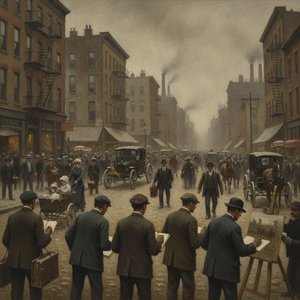
The Ashcan School: Capturing the Raw, Unfiltered Soul of Urban Life through American Realism
Discover the raw beauty of the Ashcan School. Explore how masters like Bellows and Henri captured the gritty, vibrant soul of early 20th-century New York through profound American Realism and evocative urban landscapes.
Explore artworks organized by themes, styles, and characteristics.


