

 Preview
 Send
Send Share
Share
 Details
 Guide
Guide

 Download
 Similars
 X-Ray
X-Ray Diaporama
 Q&A
Q&A Stats
Stats25 Cromwell Street

- 11.0 x 7.0 cm


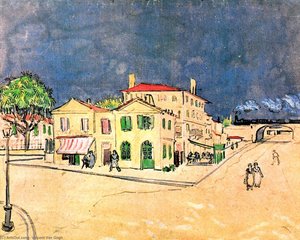
A vibrant oil on canvas painting of a yellow three-story house with green trim by Robert Priseman captures a unique architectural charm that invites you to bring this piece of contemporary British art into your collection.
 Read More
Robert Priseman (b.1965) is a British artist exploring dark socio-political themes like capital punishment & memory in provocative paintings. Featured in V&A, Royal Collection.
The artwork displayed on this page is protected by copyright law, which means we cannot legally create or sell an identical reproduction. This protection is enforced under international agreements such as the Berne Convention and by national laws, including those outlined by the U.S. Copyright Law - Title 17.
This method fully complies with copyright regulations because it does not involve copying or duplicating the protected artwork. Instead, it is a creative reinterpretation - a new painting that is influenced by the original but not identical to it.
Giclée / Art Print
Museum-quality giclée or canvas print with fast production and flexible finish options. ( Buy Hand Made Painting Switch to Digital Image)




P118B $10

P118H $10

P118W $10

P438Z $10

P508JH $12

P508YH $12

P805H $10

P805Z $10

P919BZ $10

P919G $10

P919XJ $10

P959ZH $10

P968JZ $12

W106C $8

W218G $10

W218JH $8

W218Y $10

W307PJ $10

W316G $10

W316PJ $8

W316Y $10

W398PJ $8

W4111J $10

W500HY $15

W500JH $15

W692G $12

W849H $8

W940BG $15

W953PJ $8




Standard
custom
CM
INCH
Pick from our preset sizes that match the artwork's original proportions.
Loading sizes...

width
height
Type the width and the height you need, to fit your frame or your wall. A print can only be cut, never made bigger than the picture, so a size with a different shape loses a part of the image. We send you a digital mockup to approve before we print anything. The picture shown on this page does not show the real cut — only the mockup does.
Worldwide Delivery () in 2 weeks instead of standard 4/5 weeks. (2 November)

Free Worldwide Express Shipping

High-Quality Linen Canvas

Full Shipping Insurance

Customs Tax Refund Guarantee

True Color Matching Guarantee

100-Day Return Policy (Defects Only)

100% Money-Back Guarantee

Bulk Discount Offer
 Glass option is only available in size under 110 CM

25 Cromwell Street
Giclée / Art Print
Reproduction Size
-


Total Price
$ 70
A Window into the Domestic Mundane: The Charm of 25 Cromwell Street
In the quiet, evocative oil painting 25 Cromwell Street, artist Robert Priseman invites us to pause and reconsider the beauty found within the most unassuming corners of our urban landscapes. At first glance, the work presents a modest three-story residence, rendered with a striking palette of sunny yellows and deep, verdant greens. Yet, beneath this simple depiction of a house with twin chimneys and symmetrical windows lies a profound meditation on domesticity and the architectural character of the British streetscape. The painting captures not just a structure, of stone and timber, but a sense of place—a specific, tangible moment in time frozen upon the canvas.
Priseman, an artist whose career is deeply rooted in the theoretical study of aesthetics, brings a sophisticated eye to this seemingly straightforward subject. The technique employed here is a masterful display of oil on canvas, where the texture of the paint lends a tactile dimension to the yellow facade of the house. There is a rhythmic quality to the way the green trim outlines the windows and edges, creating a visual harmony that guides the viewer's eye across the three stories. This careful application of color and form transforms a common street scene into a vibrant, almost glowing centerpiece, making it an ideal selection for those looking to inject warmth and character into a contemporary interior.
The emotional resonance of 25 Cromwell Street lies in its ability to evoke nostalgia and a sense of peaceful permanence. For the collector or interior designer, this piece serves as more than mere decoration; it is an anchor of tranquility. The interplay between the bright, optimistic yellow and the grounding green tones creates a psychological balance that can soothe a room, offering a focal point that feels both approachable and intellectually stimulating. It speaks to the beauty of the everyday, reminding us that even the most familiar structures possess a unique soul when viewed through the lens of a master's brush.
Whether placed in a sun-drenched living area or a sophisticated study, this reproduction of Priseman’s 2011 work offers an exquisite opportunity to celebrate architectural charm. It is a piece that invites conversation, prompting onlookers to wonder about the lives lived behind those two windows and the stories held within those walls. For anyone seeking to curate a collection defined by depth, color, and a love for the quiet wonders of the world, this painting stands as a testament to the enduring power of the domestic landscape.
Questions & Answers
What size and orientation are recommended for a print of "25 Cromwell Street" by Robert Priseman?
For "25 Cromwell Street", the recommended print setup is a small size and a tall orientation.
What size should I print "25 Cromwell Street" for my room?
The recommended pairing for "25 Cromwell Street" by Robert Priseman: a small print in a studio apartment.
Where should a reproduction of "25 Cromwell Street" by Robert Priseman be hung?
Format (tall) and recommended space (studio apartment) are the two placement facts recorded for "25 Cromwell Street" by Robert Priseman.
Related Artworks



Artist Biography
Robert Priseman: A Life in Provocative Art
Robert Priseman (born 1965) is a British artist, collector, writer, curator and publisher who lives and works in Essex, England. His career spans diverse artistic pursuits, marked by a consistent engagement with challenging socio-political themes and a dedication to fostering dialogue within the contemporary art landscape.
Early Life and Artistic Beginnings
Priseman’s academic foundation was laid at the University of Essex, where he studied Aesthetics and Art Theory under the influential Professor Michael Podro. This theoretical grounding profoundly shaped his artistic approach. He began his professional life as a book designer for Longman Publishers (1989-1992), concurrently developing his skills as a portrait painter in oils. During this period, he created portraits of notable figures including the Dalai Lama, Phil Collins, Jeremy Paxman and Cardinal Basil Hume. These early works are held in prestigious collections such as the Royal Collection at Windsor Castle and Corpus Christi College Cambridge.
A Shift Towards Thematic Exploration
In 2004, Priseman underwent a significant artistic shift, abandoning portraiture to embark on thematic series designed to provoke thought and engage viewers in critical discussions. This marked the beginning of his most recognized work, characterized by its unflinching exploration of difficult subjects.
Major Series and Artistic Themes
- The Hospital Paintings: Early explorations into institutional spaces and their psychological impact.
- Subterraneans: Investigations into hidden worlds and marginalized communities.
- The Francis Bacon Interiors: A deeply personal series depicting the Paris hotel room where George Dyer, Bacon’s lover, committed suicide, the hospital room where Bacon died, and his studios – a poignant exploration of grief, loss, and artistic creation.
- No Human Way to Kill: Perhaps Priseman's most impactful work, this series presents the five methods of execution used in the USA (hanging, firing squad, gassing, lethal injection, and electrocution), alongside etchings detailing other global practices. It argues that execution is a socially constructed act.
- The Troubles: A powerful reflection on the conflict in Northern Ireland.
- Nazi Gas Chambers: An unflinching confrontation with the horrors of the Holocaust.
Championing Contemporary British Painting
Priseman’s commitment extends beyond his own artistic practice. In 2013, he co-founded Contemporary British Painting with artist Simon Carter – a platform dedicated to promoting and contextualizing current painting practices in the UK through exhibitions, talks, publications, and an art prize. He also established ‘east contemporary art’ at University Campus Suffolk.
Collecting and Philanthropy
Priseman is an avid collector of British paintings, owning the “Priseman Seabrook Collection of 21st Century British Painting,” which debuted at Huddersfield Art Gallery in 2014. In 2013, he generously donated ‘The Robert Priseman Gift’ – a collection of twenty paintings by contemporary British artists – to Falmouth Art Gallery.
Academic and Professional Recognition
Priseman's contributions have been recognized through several academic appointments: Fellow at the Human Rights Centre, University of Essex (2010); Visiting Professor in Fine Art at the Department of Art and Humanities, University Campus Suffolk (2015); and a Visiting Research Fellow at the University of Leeds (2017).
Legacy and Historical Significance
With over 200 works held in major international collections – including the V&A;, Museum der Moderne Salzburg, Art Gallery of New South Wales, Musée de Louvain la Neuve, and the National Galleries of Scotland – Robert Priseman has established himself as a significant voice in contemporary British art. His willingness to confront difficult subjects, combined with his dedication to supporting other artists and fostering critical dialogue, ensures his lasting impact on the artistic landscape.

Robert Priseman
1965 -
Quick Facts
- Name: Robert Priseman
- Movement: Contemporary art
- Birth Date: 1965
- Nationality: British
- Date Of Birth: 1965
- Notable Works:
- No Human Way to Kill
- The Francis Bacon Interiors
- The Robert Priseman Gift
Related Articles

The Soul of Impressionism: Why Oil on Canvas Captures Eternal Light and Timeless Emotion
Discover the enchanting alchemy of Impressionism. Explore how the mastery of oil on canvas, through glazing and impasto, captures eternal light and emotion. Perfect for lovers of Monet and Van Gogh seeking the profound depth of hand-painted fine art.
Explore artworks organized by themes, styles, and characteristics.


