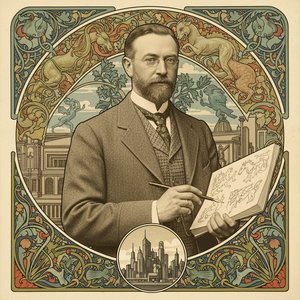
Artist Biography
The Tempestuous Vision of J.M.W. Turner
Joseph Mallord William Turner, a name synonymous with Romanticism and the dawn of modern art, was more than just a painter; he was a visionary who wrestled with light, color, and emotion in ways unprecedented for his time. Born in 1775 amidst the bustling streets of Covent Garden, London, to a modest family, Turner’s early life offered little indication of the revolutionary artist he would become. Despite retaining a distinctly lower-class accent throughout his career – a conscious choice designed to avoid the trappings of success – he possessed an extraordinary artistic talent that quickly manifested itself. His formal training at the Royal Academy of Arts began at just fourteen, and by fifteen, he was exhibiting his work, marking the beginning of a prolific and often turbulent journey.
Turner’s artistic development wasn't linear; it was a dynamic evolution shaped by observation, experimentation, and an increasingly intense engagement with the natural world. Initially influenced by the meticulous landscapes of Dutch masters like Willem van der Velde and the idealized scenes of Richard Wilson, he quickly moved beyond mere imitation. He spent much of his early career meticulously documenting English topography through watercolor sketches – a practice that would prove crucial to his later work. These detailed studies, filled with precise observations of light, shadow, and form, formed the foundation for his increasingly expressive style. Crucially, Turner’s artistic journey was not confined to England; he embarked on extensive travels throughout Europe, absorbing the influences of Italianate landscapes and the dramatic lighting of the Rhineland, all meticulously recorded in his voluminous sketchbooks.
The Language of Light and Color
Turner's genius lay not simply in depicting scenes but in conveying their *feeling*. He abandoned traditional academic techniques, prioritizing atmosphere and subjective experience over precise representation. His palette became increasingly vibrant and unconventional, utilizing layers of translucent color to create luminous effects that seemed to shimmer and vibrate with energy. This approach was particularly evident in his seascapes – works like “The Fighting Temeraire” (1839) and "Rain, Steam and Speed—The Great Western Railway" (1844) – where he captured the raw power of nature with a dramatic intensity rarely seen before. These paintings weren’t merely representations of ships or trains; they were explorations of light, movement, and emotion, rendered in a style that foreshadowed Impressionism and Abstract Art. Turner's use of color wasn't descriptive but evocative, designed to stimulate the viewer’s senses and transport them into the heart of his vision.
A Revolutionary Approach to Landscape
Turner’s influence extended beyond mere stylistic innovation; he fundamentally altered the perception of landscape painting. Prior to him, landscape was often treated as a secondary element in historical or narrative paintings. Turner elevated it to the central focus, demonstrating its capacity for profound emotional and spiritual resonance. He moved away from the static, idealized landscapes favored by earlier generations, embracing instead the dynamic forces of nature – storms, sunsets, and the ever-changing light of day. His work challenged conventional notions of beauty, revealing a world of raw power, sublime terror, and fleeting moments of exquisite wonder. His willingness to experiment with new techniques, such as mezzotint and etching, further expanded his artistic vocabulary and cemented his reputation as a true innovator.
Controversy and Legacy
Despite his growing fame, Turner remained a controversial figure throughout his life. His unconventional methods, reclusive nature, and often turbulent personality earned him both admiration and criticism. He was frequently accused of sacrificing technical accuracy for expressive effect, and his paintings were sometimes dismissed as chaotic or incomprehensible. However, these criticisms ultimately proved to be shortsighted. In the decades following his death in 1851, Turner’s work gained increasing recognition and appreciation, culminating in its current status as one of the most important and influential bodies of art in Western history. His legacy lies not only in his groundbreaking techniques but also in his profound understanding of light, color, and the human experience—a testament to a truly visionary artist who dared to paint the world as he saw it: tempestuous, beautiful, and eternally changing. His paintings continue to captivate audiences with their emotional intensity and breathtaking beauty, solidifying Turner’s place as a giant in the history of art.



 Preview
 Buy Painting
 Send
Send Share
Share
 Details

 Download
 Similars
 X-Ray
X-Ray Diaporama
 Read More






































 Glass option is only available in size under 110 CM