


 Preview
 Send
Send Share
Share
 Details
 Guide
Guide

 Download
 Similars
 X-Ray
X-Ray Diaporama
 Stats
StatsSonata for piano and violoncello (A major) op. 69, 1st movement
 Painting
- WallArt
- Romanticism
 1808
1808- 19th Century
 23.0 x 31.0 cm
 Beethoven-Haus Bonn
Sonata for piano and violoncello (A major) op. 69, 1st movement
 Read More
Explore the life & music of Ludwig van Beethoven (1770-1827), a pivotal composer transitioning from Classical to Romantic eras. Discover iconic symphonies like No. 9, Moonlight Sonata, and his enduring legacy despite deafness. #Beethoven #ClassicalMu
Hand Made Oil Reproduction
Hand-painted oil on canvas in your size and frame, made to order by our artists. ( Switch to Print Switch to Digital Image)




P118B $10

P118H $10

P118W $10

P438Z $10

P508JH $12

P508YH $12

P805H $10

P805Z $10

P919BZ $10

P919G $10

P919XJ $10

P959ZH $10

P968JZ $12

W106C $8

W218G $10

W218JH $8

W218Y $10

W307PJ $10

W316G $10

W316PJ $8

W316Y $10

W398PJ $8

W4111J $10

W500HY $15

W500JH $15

W692G $12

W849H $8

W940BG $15

W953PJ $8




Standard
custom
CM
INCH
Pick from our preset sizes that match the artwork's original proportions.
Loading sizes...

width
height
You may enter your own dimensions to fit a specific frame or space. If your selected size does not match the original image's proportions, we will either crop the artwork or extend the painting with additional hand-painted elements. A digital mockup will be sent for your approval before production begins.
Please note that the on-screen preview does not reflect the actual cropping or extension. Only the mockup will accurately show the final composition.
While custom sizes are available, we recommend selecting a dimension from the predefined list to preserve the original proportions.
Examples of what can be changed: Replace face with customer photo; Add pet (e.g., replace cat with dog); Include hidden message in background; Change background landscape or elements.
After order, TopImpressionists.com team will email client for instructions and provide a mockup preview
After order, TopImpressionists.com team will email client for instructions and provide a mockup preview
Worldwide Delivery () in 3/4 weeks instead of standard 5 weeks. (25 September). No compromise on quality.

Free Worldwide Express Shipping

High-Quality Linen Canvas

Full Shipping Insurance

Customs Tax Refund Guarantee

True Color Matching Guarantee

100-Day Return Policy (Defects Only)

100% Money-Back Guarantee

Bulk Discount Offer
 Glass option is only available in size under 110 CM

Sonata for piano and violoncello (A major) op. 69, 1st movement
Reproduction Medium
Reproduction Size
-


Total Price
$ 269
A Symphony of Light and Shadow
In the heart of 1808 Vienna, a city vibrating with artistic tension and intellectual fervor, this evocative painting captures more than just a musical moment; it captures the very essence of Ludwig van Beethoven’s spirit. As the composer navigated the encroaching silence of his deafness, his music—and this visual tribute to his Sonata for Piano and Violoncello in A major—became a vital bridge between the structured elegance of the Classical era and the raw, unbridled emotion of Romanticism. The scene is one of profound intimacy, where the bustling salons of Vienna fade into the background, leaving only the composer, his instruments, and a quiet, contemplative window that hints at a deep-seated connection to the natural world. It is a portrait not merely of a man, but of a transition in human expression.
The Artistry of Introspection
The artist employs a masterful use of chiaroscuro, allowing light to dance across the piano keys and the polished wood of the violoncello, creating a dramatic interplay that mirrors Beethoven’s own musical dynamics. Through a muted palette of rich browns and soft creams, the composition avoids the grand spectacle of heroic historical canvases in favor of intense psychological depth. There is a palpable sense of movement held within stillness; the meticulous rendering of the pianist’s hands poised over the keys and the flowing lines of the cello bow suggest the breathless anticipation of a note about to be struck. This technique does not merely represent a performance but invites the viewer into the composer's inner sanctum, where every shadow tells a story of struggle, and every highlight reflects a moment of musical brilliance.
An Enduring Presence for the Discerning Collector
For the interior designer or the passionate art collector, this piece serves as a sophisticated focal point that brings a sense of historical gravity and intellectual depth to any environment. It is far more than a decorative element; it is an invitation to reflection. Whether placed in a private study, a grand library, or a contemporary living space, the painting’s ability to evoke quiet introspection makes it a timeless addition. The work stands as a testament to the power of art to transcend time, offering a window into a period of monumental human achievement and providing a touch of classical elegance that resonates with the modern aesthetic. To possess such a reproduction is to hold a piece of musical history, bringing the transformative energy of Beethoven's soul into the modern home.
Artist Biography
early life and musical beginnings
ludwig van beethoven, a renowned german composer and pianist, was born in bonn, germany, in 1770. displaying his musical talent at a young age, he began studying music under various teachers before moving to vienna, where he would spend most of his life.- sonata for piano and violoncello (a major) op. 69, 1st movement (available at TopImpressionists.com)
- beethoven's manuscript of the missa solemnis (viewable at wikipedia)
- three opus 1 piano sonatas, patronized by karl alois, prince lichnowsky

ludwig van beethoven
1770 - 1827 , Germany
Quick Facts
- Artistic Movement Or Style: Classical Romantic
- Artists Or Movements Influenced By This Artist:
- Johannes Brahms
- Robert Schumann
- Artists Who Influenced This Artist:
- Franz Joseph Haydn
- Christian Gottlob Schulze
- Date Of Birth: 1770 Bonn Germany
- Date Of Death: 1827 Vienna Austria
- Full Name: Ludwig van Beethoven
- Nationality: German
- Notable Artworks:
- Moonlight Sonata
- Symphony No 9
- Place Of Birth: Bonn Germany
Related Articles

Timeless Resonance: Exploring Classic Vibe in Art – A Historical & Aesthetic Analysis
Explore the rich history & enduring aesthetic of Classicism art! Discover key movements, iconic artists like Raphael & David, and its lasting influence on Western art. Deepen your appreciation today.
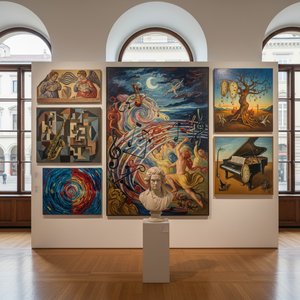
Harmonies on Canvas: Exploring the Visual Representation of Music in Art History
Explore the fascinating history of music's visual representation in art! From ancient symbolism to modern abstraction, discover how artists have captured sound and emotion on canvas. Expert insights & stunning examples.

The Enduring Legacy of Classical Style: Form, Narrative & Influence in Art
Explore the enduring legacy of classical art – from ancient Greece & Rome to Neoclassicism. Discover key artists, philosophical roots & build a timeless collection with TopImpressionists's expert guidance.

Neo-Classicism's Greatest Hits: 10 Masterpieces for Your Home |
Journey through Neo-Classicism's finest! Explore 10 iconic masterpieces by David, Ingres & Canova. Discover art history, techniques & timeless beauty – perfect for inspiring your home decor. Find museum-quality reproductions at

The Enduring Legacy of Classicism: Principles, Evolution & Influence in Western Art
Explore the enduring legacy of Classicism in Western art! Discover its historical context, key principles, iconic masterpieces & lasting influence. Learn about Renaissance and Neoclassical movements with TopImpressionists.
Explore artworks organized by themes, styles, and characteristics.


