


 Preview
 Send
Send Share
Share
 Details
 Guide
Guide

 Download
 Similars
 X-Ray
X-Ray Diaporama
 Stats
StatsDurack Ranges
 Oil On Board
- Expressionism
 1950
1950 91.0 x 122.0 cm
 National Gallery of Victoria
Experience the dramatic Expressionism of Nolan's Durack Ranges (1950), a mythic Australian Outback vista rendered in vibrant oil on board; discover this iconic piece today.
 Read More
Discover Sir Sidney Nolan (1917-1992), Australia's modernist master! Explore iconic Ned Kelly paintings, vibrant landscapes & his unique vision of Australian history. View works at TopImpressionists.
The artwork displayed on this page is protected by copyright law, which means we cannot legally create or sell an identical reproduction. This protection is enforced under international agreements such as the Berne Convention and by national laws, including those outlined by the U.S. Copyright Law - Title 17.
As a respectful and legal alternative, we offer custom, hand-painted artworks inspired by the original. Our skilled and professional artists carefully study the original's style, mood, and artistic essence to create a new, unique piece that evokes the same feeling - while remaining an original creation in its own right.
This method fully complies with copyright regulations because it does not involve copying or duplicating the protected artwork. Instead, it is a creative reinterpretation - a new painting that is influenced by the original but not identical to it.
Hand Made Oil Reproduction
Hand-painted oil on canvas in your size and frame, made to order by our artists. ( Switch to Print Switch to Digital Image)




P118B $10

P118H $10

P118W $10

P438Z $10

P508JH $12

P508YH $12

P805H $10

P805Z $10

P919BZ $10

P919G $10

P919XJ $10

P959ZH $10

P968JZ $12

W106C $8

W218G $10

W218JH $8

W218Y $10

W307PJ $10

W316G $10

W316PJ $8

W316Y $10

W398PJ $8

W4111J $10

W500HY $15

W500JH $15

W692G $12

W849H $8

W940BG $15

W953PJ $8




Standard
custom
CM
INCH
Pick from our preset sizes that match the artwork's original proportions.
Loading sizes...

width
height
You may enter your own dimensions to fit a specific frame or space. If your selected size does not match the original image's proportions, we will either crop the artwork or extend the painting with additional hand-painted elements. A digital mockup will be sent for your approval before production begins.
Please note that the on-screen preview does not reflect the actual cropping or extension. Only the mockup will accurately show the final composition.
While custom sizes are available, we recommend selecting a dimension from the predefined list to preserve the original proportions.
Examples of what can be changed: Replace face with customer photo; Add pet (e.g., replace cat with dog); Include hidden message in background; Change background landscape or elements.
After order, TopImpressionists.com team will email client for instructions and provide a mockup preview
After order, TopImpressionists.com team will email client for instructions and provide a mockup preview
Worldwide Delivery () in 3/4 weeks instead of standard 5 weeks. (12 October). No compromise on quality.

Free Worldwide Express Shipping

High-Quality Linen Canvas

Full Shipping Insurance

Customs Tax Refund Guarantee

True Color Matching Guarantee

100-Day Return Policy (Defects Only)

100% Money-Back Guarantee

Bulk Discount Offer
 Glass option is only available in size under 110 CM

Durack Ranges
Reproduction Medium
Reproduction Size
-


Total Price
$ 269
Durack Ranges - A Landscape of Myth and Memory
The painting “Durack Ranges” by Sir Sidney Robert Nolan is more than just a depiction of the Australian Outback; it’s an embodiment of Nolan's profound engagement with Aboriginal mythology and his exploration of Australia’s scarred landscape as a reflection of its history. Created in 1950, during Nolan’s formative years as a painter, this monumental canvas exemplifies his signature style—a bold simplification of form combined with vibrant color palettes that convey both grandeur and unease. It stands as one of the most iconic pieces from Nolan's Desert & Drought series, cementing his place among Australia’s foremost modernist artists.- Subject Matter: The painting captures a panoramic vista of the Durack Ranges in Western Australia—a region steeped in Aboriginal lore and considered sacred by Indigenous Australians. Nolan meticulously renders the rugged terrain, punctuated by mesas and canyons bathed in hues of ochre, crimson, and indigo.
- Style: Nolan’s approach aligns closely with Expressionism, prioritizing emotional impact over precise representation. The flattened perspective and stylized brushstrokes contribute to a sense of immediacy and drama, mirroring the vastness and power of the natural environment.
- Technique: Employing oil on board, Nolan achieved remarkable textural depth through layering multiple coats of paint—a technique that allows for subtle gradations of color and creates an illusion of movement within the static image. The artist’s deliberate use of impasto adds physicality to the canvas, conveying a palpable sense of energy.
Historical Context: Echoes of Trauma and Resilience Nolan's Desert & Drought series emerged from a period of intense debate surrounding Aboriginal land rights in Australia during the 1950s. Inspired by films depicting the Australian interior—particularly those exploring themes of displacement and hardship—Nolan sought to confront the injustices faced by Indigenous communities while simultaneously celebrating the enduring spirit of the Australian landscape. The Durack Ranges painting specifically references the biblical Exodus narrative, symbolizing the Israelites’ journey from oppression to liberation—a motif that resonates deeply with Australia's colonial past and its ongoing struggle for reconciliation.
Symbolism: Color as Emotion The dominant color scheme—primarily reds and ochres—is deliberately chosen to evoke feelings of heat, dryness, and primal energy. Nolan’s masterful use of color transcends mere visual description; it communicates the emotional resonance of the landscape—a testament to its harsh beauty and enduring significance. The reddish hues subtly hint at the blood of ancient battles fought on Aboriginal land, underscoring the painting's connection to Australia’s history of conflict and dispossession.
Emotional Impact: A Vision of Australian Identity “Durack Ranges” transcends a simple topographical representation; it functions as a powerful visual meditation on themes of isolation, resilience, and spiritual contemplation. Nolan invites viewers to contemplate the immensity of the Outback—to confront its challenges while simultaneously appreciating its sublime grandeur. The painting’s enduring appeal lies in its ability to capture the essence of Australian identity—a complex tapestry woven from myth, landscape, and the legacy of colonization. It remains a cornerstone of Nolan's oeuvre and an unforgettable emblem of Australian art history.
Questions & Answers
Where can I see a preview of "Durack Ranges"?
A preview of "Durack Ranges" by Sir Sidney Robert Nolan is available on the artwork's Preview page.
When was "Durack Ranges" made?
The creation of "Durack Ranges" by Sir Sidney Robert Nolan is dated 1950.
What kind of piece is "Durack Ranges"?
"Durack Ranges" by Sir Sidney Robert Nolan is classified as wall art. The category describes the kind of artwork the original is.
What stage of Sir Sidney Robert Nolan's career does "Durack Ranges" (1950) belong to?
The 1950 date places "Durack Ranges" in the Formative Years of Sir Sidney Robert Nolan's development.
Where and for what purpose is "Durack Ranges" recommended?
"Durack Ranges" by Sir Sidney Robert Nolan is recommended for accent, ideally in a living room. Use and space together guide where a reproduction fits.
Is "Durack Ranges" by Sir Sidney Robert Nolan in the public domain?
The copyright answer for "Durack Ranges" by Sir Sidney Robert Nolan: the work is still protected by copyright. This determines whether reproductions of the image may be freely made.
What color intensity does "Durack Ranges" by Sir Sidney Robert Nolan have?
"Durack Ranges" by Sir Sidney Robert Nolan shows a balanced color intensity.
Is "Durack Ranges" by Sir Sidney Robert Nolan a portrait, landscape or square composition?
"Durack Ranges" by Sir Sidney Robert Nolan has a landscape format. The format describes the proportions of the composition.
Artist Biography
A Life Painted in Myth and Landscape
Sir Sidney Robert Nolan, born in Melbourne in 1917, stands as a monumental figure in 20th-century Australian art. His journey was not one of conventional artistic training but rather an explosive emergence from the working-class streets of St Kilda into a world of vibrant imagination and relentless experimentation. Nolan wasn’t simply a painter; he was a visual storyteller, a mythmaker who wrestled with Australia's history, its landscapes, and its very identity. From his early days as a runner for an illegal betting ring to his eventual acclaim on the international stage, Nolan’s life was marked by a restless energy and a refusal to be confined by artistic norms. He absorbed influences from diverse sources – the poetry of Rimbaud, the spatial innovations of Cézanne, the raw emotion of Danila Vassilieff – yet forged a style uniquely his own, one that resonated with a distinctly Australian sensibility. His early exposure to the harsh realities of Melbourne life and the allure of its underbelly would profoundly shape his artistic vision, imbuing his work with a sense of both defiance and vulnerability.The Shaping of an Iconoclast
Nolan’s formative years were steeped in intellectual ferment. The Heide Circle, centered around patrons John and Sunday Reed, proved pivotal. This haven for artists and writers fostered a spirit of radical experimentation and provided Nolan with crucial support during his developing phase. It was at Heide that he encountered kindred spirits – Albert Tucker, Joy Hester, Arthur Boyd – all grappling with the challenge of creating a distinctly Australian modernism. The influence of modernist literature, particularly the Symbolist poets, cannot be overstated. Rimbaud’s call for a “systematic derangement of the senses” became a guiding principle for Nolan, liberating him from representational constraints and encouraging him to explore the emotional power of color, form, and symbolism. His early works demonstrate this influence, often featuring fragmented figures and dreamlike landscapes that hint at deeper psychological truths. He wasn’t interested in merely depicting reality; he sought to capture its essence, its underlying emotions, and its hidden narratives. This period also saw Nolan experimenting with various media, from stage design for the Ballet Russes to commercial art, each experience contributing to his growing technical prowess and artistic vocabulary.Ned Kelly and the Australian Myth
While Nolan’s oeuvre is remarkably diverse, he is perhaps best known for his series of paintings depicting Ned Kelly, the infamous Australian bushranger. This wasn't simply a historical retelling; it was a profound exploration of Australian identity, lawlessness, and the romanticized figure of the outlaw. Nolan stripped away the conventional heroic imagery associated with Kelly, presenting him as an enigmatic, almost spectral presence encased in iconic armor. The flattened planes of color, the stark contrasts, and the simplified forms create a powerful visual statement that transcends mere representation. The Ned Kelly series became a defining moment in Australian art, transforming the bushranger from a historical figure into a national symbol. It sparked debate, challenged conventional narratives, and forced Australians to confront their complex relationship with their past. Beyond Kelly, Nolan repeatedly returned to themes drawn from Australian history and folklore – The First Fleet, The Burke and Wills Expedition – each series imbued with his signature blend of poetic intensity and historical awareness.A Prolific and Restless Vision
Nolan’s artistic output was astonishingly prolific, spanning painting, sculpture, ceramics, stage design, and even opera sets. He refused to be pigeonholed, constantly reinventing his style and exploring new avenues of expression. His landscapes, often stark and desolate, capture the vastness and harsh beauty of the Australian outback. Works like “Antarctica” demonstrate his ability to convey a sense of isolation and existential unease through minimalist forms and evocative color palettes. He traveled extensively throughout his life – Europe, Africa, America – each journey informing his art with new perspectives and influences. His later works often reflect a more introspective mood, grappling with themes of mortality, memory, and the search for meaning. Despite achieving international recognition, Nolan remained deeply connected to Australia, viewing his art as a means of understanding and interpreting its unique character. He received numerous accolades throughout his career, including appointments as an Officer of the Order of Merit (OM), a Companion of the Order of Australia (AC), and a Commander of the Order of the British Empire (CBE).Legacy and Enduring Influence
Sir Sidney Nolan’s impact on Australian art is undeniable. He challenged conventional artistic norms, embraced experimentation, and created a body of work that continues to resonate with audiences today. His bold depictions of Ned Kelly have become iconic images, instantly recognizable as symbols of Australia's rebellious spirit and complex history. His influence can be seen in the work of countless contemporary artists, who continue to draw inspiration from his innovative techniques and his commitment to exploring Australian identity. Nolan’s paintings are held in major museums and collections around the world, ensuring that his legacy will endure for generations to come. To explore more of his artwork, platforms like TopImpressionists offer a wide range of reproductions, allowing art lovers to experience the power and beauty of his vision firsthand. He left behind not just a collection of paintings but a new way of seeing Australia – a land of myth, mystery, and enduring artistic potential.
Sir Sidney Robert Nolan
1917 - 1992 , Australia
Quick Facts
- Full Name: Sir Sidney Robert Nolan
- Nationality: Australian
- Date Of Birth: 1917
- Date Of Death: 1992
- Place Of Birth: Melbourne, Australia
- Notable Artworks:
- Ned Kelly series
- Carriers of Horses
- AFL Series
- Landscape w/ motif
- Artistic Movement Or Style: Modernist
- Artists Who Influenced This Artist:
- Rimbaud
- Cézanne
- Kandinsky
- Klee
Related Articles
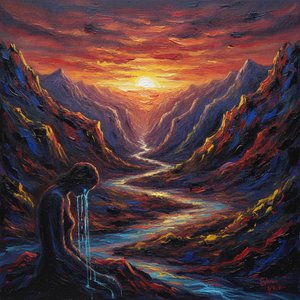
Capturing Emotion: A Journey Through the Soul of Expressionist Landscapes
Explore the profound emotional depth of Expressionist landscapes. Discover how Post-Impressionist masters moved beyond light to capture the soul through vibrant color and form. A curated journey for true art lovers seeking the beauty of expressive mastery.
Explore artworks organized by themes, styles, and characteristics.


