Preview
 Send
Send Share
Share
 Details
 Guide
Guide

 Download
 Similars
 X-Ray
X-Ray Diaporama
 Q&A
Q&A Stats
StatsHay Time

- 51.0 x 71.0 cm


sir william george gillies
Sir William George Gillies: A Life in Scottish Art
Early Life and Education
Born: Haddington, East Lothian, United Kingdom, 1898.
Gillies initially enrolled at the Edinburgh College of Art but his studies were interrupted by service in World War I with the Royal Engineers.
Following the war, he returned to complete his education at the Edinburgh College of Art, graduati
 Read More
Explore W.G. Gillies' Scottish landscapes & still lifes. Discover his Cubist influences, 1922 Group ties, Edinburgh College of Art legacy & profound impact on 20th-century art.
The artwork displayed on this page is protected by copyright law, which means we cannot legally create or sell an identical reproduction. This protection is enforced under international agreements such as the Berne Convention and by national laws, including those outlined by the U.S. Copyright Law - Title 17.
This method fully complies with copyright regulations because it does not involve copying or duplicating the protected artwork. Instead, it is a creative reinterpretation - a new painting that is influenced by the original but not identical to it.
Giclée / Art Print
Museum-quality giclée or canvas print with fast production and flexible finish options. ( Buy Hand Made Painting Switch to Digital Image)




P118B $10

P118H $10

P118W $10

P438Z $10

P508JH $12

P508YH $12

P805H $10

P805Z $10

P919BZ $10

P919G $10

P919XJ $10

P959ZH $10

P968JZ $12

W106C $8

W218G $10

W218JH $8

W218Y $10

W307PJ $10

W316G $10

W316PJ $8

W316Y $10

W398PJ $8

W4111J $10

W500HY $15

W500JH $15

W692G $12

W849H $8

W940BG $15

W953PJ $8




Standard
custom
CM
INCH
Pick from our preset sizes that match the artwork's original proportions.
Loading sizes...

width
height
Type the width and the height you need, to fit your frame or your wall. A print can only be cut, never made bigger than the picture, so a size with a different shape loses a part of the image. We send you a digital mockup to approve before we print anything. The picture shown on this page does not show the real cut — only the mockup does.
Worldwide Delivery () in 2 weeks instead of standard 4/5 weeks. (7 November)

Free Worldwide Express Shipping

High-Quality Linen Canvas

Full Shipping Insurance

Customs Tax Refund Guarantee

True Color Matching Guarantee

100-Day Return Policy (Defects Only)

100% Money-Back Guarantee

Bulk Discount Offer
 Glass option is only available in size under 110 CM

Hay Time
Giclée / Art Print
Reproduction Size
-


Total Price
$ 70
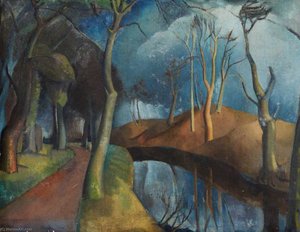
A Vision of Rural Tranquility: Exploring William George Gillies’ “Hay Time”
“Hay Time,” painted in 1952 by Sir William George Gillies, stands as a testament to the enduring beauty of Scottish landscape painting and embodies the spirit of Surrealist influences subtly interwoven with Impressionistic sensibilities. More than just a depiction of a pastoral scene—rolling hills dotted with trees and scattered dwellings—the artwork speaks volumes about Gillies’ artistic evolution and his engagement with groundbreaking movements shaping European art in the mid-20th century.
The Influence of Cubism and Cézanne
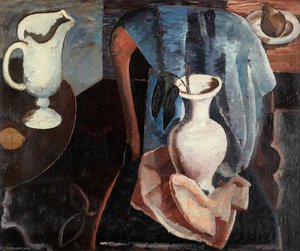
Gillies' initial foray into modern art began with a profound appreciation for Cubism, fostered during his studies under André Lhote in Paris. This exposure instilled in him a geometric approach to representation, evident in early works like “Two Pots, Saucer and Fruit” (1933). However, Gillies didn’t simply adopt Cubist principles; he skillfully blended them with the foundational techniques of Cézanne—particularly his use of flattened planes and simplified forms—resulting in compositions that retain a palpable sense of organic structure. The muted color palette, reminiscent of Picasso's understated explorations, underscores this careful balance between abstraction and observation.
A Meeting Point with Paul Klee’s Imagination
A transformative encounter with the art of Paul Klee in 1934 irrevocably altered Gillies’ artistic trajectory. Klee’s whimsical use of color and his embrace of childlike spontaneity profoundly impacted Gillies, prompting him to infuse his paintings with a similar imaginative quality. This shift is particularly noticeable in “Hay Time,” where Gillies employs vibrant hues—particularly yellows and greens—to convey not merely visual accuracy but also an emotional resonance. The artist’s deliberate distortions of perspective and form contribute to the painting's dreamlike atmosphere, mirroring Klee’s exploration of subconscious imagery.
Historical Context: Scotland During Wartime
“Hay Time” was created during a period of significant upheaval in Britain—the Second World War. The anxieties and uncertainties of the era undoubtedly informed Gillies’ artistic vision, encouraging him to capture moments of serene beauty amidst turbulent times. The painting's tranquil depiction of the Scottish countryside serves as an antidote to the pervasive fear and disruption of the war years, offering viewers a respite from conflict and inviting contemplation on themes of resilience and harmony.
Symbolism and Emotional Impact
Beyond its formal considerations—the geometric interplay of Cézanne’s influence and the chromatic vibrancy inspired by Klee— “Hay Time” resonates with deeper symbolic meanings. The haystacks themselves represent fertility and abundance, anchoring the scene in the rhythms of rural life. Simultaneously, the muted tones of the landscape convey a sense of melancholy and introspection, reflecting Gillies' own contemplative spirit as an artist and humanist. Ultimately, the painting evokes feelings of peace, nostalgia, and appreciation for the natural world—a timeless message conveyed with remarkable subtlety and grace.
- Size: 51 x 71 cm
- Date: 1952
Questions & Answers
How can "Hay Time" by Sir William George Gillies be used in home decor?
"Hay Time" by Sir William George Gillies is recommended for accent, ideally in a living room. Use and space together guide where a reproduction fits.
Can I see "Hay Time" by Sir William George Gillies on my own wall before buying?
"Hay Time" has an augmented reality preview: the artwork's AR Preview page shows it in your own space on a compatible device.
Is "Hay Time" one of Sir William George Gillies's most popular works?
The popularity level recorded for "Hay Time" by Sir William George Gillies is recognized.
Related Artworks


Artist Biography
Sir William George Gillies: A Life in Scottish Art
Early Life and Education
- Born: Haddington, East Lothian, United Kingdom, 1898.
- Gillies initially enrolled at the Edinburgh College of Art but his studies were interrupted by service in World War I with the Royal Engineers.
- Following the war, he returned to complete his education at the Edinburgh College of Art, graduating and subsequently becoming a dedicated teacher there for over 40 years.
Artistic Development and Influences
- Gillies’ artistic journey began with an exploration of Cubism after studying under André Lhote in Paris (1923) and traveling to Italy (1924).
- Early works, like “Two Pots, Saucer and Fruit” (1933), demonstrate this influence, showing a Cézanne-inspired arrangement with Braque and Picasso’s understated color palettes.
- A pivotal moment came in 1934 when he encountered the work of Paul Klee, inspiring him to adopt a more imaginative use of colour and childlike qualities in his compositions.
- He gradually moved away from strict Cubism, developing a distinctive style rooted in Scottish landscape and still life traditions.
The 1922 Group and Collaborative Spirit
- In 1922, Gillies co-founded the “1922 Group” alongside fellow artists including William Crozier, William Geissler, and William MacTaggart.
- This exhibition society provided a platform for emerging Scottish artists to showcase their work at the New Gallery in Edinburgh for a decade.
- The group fostered a sense of community and innovation within the Scottish art scene.
Themes and Subject Matter
- Landscapes: Gillies is renowned for his depictions of the Lothian, Fife, and Border regions of Scotland. He captured the essence of these landscapes with a sensitive eye.
- Still Lifes: Still life compositions were another significant focus, often featuring ceramics created by his younger sister, Emma Smith Gillies, whose premature death in 1936 deeply affected him.
- Portraiture: While he experimented with portraiture early in his career, landscapes and still lifes became his primary subjects.
Major Achievements and Recognition
- Gillies served as Principal of the Edinburgh College of Art from 1959 until his retirement in 1966.
- His prolific output and dedication to teaching had a profound influence on generations of Scottish painters.
- He was elected a Royal Academician (RA), signifying significant recognition within the art world.
Historical Significance and Legacy
- Sir William George Gillies is considered one of Scotland’s most important 20th-century painters.
- His work bridges the gap between early modernism and a distinctly Scottish artistic identity.
- Legacy: His influence extends beyond his paintings, shaping the direction of Scottish art through his teaching and mentorship.
- He died in 1973, leaving behind a rich body of work that continues to be celebrated for its beauty, sensitivity, and enduring relevance.

Sir William George Gillies
1898 - 1973 , United Kingdom
Quick Facts
- Name: Sir William George Gillies
- Movement:
- Cubism
- Scottish Colourists
- Birth Date: 1898
- Death Date: 1973
- Birth Place: Haddington, United Kingdom
- Nationality: Scottish
- Date Of Birth: 1898
- Date Of Death: 1973
- Influenced By:
- André Lhote
- Cézanne
- Braque
- Picasso
- Paul Klee
- Notable Works:
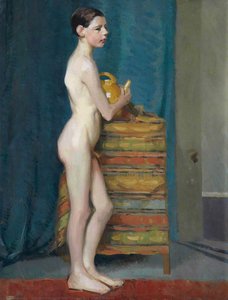
- Young Boy with a Teapot
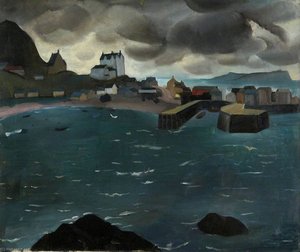
- Mediterranean Landscape with Overcast Sky
- Still Life – Yellow Jug and Striped Cloth
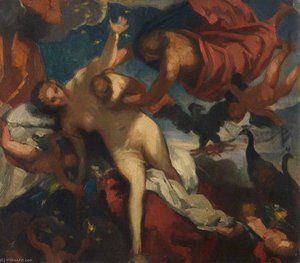
- The Origin of the Milky Way (after Jacopo Tintoretto)
- Place Of Birth: Haddington, United Kingdom
Related Articles

Fragmented Beauty: Exploring the Soul and Geometric Depth of Cubist Landscapes
Embark on a cultural journey through the soul of Cubist landscapes. Discover how masters like Braque and Rivera redefined nature through geometric beauty, fragmented forms, and profound abstraction in this expert art-history exploration.
Explore artworks organized by themes, styles, and characteristics.