

Shown: · With its frame:
 Preview
 Send
Send Share
Share
 Details
 Guide
Guide

 Download
 Similars
 X-Ray
X-Ray Diaporama
 Q&A
Q&A Stats
Stats


$ 269
Hand Made Oil Reproduction
Hand-painted oil on canvas in your size and frame, made to order by our artists. ( Switch to Print Switch to Digital Image)
Size
·Standard
custom
CM
INCH
Pick from our preset sizes that match the artwork's original proportions.
Loading sizes...

width
height
Type the width and the height you need, to fit your frame or your wall. This is hand-painted, so for a size with a different shape the artist can paint a bit more around the picture, or cut a bit — you choose. We send you a digital mockup to approve before the painting starts. The picture shown on this page does not show the real result — only the mockup does.
 Read more
Finish
·
White $1

Blurside $1

Extended $1

P118B $10

P118H $10

P118W $10

P438Z $10

P508JH $12

P508YH $12

P805H $10

P805Z $10

P919BZ $10

P919G $10

P919XJ $10

P959ZH $10

P968JZ $12

W106C $8

W218G $10

W218JH $8

W218Y $10

W307PJ $10

W316G $10

W316PJ $8

W316Y $10

W398PJ $8

W4111J $10

W500HY $15

W500JH $15

W692G $12

W849H $8

W940BG $15

W953PJ $8

H24-GOLD $30

H24-SILVER $30

H36-GOLD $45

H36-SILVER $45
Shipped in a protective tube, ready for your own framer.
Above 105 cm the frame is shipped as a kit for a professional framer — read the details.
Extras
optionalWhat do the extras include?
Examples of what can be changed: Replace face with customer photo; Add pet (e.g., replace cat with dog); Include hidden message in background; Change background landscape or elements.
After order, TopImpressionists.com team will email client for instructions and provide a mockup preview
After order, TopImpressionists.com team will email client for instructions and provide a mockup preview
Worldwide Delivery () in 3/4 weeks instead of standard 5 weeks. (29 October). No compromise on quality.
Protective Varnish
Nameplate
Engraved Bronze Plaque Details
This elegant plaque features the artist's name and the title of the artwork, finely engraved for a timeless presentation.
It is made from bronze with a refined, elegant finish. The text is precisely laser-engraved for a sharp and permanent result. Measuring 9x2 cm, the plaque is compact yet easy to read. It's built to be durable and scratch-resistant, offering a professional, museum-quality look. Mounting is simple thanks to the included adhesive backing.
Transparent Acrylic Plaque Details
The plaque includes essential engraved details such as the artist's name, the title of the artwork, the date it was created, the type of media used-like oil on canvas or watercolor-a brief description of the piece, and a QR code that links to the complete artwork information.
It is crafted from clear acrylic, offering a sleek, modern appearance. The text is UV-engraved in black to ensure strong visual contrast. With a size of 10x15 cm, it ensures optimal readability. It comes equipped with two metal hooks for secure wall mounting. The plaque is designed to be weather-resistant, making it suitable for various environments, and it includes interactive features that work seamlessly with smartphone scanning.
Black Acrylic Plaque Details
This elegant plaque includes engraved information such as the artist's name, the title of the artwork, the date it was created, the type of media used (like oil on canvas or watercolor), a short description of the artwork, and a QR code for quick access to more information.
The plaque itself is made from refined black acrylic with a premium finish. The text is laser-engraved in white for high contrast and readability. Its size is 10x15 cm, designed to be easy to read. It comes with two metal hooks for professional mounting. The design is sleek and fits any interior style. It is also weather-resistant and durable, with built-in digital integration for mobile compatibility.
Glass option is only available in size under 110 CM
 Glass option is only available in size under 110 CM
- Free Worldwide Express Shipping
- High-Quality Linen Canvas
- Full Shipping Insurance
- Customs Tax Refund Guarantee
- True Color Matching Guarantee
- 100-Day Return Policy (Defects Only)
- 100% Money-Back Guarantee
- Bulk Discount Offer


Collectible Description
Discover "St Matthew" by Titian Ramsay Peale II – a rediscovered Renaissance masterpiece showcasing the artist's refined style and attention to detail. Explore this sacred art piece today!
Artist Biography
High Renaissance style defines Venus Anadyomene. Discover the stunning beauty of his classical works today.
About the painting
A Renaissance Echo in American Shores: Titian Ramsay Peale II’s “St Matthew”
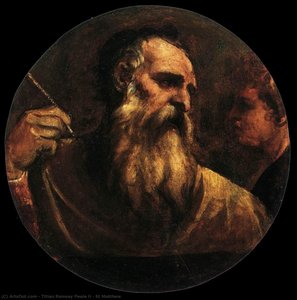
Titian Ramsay Peale II's “St Matthew” is not merely a portrait; it’s a quiet contemplation rendered in oil, a testament to the enduring influence of the High Renaissance filtered through the sensibilities of an early 19th-century American artist. The painting depicts two figures engaged in what appears to be earnest conversation – one, presumably St. Matthew himself, distinguished by a flowing robe and a thoughtful beard, holding a pencil as if poised to capture inspiration. His companion, younger and clean-shaven, listens intently, creating a dynamic interplay of age and experience, wisdom and receptivity. The intimacy of the scene is striking; the figures are closely positioned, drawing the viewer into their private world. The circular frame adds an unusual depth, almost like peering through a window into another time, enhancing the sense of focused introspection.
Inheriting a Legacy: Peale II and the Renaissance Revival
To understand “St Matthew,” one must consider Titian Ramsay Peale II’s lineage. Born in 1799, he was the son of Charles Willson Peale, a pivotal figure in American portraiture and founder of one of the nation's first museums. This familial connection wasn’t simply about inheritance; it was an immersion into a world where art was intertwined with scientific inquiry and civic duty. Peale II consciously embraced the aesthetic principles of the High Renaissance – a period characterized by harmonious composition, idealized forms, and a profound interest in humanism. While many American artists of his time were grappling with distinctly national styles, Peale II looked to Italy for inspiration, specifically to masters like Raphael and Titian (from whom he took his first name), seeking to recreate the elegance and spiritual depth of their work. This dedication to classical ideals is evident in the careful modeling of forms, the subtle use of chiaroscuro – the play of light and shadow – and the overall sense of balance and serenity that permeates “St Matthew.”
Decoding the Symbolism: Faith, Knowledge, and Artistic Creation
The symbolism within "St. Matthew" is layered and invites contemplation. The inclusion of a pencil in the hand of St. Matthew is particularly significant. Traditionally depicted with writing implements like quills or books, the pencil suggests a more modern approach to recording divine inspiration – perhaps alluding to the evolving role of art itself as a means of interpreting faith. It’s a subtle nod towards the artist's own profession and the power of visual representation. The attentive posture of the younger man could represent the burgeoning Christian community or even the artist himself, seeking guidance from the apostle. The painting isn’t a dramatic narrative scene; it’s a moment of quiet revelation, emphasizing the intellectual and spiritual journey inherent in both faith and artistic creation. It's a visual meditation on how knowledge is passed down, interpreted, and ultimately, given new form.
A Rediscovered Voice: The Enduring Appeal of Peale II
For many years, Titian Ramsay Peale II remained somewhat overshadowed by his more famous father and brother, Rembrandt. However, recent scholarship has begun to recognize the unique qualities of his work – a refined technique, a deep understanding of Renaissance principles, and a quiet emotional resonance that sets him apart. “St Matthew” exemplifies this rediscovery. It’s a painting that rewards close viewing, revealing subtle details and inviting viewers to engage with its timeless themes. As an artwork for the modern home, it offers a touch of historical elegance and intellectual depth, capable of transforming any space into a haven of contemplation and beauty. A reproduction of “St Matthew” isn't just acquiring a beautiful image; it’s welcoming a piece of American artistic heritage – a Renaissance echo resonating across time.
Questions & Answers
Can I watch "St Matthew" as a full-screen slideshow?
"St Matthew" by Titian Ramsay Peale II can be viewed as a slideshow on the artwork's Diaporama page.
What is the overall mood of "St Matthew" by Titian Ramsay Peale II?
The overall mood of "St Matthew" by Titian Ramsay Peale II is elegant. The mood describes the general atmosphere of the work.
What luminance does "St Matthew" by Titian Ramsay Peale II have?
"St Matthew" by Titian Ramsay Peale II has a dark luminance. Luminance describes how much light the colors appear to reflect.
Quick facts and art quiz
About Titian Ramsay Peale II

Titian Ramsay Peale II
1799 - 1885
Artist Biography
The intersection of science and classical form
To look at the work of Titian Ramsay Peale II is to see a deliberate attempt to reconcile the rigorous demands of 19th-century natural history with the aesthetic weight of the High Renaissance. Born in Philadelphia in 1799, he did not merely inherit a famous name as the son of Charles Willson Peale; he inherited a specific way of seeing. His early years were defined by this dual focus. He was an explorer and a scientific illustrator long before he was purely a painter. During the Stephen Harriman Long expedition to the Rocky Mountains between 1819 and 1820, his task was documentation. He recorded flora and fauna with a precision that required anatomical accuracy. This period of fieldwork provided the technical foundation for his later canvases. He understood how light hit a wing or how texture defined a specimen.
This scientific training prevented his later religious and mythological works from becoming mere abstractions. When he turned to subjects like St. Augustine, he applied the same scrutiny to the folds of a garment as he would to a botanical specimen. He utilized techniques such as sfumato to soften edges, yet the underlying structure remained grounded in physical reality. His work exists in the tension between the observational eye of a naturalist and the stylistic ambitions of Venetian colorism.
A technical bridge between eras
Peale’s development was marked by an refusal to adhere to the purely utilitarian trends of American art in his era. While many contemporaries focused on straightforward portraiture or landscape, he looked backward to the principles of artists like Rubens and the Venetian masters. This is most evident in his handling of color and light. He sought a luminous quality that mirrored the Old World traditions. His religious paintings, such as The Holy Family with a Shepherd, demonstrate a controlled use of oil paint to build depth through layers. He did not rely on superficial beauty; he relied on the structural application of pigment.
His technical repertoire was broad and functional. He worked across several media to achieve his goals:
- Watercolor and graphite for scientific documentation
- Oil on canvas for religious and mythological subjects
- Lithography and ink for illustration
- Photography, which he adopted as an amateur later in life
This versatility allowed him to move between the microscopic detail of a Cicada watercolor and the atmospheric scale of a landscape. He was not interested in style for its own sake, but in how specific techniques could communicate the weight of his subject matter.
The legacy of an overlooked naturalist
For much of the 20th century, Peale’s significance was obscured by the sheer scale of the Peale family's broader impact on American culture. He did not fit the mold of the purely commercial portraitist. His career included roles as a chief naturalist for the United States Exploring Expedition from 1838 to 1842 and work within the United States Patent Office. These were not distractions from his art; they were the source of it. The precision found in his wildlife drawings informed the dignity he brought to his classical subjects.
Today, the value of his work lies in this specific synthesis. He represents a moment when American identity was being formed through the simultaneous exploration of new territories and the reinterpretation of ancient artistic values. His paintings, now held in institutions such as the Uffizi Gallery and the Scottish National Gallery of Modern Art, remain relevant because they refuse to separate the intellect from the aesthetic. He proved that scientific observation and classical reverence could occupy the same canvas.
Explore artworks organized by themes, styles, and characteristics.




Titian Ramsay Peale II
St Matthew
() ·
With its frame: · Hand-painted in oil on linen
Total