Atelier — Complimentary worldwide shipping — Delivery 2–6 weeks
Painting from Photo Wishlist Cart
PreviewPreview AR previewAR preview Buy Print Buy PrintBuy Hand Made Painting Buy Hand Made Painting SendSend
DetailsDetails Add to favorites Add to favorites DownloadDownload SimilarsSimilars X-RayX-Ray DiaporamaDiaporama

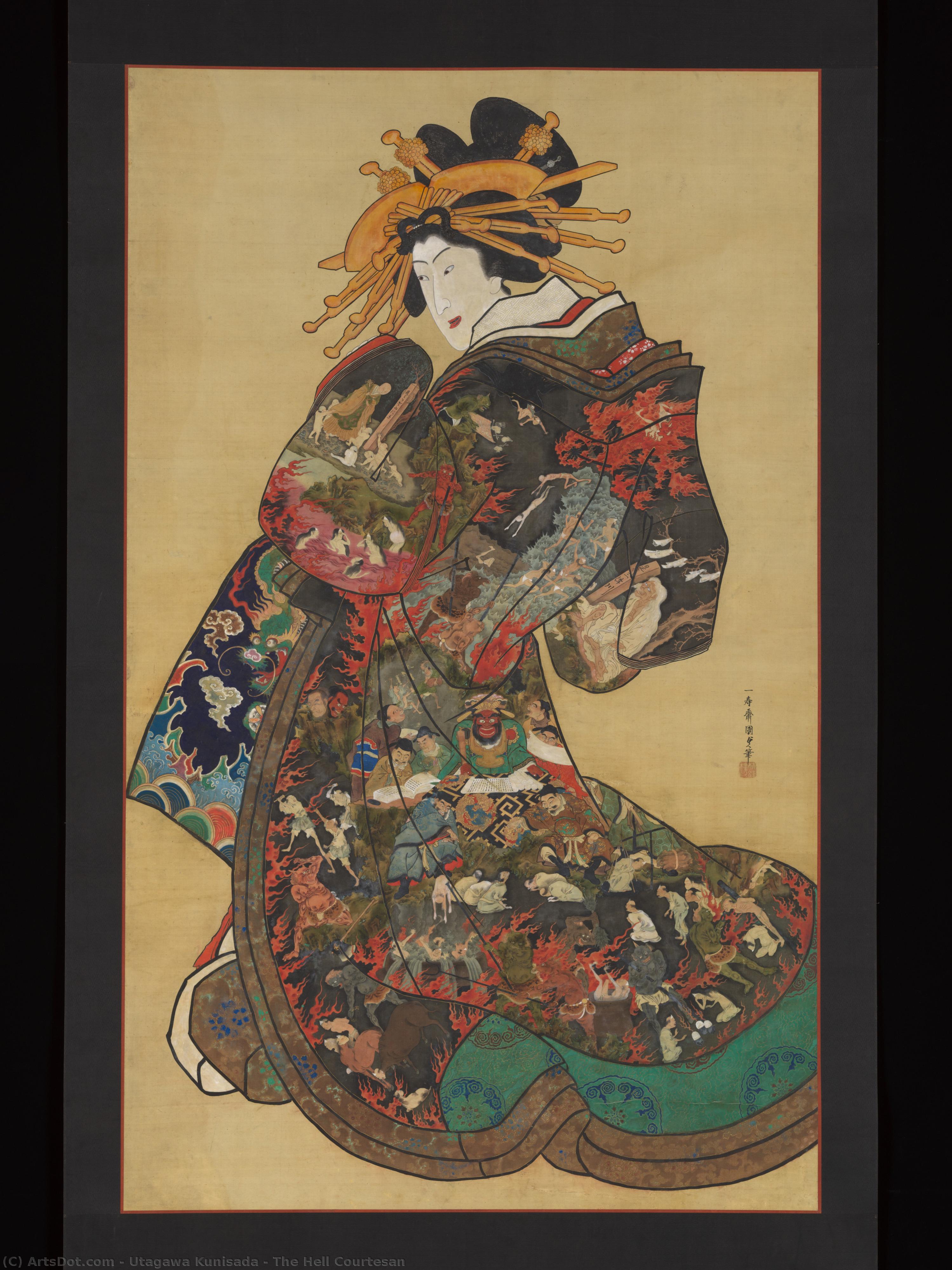
The Hell Courtesan

  • Creation date1850
  • Dimensions165.0 x 101.0 cm

Discover Utagawa Kunisada (1786-1865), the most popular ukiyo-e artist of 19th-century Japan! Explore his iconic kabuki actor portraits (yakusha-e), beautiful women (bijin-ga), and vibrant woodblock prints. A rediscovered master.

Purchase a high-resolution, enhanced digital image, far superior to the online preview.

Each file is meticulously prepared by our in-house specialists using advanced tools and expert manual retouching. We ensure every image has exceptional clarity, precise color accuracy, and fine detail.

The final file is delivered via email within 72 hours, optimized for immediate use in professional, editorial, and print environments. This is the same quality trusted by top-tier design studios, publishers, and galleries.

Digital Image

Download a high-resolution file for personal display, printing, and creative projects. (Buy Print Buy PrintBuy Hand Made Painting Buy Hand Made Painting)

Total Price

$ 24.90

Included in Every Digital Image Order

Expert Digital Delivery, Guaranteed

When you choose TopImpressionists.com, you're not just getting an image - you're receiving a professionally enhanced digital artwork, crafted with precision and backed by a satisfaction guarantee. Here's everything that comes with your order, automatically:

shipping_icon
Fast Email Delivery

Your high-resolution digital image file will be emailed to you within 72 hours of ordering - ready for immediate use.

canvas_icon
AI-Enhanced Digital File

Your artwork is professionally optimized using advanced AI tools and manual editing, ensuring maximum detail, clarity, and color accuracy.

insurance_icon
Free Lifetime Re-Delivery

Accidentally deleted or lost your file? No worries - we'll resend it to you anytime, free of charge.

tax_icon
No Import Fees - Ever

Enjoy your artwork instantly with zero customs, duties, or delivery fees - digital downloads are always tax-free.

color_icon
Color Accuracy Guarantee

We ensure your digital image reflects the original colors as closely as possible using professional tools and color management.

return_icon
60-Day Satisfaction Guarantee

If you're not satisfied with your digital image, we'll revise it or refund 100% within 60 days - no questions asked.

guarantee_icon
100% Money-Back Guarantee

Not satisfied? Get a full refund within 60 days of receiving your digital file - no questions asked.

discount_icon
Bulk Order Discounts

Buy 3 images, save 10% - Buy 5, save 15% - Buy 10+, save 20%. Great for creative projects, galleries, and agencies.

Collectible Description

This dazzling, nearly life-size, portrayal of a courtesan commands our attention because of the sumptuously patterned robes showing gory scenes of the Buddhist hell, presided over by Enma-ō, a wrathful god in Buddhism who judges the dead and presides as the King of Hell. Seated on throne, he is surrounded by seven of his judges while he reviews and records the misdeeds of the recently deceased, some of whom are prostrated in terror before him. Surrounding the central image of King Enma’s court are gory scenes of punishments of hell with demons presiding over sinners being variously tortured, burnt, and boiled.The subject is a woman of medieval times in Japan who worked in the Takasu district of Osaka and who was known as the Hell Courtesan, (Jigoku Dayū). Jigoku, literally “hell,” was also a term referring to unlicensed courtesans, while tayū (read dayū in combination with jigoku) was the term for the highest-ranking courtesan. In this portrayal, the woman’s high status is recognizable through her ornate hair adornments and luxurious, layered garments. Jigoku is said to have achieved redemption through an encounter with the fifteenth-century Zen monk Ikkyū (1394–1481), son of an emperor and forty-seventh abbot of the great Rinzai Zen temple Daitokuji in Kyoto. Although one of most venerable monks in the history of medieval Buddhism, Ikkyū was notorious for pursuing the path of enlightenment while enjoying the sensual pleasures of drink and cavorting with prostitutes. He mocked the hypocrisy of other monks who adopted a holier-than-thou attitude. According to legend, on his first encounter with Jigoku, he composed the opening stanza of a linked verse (renga):Kikishi yorimite osoroshikiJigoku kanaThough I had heardall about “Hell,”seeing the real thing—more daunting still!The Hell Courtesan"s beauty was osoroshiki, which can mean “frightening.” as in the case of the Buddhist hell, or “daunting,” to describe the attractions of this femme fatale. Jigoku, a woman of many talents, immediately improvised the final stanza:Iki-kuru hito moochizarameyawaEven the living who draw nearcannot but fall into the abyss!(Trans. John T. Carpenter)By cleverly alluding to men who are ensnared by the beauty of courtesans, Jigoku revealed herself already enlightened in a worldly sense, and Monk Ikkyū was to direct her on the path to spiritual redemption. The apocryphal story was updated by the popular writer and ukiyo-e artist Santo Kyōden (Kitao Masanobu, 1761–1816) in Stories of drunken enlightenment in Japan (Honchō suibodai zenden), illustrated by Utagawa Toyokuni and published in 1809. This book inspired numerous nineteenth-century paintings of the Hell Courtesan including by prominent artists Kuniyoshi, Kunichika, and at the fin-de-siecle, by Kawanabe Kyōsai. The story was even more widely popularized when the play Ikkyū’s Tale of Hell (Ikkyū jigoku banashi) by the leading Kabuki dramatist, Kawatake Mokuami (1816–1893), was performed at the Ichimura theater in Tokyo in 1865. Actor prints commemorating the play, including one by Kunisada II, circulated widely. In the Kabuki version of events, Ikkyū enters a brothel and meets the courtesan Jigoku. As he dances with women in the brothel Jikoku peeps from behind a screen and to her astonishment sees that Ikkyū’s voluptuous companions have shriveled to their bare bones. The vision of dancing skeletons vanishes when she rejoins the group, but still viewers were reminded of the underlying Buddhist truth that beneath even the most glamorous facade lurks inevitable old age and death. In the play, Jigoku finds enlightenment with this graphic demonstration of human impermanence.

Artist Biography

The Maestro of Edo’s Artistic Zenith

Utagawa Kunisada, born Sumida Shōgorō IX in the vibrant district of Honjo, Japan, stands as arguably the most celebrated ukiyo-e artist of the 19th century. His prolific output and unparalleled commercial success cemented his position as a titan amongst his contemporaries—Hiroshige, Hokusai, and Kuniyoshi—establishing him as the undisputed champion of color woodblock printing during the Edo period. While European collectors initially regarded these masters as inferior to classical ukiyo-e artists, a resurgence of appreciation in the mid-20th century has rightfully elevated Kunisada’s stature, recognizing him as one of the foremost figures in Japanese artistic history.

Kunisada's formative years were marked by familial stability stemming from his father’s modest ferry service business, a circumstance that afforded him a degree of financial security uncommon for artists of his time. His father, an amateur poet, instilled in Kunisada a deep passion for literature and artistic expression. Recognizing his innate talent, the legendary Toyokuni I, the dominant figure of the Utagawa school and a renowned Kabuki designer, took Kunisada under his wing as an apprentice. This apprenticeship imparted invaluable knowledge of theatrical art and printmaking techniques, solidifying Kunisada’s connection to the Utagawa lineage. The studio name kuni-sada, derived from Toyokuni I's surname, symbolized this heritage and foreshadowed Kunisada’s own enduring legacy as a leader in the field.

A Mastery of Color and Character

As his career blossomed, Kunisada became a master of capturing the ephemeral beauty of the "floating world." His work is characterized by an extraordinary ability to breathe life into his subjects through vibrant colors and meticulous detail. He achieved unparalleled success in several distinct genres:

  • Yakusha-e: His iconic portraits of Kabuki actors, which captured the dramatic intensity and stylized movements of the stage with psychological depth.
  • Bijin-ga: His exquisite depictions of beautiful women, where he utilized flowing lines and intricate patterns to convey elegance and grace.
  • Musha-e: His dynamic prints of legendary warriors and historical scenes, showcasing his command over action and composition.

The technical brilliance of Kunisada lay in his ability to push the boundaries of woodblock printing. He utilized a rich palette that became synonymous with the aesthetic of late Edo Japan. His compositions were not merely decorative; they were narrative powerhouses that reflected the social pulse of the era, from the high drama of the theater to the quiet elegance of the tea house.

Legacy and Historical Significance

The historical significance of Utagawa Kunisada cannot be overstated. He was not just a painter but a cultural chronicler who documented the zenith of Edo's urban culture. His work bridged the gap between traditional craftsmanship and the burgeoning commercial art market, making high-quality art accessible to a wide audience. Though his fame faced a period of relative obscurity in the West during the early modern era, contemporary scholarship has reclaimed him as a central pillar of Japanese art.

Today, we look back at Kunisada not merely as a successor to Toyokuni I, but as an artist who redefined the possibilities of the ukiyo-e medium. His influence can be seen in the evolution of graphic design and the continued reverence for Japanese printmaking worldwide. To study Kunisada is to witness the very heartbeat of 19th-century Japan, captured in ink, pigment, and wood.

Utagawa Kunisada

Utagawa Kunisada

1786 - 1865 , Japan

Quick Facts

  • Artistic Movement Or Style: Ukiyo-e
  • Artists Or Movements Influenced By This Artist: ['Classical Ukiyo-e']
  • Artists Who Influenced This Artist: ['Toyokuni I']
  • Date Of Birth: 1786
  • Date Of Death: 1865
  • Full Name: Utagawa Kunisada
  • Nationality: Japanese
  • Notable Artworks:
    • Memorial Portrait of the Actor Ichikawa Ōmezō I
    • Tokyo Civilization Famous Places: Contests: Ginza Brick Stone
    • Ronins attack on the house of lord Kira (left panel of a triptych)
  • Place Of Birth: Honjo, Japan
© TopImpressionists.com — All Rights Reserved  ·  100% Hand-Painted · Satisfaction Guaranteed · Free Worldwide Shipping
VISA MASTERCARD