

 Preview
 Send
Send Share
Share
 Details
 Guide
Guide

 Download
 Similars
 X-Ray
X-Ray Diaporama
 Q&A
Q&A Stats
StatsTwo Cypresses

- 74.0 x 93.0 cm


 Read More
Giclée / Art Print
Museum-quality giclée or canvas print with fast production and flexible finish options. ( Buy Hand Made Painting Switch to Digital Image)




P118B $10

P118H $10

P118W $10

P438Z $10

P508JH $12

P508YH $12

P805H $10

P805Z $10

P919BZ $10

P919G $10

P919XJ $10

P959ZH $10

P968JZ $12

W106C $8

W218G $10

W218JH $8

W218Y $10

W307PJ $10

W316G $10

W316PJ $8

W316Y $10

W398PJ $8

W4111J $10

W500HY $15

W500JH $15

W692G $12

W849H $8

W940BG $15

W953PJ $8




Standard
custom
CM
INCH
Pick from our preset sizes that match the artwork's original proportions.
Loading sizes...

width
height
Type the width and the height you need, to fit your frame or your wall. A print can only be cut, never made bigger than the picture, so a size with a different shape loses a part of the image. We send you a digital mockup to approve before we print anything. The picture shown on this page does not show the real cut — only the mockup does.
Worldwide Delivery () in 2 weeks instead of standard 4/5 weeks. (4 November)

Free Worldwide Express Shipping

High-Quality Linen Canvas

Full Shipping Insurance

Customs Tax Refund Guarantee

True Color Matching Guarantee

100-Day Return Policy (Defects Only)

100% Money-Back Guarantee

Bulk Discount Offer
 Glass option is only available in size under 110 CM

Two Cypresses
Giclée / Art Print
Reproduction Size
-


Total Price
$ 70
Two Cypresses
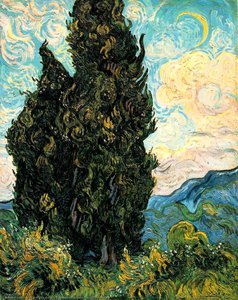
Vincent van Gogh’s “Two Cypresses” stands as a poignant emblem of artistic exploration and emotional resonance within the Post-Impressionist movement. Painted in 1889 during his stay at Saint-Rémy asylum, this landscape transcends mere depiction; it embodies Van Gogh's profound engagement with nature and his unwavering pursuit of expressive color—a characteristic hallmark of his oeuvre. The painting captures two towering cypress trees against a turbulent sky, punctuated by the distant silhouette of a mountain range, offering viewers an immersive experience into the artist’s inner world.Artistic Style and Technique
The artwork exemplifies Van Gogh's distinctive Post-Impressionist style, prioritizing bold brushstrokes and vibrant hues over meticulous realism. Employing oil on canvas—a medium championed by artists like Claude Monet and Eugène Boudin—allowed him to achieve a textural richness unparalleled in its time. As documented extensively in The Art Media Oil On Canvas, this technique facilitated the creation of luminous surfaces and dynamic compositions that conveyed emotion as much as visual information. The swirling brushstrokes aren’t merely decorative; they are conduits for conveying Van Gogh's psychological state—a reflection of his turbulent inner life during a period marked by mental instability.Symbolism and Interpretation
The cypress trees themselves hold significant symbolic weight within Van Gogh’s artistic lexicon. Frequently interpreted as symbols of mourning, resilience, and eternal life—rooted in their association with cemeteries and their upward reaching form—they represent the artist's contemplation on mortality and his unwavering faith in transcendence. The overcast sky contributes to an atmosphere of solemnity and introspection, mirroring Van Gogh’s own emotional landscape. Furthermore, the distant mountain provides depth and grandeur to the scene, symbolizing stability amidst chaos – a visual counterpoint to the agitated brushstrokes dominating the foreground. Finally, the inclusion of a clock—a recurring motif in Van Gogh's work—suggests an awareness of time passing and perhaps a preoccupation with confronting one’s own mortality.Comparison with Other Works
“Two Cypresses” shares stylistic similarities with other seminal paintings by Van Gogh, notably “The Starry Night,” which similarly utilizes expressive brushstrokes and vibrant color palettes to convey profound emotional depth. Both canvases demonstrate a masterful manipulation of light and shadow—a technique honed through extensive observation of the natural world—resulting in images that are simultaneously captivating and emotionally charged. Like "Starry Night," "Two Cypresses" invites viewers into a realm beyond mere visual representation, prompting contemplation on themes of spirituality and human experience.Relevance in Modern Art
The influence of “Two Cypresses” resonates powerfully within contemporary art practices. Artists continue to draw inspiration from Van Gogh’s expressive approach—particularly his bold use of color and textural layering—resulting in artworks that prioritize emotional impact alongside formal considerations. Consider Paul Signac's "Two Cypresses," a fellow Post-Impressionist painter who similarly sought to capture the essence of nature through vibrant hues and dynamic brushstrokes, as exemplified by Opus 241. This artwork serves as a testament to Van Gogh’s enduring legacy—a beacon for artists striving to communicate profound emotions through visual mediums.For those eager to immerse themselves in the beauty and artistry of Vincent van Gogh's vision, Painting by 'Vincent Van Gogh' | Vincent Van Gogh: Two Cypresses awaits exploration on TopImpressionists.
- Artist: Vincent Van Gogh
- Painting Title: Two Cypresses
- Size: 74 x 93 cm
- Medium: Oil On Canvas
- Style: Post-Impressionism
- Date: 1889
Questions & Answers
Where in the home does a reproduction of "Two Cypresses" fit well?
The recommended space for "Two Cypresses" by Vincent Willem Van Gogh is a living room. The suggestion can of course be adapted to your interior.
Where is the portrait format of "Two Cypresses" recommended to be displayed?
With its portrait shape, a reproduction of "Two Cypresses" is suggested for a living room.
How do medium and movement combine in "Two Cypresses"?
"Two Cypresses" is made in acrylic on canvas, in the Post-Impressionism style.
Related Artworks




Artist Biography
A Life Painted in Passion: Vincent van Gogh
Vincent Willem van Gogh, a name synonymous with vibrant color and raw emotion, remains one of the most recognizable and beloved figures in art history. Born on March 30, 1853, in Zundert, Netherlands, his journey from a troubled young man seeking purpose to an artistic visionary is a poignant tale of dedication, struggle, and ultimately, enduring legacy. While he achieved little commercial success during his lifetime – selling only one painting, *The Red Vineyard*, before his death – Van Gogh’s impact on modern art is immeasurable, paving the way for Expressionism and influencing countless artists who followed. His story isn't just about brushstrokes and canvases; it's a testament to the power of human expression in the face of adversity.
Early Years and Artistic Awakening
Van Gogh’s early life was marked by a series of unfulfilled aspirations. He tried his hand at various professions – an art dealer, a teacher, and even a missionary – before finally dedicating himself to painting at the relatively late age of 27. These earlier experiences profoundly shaped his worldview and found their way into his art. His initial works, depicting scenes of peasant life in rural Belgium, reflect a deep empathy for the working class and a somber palette reflecting their hardships. Influenced by artists like Jean-François Millet, Van Gogh sought to capture the dignity and resilience of these individuals through stark realism. However, it was his move to Paris in 1886 that proved transformative. There, he encountered Impressionism and Post-Impressionism, absorbing the techniques of masters like Monet, Renoir, and Pissarro. This exposure broadened his artistic horizons, leading him to experiment with brighter colors and looser brushwork, though retaining a distinct emotional intensity absent in many of his contemporaries. His brother Theo, an art dealer, played a crucial role during this period, providing financial support and acting as a vital link to the Parisian art world. Their extensive correspondence offers invaluable insights into Van Gogh’s artistic development and personal struggles.
The Southern Light and Explosive Creativity
Seeking a more vibrant landscape and a sense of renewal, Van Gogh relocated to Arles in southern France in 1888. This move marked a period of intense creative output, characterized by an explosion of color and a distinctive impasto technique – applying paint thickly onto the canvas, creating a textured surface that seems to pulsate with energy. It was here that he produced some of his most iconic works: *Sunflowers*, *The Night Cafe*, and *Starry Night*. The intense sunlight of Provence seemed to ignite his imagination, leading him to depict landscapes and still lifes with an unprecedented vibrancy. His desire for artistic collaboration led him to invite Paul Gauguin to join him in Arles, hoping to establish a utopian artists' colony. However, their relationship proved volatile, culminating in a dramatic confrontation that resulted in Van Gogh mutilating his own ear. This event underscored the fragility of his mental state and marked the beginning of a period of institutionalization and increasing psychological distress.
Later Years and Enduring Legacy
Following his breakdown, Van Gogh voluntarily entered an asylum at Saint-Rémy, where he continued to paint prolifically, capturing the surrounding landscapes with both beauty and turmoil. Works like *The Starry Night*, painted during this time, are imbued with a sense of cosmic wonder and profound emotional depth. He later moved to Auvers-sur-Oise under the care of Dr. Paul Gachet, but his struggles persisted. On July 29, 1890, at the age of 37, Van Gogh tragically died from a self-inflicted gunshot wound. Despite achieving little recognition during his lifetime, his work began to gain posthumous acclaim thanks largely to the tireless efforts of his sister-in-law, Johanna van Gogh-Bonger, who inherited his estate and dedicated herself to promoting his art. Today, Van Gogh’s paintings are celebrated worldwide for their emotional intensity, innovative techniques, and enduring beauty. His legacy extends far beyond the canvas; he has become a symbol of artistic passion, perseverance in the face of adversity, and the power of art to express the deepest human emotions.
Key Influences and Artistic Development
- Early Realism: Jean-François Millet’s depictions of peasant life influenced Van Gogh's early works.
- Impressionism & Post-Impressionism: Exposure to Monet, Renoir, Pissarro and others in Paris broadened his palette and technique.
- Japanese Prints: Van Gogh was deeply influenced by Japanese woodblock prints, which he collected avidly. Their bold compositions and flat planes of color impacted his own style.
- Emotional Expression: Above all, Van Gogh sought to convey emotion through his art, prioritizing subjective experience over objective representation. This focus on emotional intensity became a defining characteristic of his work and paved the way for Expressionism.

Vincent Willem Van Gogh
1853 - 1890 , Netherlands
Related Articles

The Soul of the Brushstroke: Decoding Van Gogh's Emotional Impasto
Explore the profound emotional depth of Van Gogh's impasto technique. Discover how his sculptural brushstrokes and textured oil layers define Post-Impressionism through an expert art-historical lens, perfect for discerning collectors and fine art enthusiasts.
Explore artworks organized by themes, styles, and characteristics.


![Irises [1889]](/media/artworks/images-thumb/ca/85/ca85582a4fd1dc392efef83ec4dc3124.jpg)

