William Louis Sonntag: Bridging Romanticism and Italian Light
William Louis Sonntag (1822-1900) stands as a significant, if often overlooked, figure within the Hudson River School of American landscape painting. Born in East Liberty, Pennsylvania—a small settlement near Pittsburgh—Sonntag’s artistic journey began not with formal training but with an innate fascination for the natural world and a determination to capture its essence on canvas. His early life was marked by his father's skepticism towards a career in art, leading Sonntag to pursue carpentry before ultimately dedicating himself fully to painting. This self-directed path shaped his distinctive style—a blend of Romantic idealism, meticulous observation, and an increasingly sophisticated understanding of light and color.
Sonntag’s artistic development unfolded through a series of pivotal experiences. A formative period occurred in Cincinnati, Ohio, where he honed his skills and established a local reputation. He began to exhibit his work, attracting attention that ultimately led to commissions from the Baltimore & Ohio Railroad, an arrangement that allowed him to document the dramatic landscapes along the railway’s route. This experience proved invaluable, not only for its financial rewards but also for its exposure to diverse terrains and the practicalities of capturing fleeting moments of light and atmosphere. Crucially, it coincided with a significant friendship and artistic collaboration with Robert Seldon Duncanson, another prominent Hudson River School painter, whose influence subtly shaped Sonntag’s evolving style.
The Italian Influence: Florence and Beyond
A defining moment in Sonntag's career arrived in 1853 when he embarked on a transformative journey to Europe, specifically to Florence. This extended sojourn proved profoundly influential, fundamentally altering his artistic perspective. He spent several months immersed in the Florentine art scene, studying the techniques of Italian masters and absorbing the rich color palettes and atmospheric effects characteristic of the region. Unlike many American artists who simply replicated Italian landscapes, Sonntag sought to internalize the *spirit* of Italy—its light, its drama, and its connection to classical ideals.
Returning to America in 1857, Sonntag established himself in New York City, maintaining a studio while continuing to travel extensively. He continued to paint Italian scenes, often incorporating elements of Romanticism and a burgeoning interest in Neo-Classicism. His paintings from this period are characterized by a heightened sense of drama, bold brushwork, and an almost theatrical use of light—a direct result of his Florentine experience. It’s important to note that Sonntag's reliance on photographs for some of these Italian landscapes has been documented; he often worked from images rather than directly from observation, demonstrating a pragmatic approach to capturing the desired effect.
Technique and Style: A Synthesis of Observation and Idealization
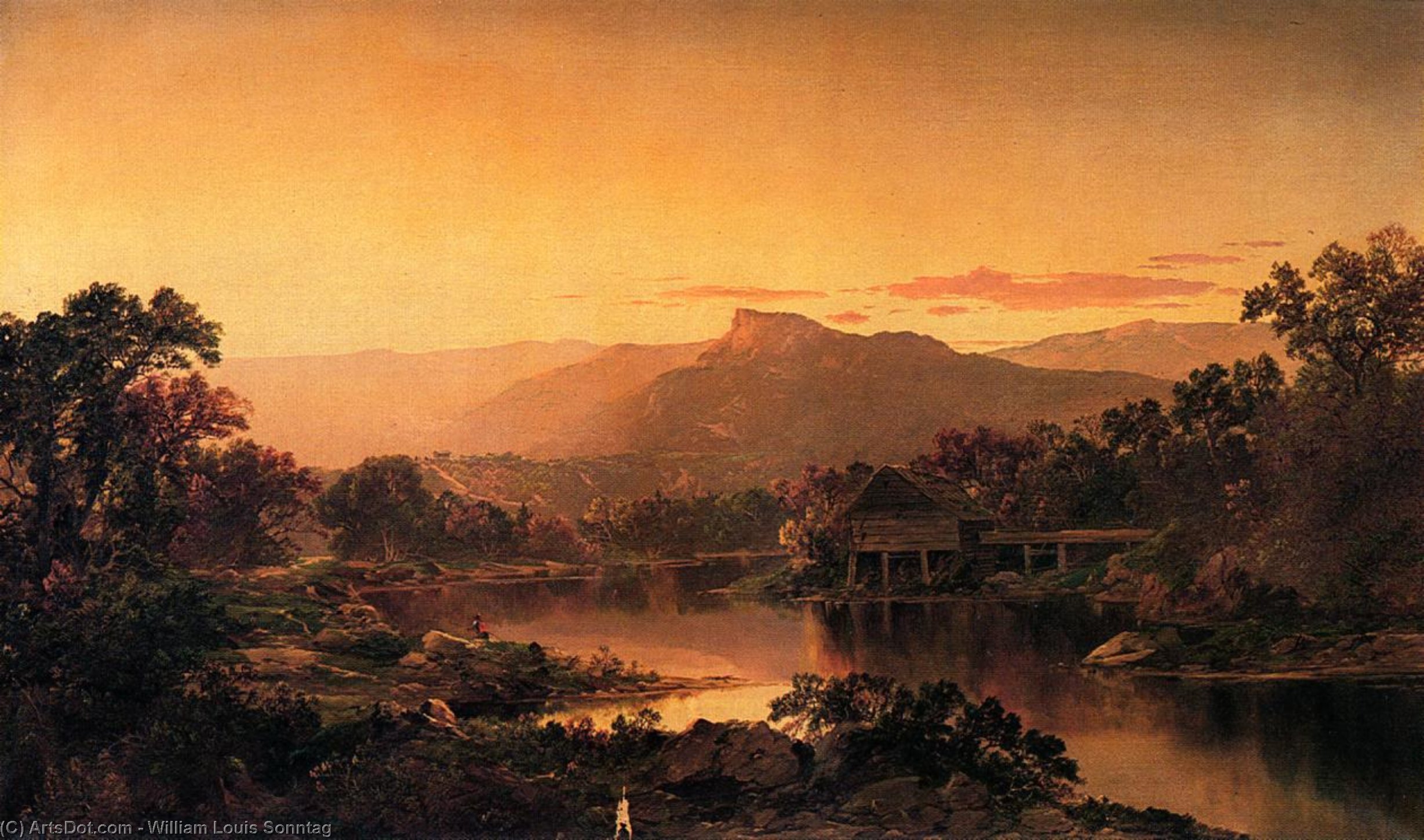
Sonntag’s artistic technique was marked by a careful balance between meticulous observation and idealized representation. He possessed a keen eye for detail, evident in his renderings of foliage, rock formations, and atmospheric effects. However, he wasn't simply aiming for photographic realism; rather, he employed a painterly approach—using broad brushstrokes and vibrant colors to convey mood and emotion. His compositions often featured dramatic diagonals and carefully orchestrated lighting schemes, creating a sense of depth and movement.
His landscapes frequently incorporated elements of the Hudson River School’s emphasis on the sublime—the awe-inspiring power and beauty of nature. Yet, Sonntag's work possessed a distinct emotional intensity that set him apart from some of his contemporaries. He wasn’t merely depicting scenery; he was conveying a sense of spiritual connection to the wilderness, often imbued with a melancholic or reflective quality. The influence of the Barbizon School—a French movement emphasizing plein air painting and capturing the fleeting effects of light—can also be discerned in his later works.
Legacy and Historical Significance
William Louis Sonntag’s contribution to American landscape painting is often overshadowed by more celebrated figures within the Hudson River School. However, his distinctive style—characterized by its dramatic lighting, evocative compositions, and a profound engagement with the spirit of the American wilderness—holds considerable historical significance. He represents a crucial bridge between the early Romantic idealism of the movement and the increasingly realistic tendencies that would emerge in subsequent decades.
Sonntag’s work continues to be appreciated for its technical skill, emotional depth, and its embodiment of the American spirit. His paintings offer a valuable window into the 19th century—a time when artists sought to capture the grandeur of the nation's expanding frontier and grapple with fundamental questions about humanity’s place within the natural world. His legacy resides not only in his individual masterpieces but also in his role as a key participant in one of America’s most influential artistic movements.


 Preview
 Buy Painting
 Send
Send Share
Share
 Details

 Download
 Similars
 X-Ray
X-Ray Diaporama
 Read More






































 Glass option is only available in size under 110 CM



