Preview
 Send
Send Share
Share
 Details
 Guide
Guide

 Download
 Similars
 X-Ray
X-Ray Diaporama
 Stats
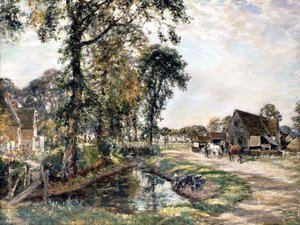
StatsMeadow Pool
William Mark Fisher (1841-1923) was a Boston-born artist who brought Impressionism to England. Known for idyllic landscapes, rural scenes & farm life paintings, he exhibited at the Royal Academy and is considered one of England’s greatest landscape p
 Read More
The artwork displayed on this page is protected by copyright law, which means we cannot legally create or sell an identical reproduction. This protection is enforced under international agreements such as the Berne Convention and by national laws, including those outlined by the U.S. Copyright Law - Title 17.
As a respectful and legal alternative, we offer custom, hand-painted artworks inspired by the original. Our skilled and professional artists carefully study the original's style, mood, and artistic essence to create a new, unique piece that evokes the same feeling - while remaining an original creation in its own right.
This method fully complies with copyright regulations because it does not involve copying or duplicating the protected artwork. Instead, it is a creative reinterpretation - a new painting that is influenced by the original but not identical to it.
Hand Made Oil Reproduction
Hand-painted oil on canvas in your size and frame, made to order by our artists. ( Switch to Print Switch to Digital Image)




































Standard
custom
CM
INCH
Pick from our preset sizes that match the artwork's original proportions.
Loading sizes...

width
height
Type the width and the height you need, to fit your frame or your wall. This is hand-painted, so for a size with a different shape the artist can paint a bit more around the picture, or cut a bit — you choose. We send you a digital mockup to approve before the painting starts. The picture shown on this page does not show the real result — only the mockup does.
Examples of what can be changed: Replace face with customer photo; Add pet (e.g., replace cat with dog); Include hidden message in background; Change background landscape or elements.
After order, TopImpressionists.com team will email client for instructions and provide a mockup preview
After order, TopImpressionists.com team will email client for instructions and provide a mockup preview
Worldwide Delivery () in 3/4 weeks instead of standard 5 weeks. (21 October). No compromise on quality.

Free Worldwide Express Shipping

High-Quality Linen Canvas

Full Shipping Insurance

Customs Tax Refund Guarantee

True Color Matching Guarantee

100-Day Return Policy (Defects Only)

100% Money-Back Guarantee

Bulk Discount Offer
 Glass option is only available in size under 110 CM

Meadow Pool
Reproduction Medium
Reproduction Size
-


Total Price
$ 269
Artist Biography
The Transatlantic Vision of William Mark Fisher
The story of William Mark Fisher is one of profound geographical and artistic transition, a journey that began in the intellectual heart of Boston and found its ultimate expression in the rolling hills of the English countryside. Born in Massachusetts, Fisher emerged as a pivotal figure who bridged the gap between American sensibilities and the burgeoning English Impressionist movement during the late Victorian era. His life’s work serves as a luminous bridge between two worlds, capturing a sense of pastoral tranquility that remains timelessly evocative.
Fisher's early years were steeped in the vibrant artistic ferment of the Boston art scene. It was here that he first encountered the transformative philosophies of luminaries such as George Inness and Jules Bastien-Lepage. These masters championed the practice of plein air painting—the act of working outdoors to capture the fleeting, ephemeral qualities of light and atmosphere. This commitment to direct observation became the bedrock of Fisher's technique, instilling in him a lifelong devotion to the truth of nature.
A Mastery of Light and Landscape
While his formal training at the Boston School of Fine Arts provided him with a rigorous foundation in draughtsmanship and color theory, it was his relocation to England in 1871 that truly ignited his creative spirit. Settling in Worcestershire, Fisher found himself immersed in a landscape that would become his primary muse. He embraced the picturesque English countryside, translating its quiet beauty onto canvas through a style characterized by soft brushstrokes and a muted, sophisticated palette.
Fisher’s technical prowess is most evident in his masterful use of atmospheric perspective. By meticulously layering colors, he was able to convey an incredible sense of depth and distance, making his canvases shimmer with the subtle gradations of light and shadow. His paintings often feature:
- Idyllic Pastoral Scenes: Peaceful depictions of cows grazing amidst rolling hills.
- Atmospheric Depth: The use of light to create a sense of vast, breathing space.
- Rural Nostalgia: A profound focus on the quiet dignity of farm life and the natural world.
Through these elements, Fisher did more than merely record scenery; he captured an emotional resonance—a sense of peace and nostalgia for a bygone era that continues to captivate viewers today.
Legacy and Historical Significance
The significance of William Mark Fisher lies in his ability to synthesize the technical innovations of Impressionism with the traditional subject matter of English landscape painting. His work was not merely decorative but served as a vital contribution to the evolution of late 19th-century art. By exhibiting at the prestigious Royal Academy, he secured his place among the most respected painters of his generation, earning recognition for his ability to elevate simple rural scenes into profound meditations on light and existence.
Though time has occasionally obscured the names of many Victorian painters, Fisher’s legacy remains preserved in the enduring beauty of his landscapes. He stands as a testament to the power of artistic migration—how an artist, transplanted from the American coast to the English heartland, could find a universal language in the light of a setting sun over a quiet meadow. His work remains a cornerstone for those seeking to understand the delicate intersection of Impressionism and the pastoral tradition.

William Mark Fisher
1968 - 2017 , United States of America
Quick Facts
- Full Name: William Mark Fisher
- Nationality: American
- Date Of Birth: 1968
- Date Of Death: 2017
- Place Of Birth: Boston, United States of America
- Notable Artworks:
- Land and Sea
- Landscape with Cattle
- Midday Rest
- Artistic Movement Or Style: Impressionism
- Artists Who Influenced This Artist: ['George Inness']
- Artists Or Movements Influenced By This Artist: ['Plein air painting']
Explore artworks organized by themes, styles, and characteristics.