


 Preview
 Send
Send Share
Share
 Details
 Guide
Guide

 Download
 Similars
 X-Ray
X-Ray Diaporama
 Stats
StatsThe Flirt
 Acrylic On Canvas
- WallArt
- American Realism
 1874
1874 29.0 x 39.0 cm
 Read More
Giclée / Art Print
Museum-quality giclée or canvas print with fast production and flexible finish options. ( Buy Hand Made Painting Switch to Digital Image)




P118B $10

P118H $10

P118W $10

P438Z $10

P508JH $12

P508YH $12

P805H $10

P805Z $10

P919BZ $10

P919G $10

P919XJ $10

P959ZH $10

P968JZ $12

W106C $8

W218G $10

W218JH $8

W218Y $10

W307PJ $10

W316G $10

W316PJ $8

W316Y $10

W398PJ $8

W4111J $10

W500HY $15

W500JH $15

W692G $12

W849H $8

W940BG $15

W953PJ $8




Standard
custom
CM
INCH
Pick from our preset sizes that match the artwork's original proportions.
Loading sizes...

width
height
Type the width and the height you need, to fit your frame or your wall. A print can only be cut, never made bigger than the picture, so a size with a different shape loses a part of the image. We send you a digital mockup to approve before we print anything. The picture shown on this page does not show the real cut — only the mockup does.
Worldwide Delivery () in 2 weeks instead of standard 4/5 weeks. (27 October)

Free Worldwide Express Shipping

High-Quality Linen Canvas

Full Shipping Insurance

Customs Tax Refund Guarantee

True Color Matching Guarantee

100-Day Return Policy (Defects Only)

100% Money-Back Guarantee

Bulk Discount Offer
 Glass option is only available in size under 110 CM

The Flirt
Giclée / Art Print
Reproduction Size
-


Total Price
$ 70
The Flirt: A Snapshot of American Coastal Life
Winslow Homer’s “The Flirt,” painted in 1874, isn't merely a depiction of fishermen; it’s a masterful distillation of the spirit of late Victorian America—a blend of rugged practicality and quiet contemplation. Homer, acutely attuned to his surroundings, captured a moment frozen in time on Penobscot Bay, Maine, offering viewers an intimate glimpse into rural life and maritime tradition. The painting's horizontal format emphasizes breadth and stability, mirroring the expansive ocean horizon against which the sailboat drifts.- Composition & Technique: Homer employed loose brushstrokes—a hallmark of his style—to convey texture and movement. Watercolor was favored for its ability to capture subtle tonal variations, particularly in the sky and sea foam, creating an ethereal quality that distinguishes it from more formal academic painting.
- Subject Matter & Narrative: The scene unfolds with remarkable detail: a young man and four boys navigate a small sailboat, their faces illuminated by dappled sunlight filtering through the clouds. Homer’s careful observation of human interaction—the boy leaning against the mast, maneuvering the sail—suggests a narrative beyond mere visual representation.
- Symbolism & Atmosphere: The sailboat itself symbolizes adventure and exploration, while the choppy sea represents both challenge and opportunity. Homer skillfully uses color to evoke mood; the muted greens and blues of the ocean contrast with the warm hues of the boys’ clothing and faces, creating a harmonious balance that captures the essence of summer days at sea.
- Historical Context: Painted during Homer's prolific period of coastal excursions—a conscious effort to reconnect with his roots—the painting reflects broader trends in American art of the era. Artists like Homer were increasingly interested in portraying everyday life and landscapes, rejecting the grand narratives favored by European academies.
Detailed Examination: Color Palette & Brushwork
The color palette is remarkably restrained yet profoundly expressive. Homer’s masterful use of watercolor allows for nuanced gradations of tone—particularly noticeable in the sky—creating a luminous effect that imbues the scene with an air of serenity. The artist's brushstrokes are loose and fluid, capturing the movement of the wind and sea foam with remarkable accuracy. Homer’s technique prioritizes capturing the immediacy of observation over achieving photographic realism; instead, he strives to convey feeling and atmosphere—a goal achieved brilliantly in “The Flirt.”Provenance & Significance
“The Flirt” boasts a distinguished provenance tracing back to Lawson Valentine and Lucy Houghton Valentine, who bequeathed it to their daughter Almira Valentine Pulsifer. Subsequent owners included Harold Trowbridge Pulsifer and Alice Pulsifer Doyle, culminating in its current residence at the Colby College Museum of Art. This painting stands as a testament to Homer’s enduring legacy—a symbol of American artistic independence and a captivating portrayal of a bygone era. Its inclusion in prominent exhibitions underscores its importance within the canon of 19th-century art.Emotional Impact & Artistic Legacy
More than just a beautiful seascape, “The Flirt” resonates with viewers on an emotional level—evoking feelings of nostalgia for simpler times and celebrating the beauty of the natural world. Homer’s ability to convey both visual precision and psychological depth cemented his reputation as one of America's greatest painters. The painting continues to inspire artists today, demonstrating the enduring power of observation and the transformative potential of watercolor technique.Questions & Answers
What feeling is "The Flirt" associated with?
"The Flirt" is associated with a tranquil feeling. The emotional tone describes the impression the work gives.
What color palette is used in "The Flirt" by Winslow Homer?
"The Flirt" by Winslow Homer uses an earthy color palette. The palette summarizes the work's overall color character.
Can I watch "The Flirt" as a full-screen slideshow?
"The Flirt" by Winslow Homer can be viewed as a slideshow on the artwork's Diaporama page.
Related Artworks


Artist Biography
A Brush with the American Spirit: The Life and Art of Winslow Homer
Winslow Homer, born in Boston in 1836, wasn’t sculpted by the traditional European art academies that shaped so many of his contemporaries. Instead, he emerged from a distinctly American experience, one rooted in practicality and observation. His journey began not with grand historical canvases, but as a commercial illustrator at the tender age of twelve for Harper's Weekly. This early apprenticeship was formative, honing an exceptional ability to capture scenes with clarity and detail – skills that would become hallmarks of his mature work. He wasn’t learning perspective in Paris; he was learning to *see* America, its people, and its unfolding story. The bustling streets of Boston, the quiet dignity of rural New England life, these were his first subjects, rendered with a precision born of necessity for the demands of print media. This foundation allowed him to transition into painting, initially in watercolor, before fully embracing the expressive potential of oil paints.From Pastoral Scenes to the Raw Power of Nature
Homer’s early paintings often depicted idyllic scenes – children playing, farmers tending their fields, quiet moments of domesticity. These works, while charming, hinted at a deeper artistic sensibility waiting to be unleashed. The catalyst for this transformation was undoubtedly the Civil War. As a war correspondent for Harper's Weekly, Homer witnessed firsthand the brutal realities of conflict. He didn’t focus on heroic battles or grand strategies; instead, he documented the everyday lives of soldiers and civilians, the quiet moments of grief and resilience amidst chaos. This experience profoundly altered his artistic vision. The pastoral scenes gave way to more challenging subjects: veterans grappling with trauma, freed slaves navigating a new world, and the stark beauty of landscapes touched by hardship. He began to explore themes of struggle, isolation, and humanity’s precarious relationship with nature – themes that would dominate his most powerful works. His style also evolved, becoming bolder and more direct, reflecting the raw emotional impact of what he had witnessed.Mastering Light, Texture, and the American Landscape
Winslow Homer's artistic technique is immediately recognizable for its solidity and texture. He wasn’t interested in fleeting impressions; he wanted to build up a sense of tangible reality on the canvas. His oil paintings are characterized by a direct painting approach – layers of paint applied with confidence, creating depth and luminosity. He possessed an extraordinary ability to capture light, whether it was the dazzling glare of the sun on the ocean or the soft glow of twilight over a rural landscape. This mastery extended to his watercolors, where he achieved remarkable atmospheric effects through vibrant colors and delicate washes. Breezing Up (A Fair Wind), painted in 1876, exemplifies this skill – a quintessential depiction of American maritime life, brimming with energy and movement. The Gulf Stream, created decades later, is perhaps his most iconic work, a powerful and symbolic portrayal of a lone man battling the forces of nature, a metaphor for human struggle against overwhelming odds. He wasn’t simply painting what he saw; he was conveying a feeling, an emotional truth about the human condition.A Legacy Forged in American Realism
While Homer admired European artists like those of the Barbizon school – known for their realistic depictions of rural life – and acknowledged influences from Courbet and Millet, he ultimately forged his own distinctly American path. He rejected the prevailing academic conventions and instead focused on capturing the unique spirit of his country. His legacy lies in his ability to depict America with honesty and authenticity, without romanticizing or idealizing it. He wasn’t interested in imitating European styles; he wanted to create an art that was uniquely American, reflecting its landscapes, its people, and its challenges. Innocence, a poignant portrayal of childhood set against the backdrop of nature, and Man of Science, demonstrating his skill in capturing human psychology, are testaments to this commitment. His influence can be seen in the work of later American painters who sought to depict their own country with similar directness and emotional depth.A Lasting Impression: Homer’s Historical Significance
Winslow Homer's art offers a profound window into 19th-century America, providing invaluable insights into the social, political, and cultural landscape of his time. His paintings are not merely beautiful representations; they are powerful statements about human resilience, the beauty and power of nature, and the complexities of the American experience. He died in 1910, leaving behind a prolific body of work that continues to resonate with audiences today. His ability to capture the essence of a nation undergoing rapid change – from the aftermath of civil war to the dawn of a new century – ensures his place as one of America’s most important and enduring artists. He wasn't just painting pictures; he was documenting a moment in time, preserving it for generations to come.- His work continues to inspire contemporary artists.
- Homer remains a pivotal figure in the development of American Realism.

Winslow Homer
1836 - 1910 , United States of America
Quick Facts
- Artistic Movement Or Style: American Realism
- Artists Or Movements Influenced By This Artist: ['Later American painters']
- Artists Who Influenced This Artist:
- Courbet
- Millet
- Full Name: Winslow Homer
- Nationality: American
- Notable Artworks:
- The Gulf Stream
- Breezing Up (A Fair Wind)
- Undertow
- Natural Bridge, Bahamas
- Place Of Birth: Boston, United States of America
- Date Of Birth: 1836
- Date Of Death: 1910
Related Articles
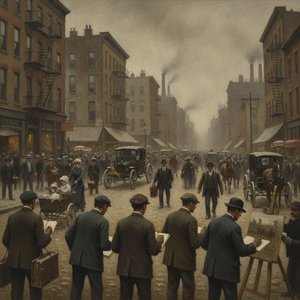
The Ashcan School: Capturing the Raw, Unfiltered Soul of Urban Life through American Realism
Discover the raw beauty of the Ashcan School. Explore how masters like Bellows and Henri captured the gritty, vibrant soul of early 20th-century New York through profound American Realism and evocative urban landscapes.
Explore artworks organized by themes, styles, and characteristics.


