The Visible Invisible: Art as a Conduit for Spiritual Presence
There is a profound, quiet magic that occurs when the brush touches the canvas, or when a sculptor carves into wood, not merely to replicate the world we see, but to beckon the presence of what remains unseen. Throughout history, humanity has rarely been content with the boundaries of the physical realm; we have always sought to reach across the veil. In many traditions, art serves as much more than decoration; it acts as a vital bridge, a luminous window through which the divine might glance into our earthly existence. This intersection of the tangible and the transcendent is where the true soul of creativity resides, transforming mere objects into sacred conduits.
Consider the way light dances across an Impressionist landscape, or how a heavy, textured impasto can suggest the weight of a spiritual truth. While we often admire these works for their aesthetic brilliance, there is an underlying impulse to capture the ephemeral—the very essence of a moment that feels touched by something greater than ourselves. When art functions as a medium for the invisible, it ceases to be a passive object of contemplation and becomes an active participant in our spiritual lives, giving form to the shadows of the soul and the radiance of the heavens.
Vessels of the Sacred: Masks, Altars, and the Architecture of Ritual
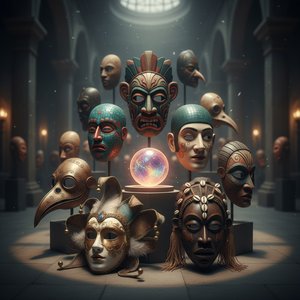
To understand how art facilitates this divine dialogue, one must look toward the profound traditions of African art, where the creation of objects is often a deeply liturgical act. In these contexts, art is not merely inspired by the divine; it is designed to house it. Through the meticulous crafting of masks, figurative sculptures, and instruments of divination, artists provide a visual language for spirits, gods, and ancestors. These are not mere representations but vessels. Through rituals of consecration—be they through prayer, sacrifice, or performance—an artist’s work is transformed, becoming an inhabited space where the sacred can reside.
The architecture of ritual relies heavily on these focal points. Altars and shrine sculptures serve as the meeting grounds for the living and the spirit world, providing a structured way to address fundamental human concerns such as physical health, psychological well-being, and social harmony. In this sacred geometry, every carved line and applied pigment serves a purpose: to maintain and renew the imagined world of the divine for the benefit of humankind. These objects allow us to communicate with lesser divinities—the spirits who guide the fortunes and misfortunes of our everyday lives—ensuring that even in the face of earthly struggle, we are never truly disconnected from the cosmic order.
Divine Inspiration: From Ancestral Dreams to Artistic Vision
The genesis of such profound art often lies in the most intimate of human experiences: the dream. While Western psychological perspectives, influenced by Freud, might view dreams as internal resolutions of the unconscious, many African cultures offer a more expansive interpretation. In these traditions, a dream can be an external initiation—a message sent from a spirit-being wishing to communicate with a devotee. The artist, acting as a medium, captures the aesthetic qualities revealed in these nocturnal visions, translating divine knowledge into physical form.
This process of receiving and recording creates a beautiful, cyclical relationship between the creator and the creator of all things. The very beauty of the resulting artwork is intended to capture the attention of the spirit for whom it was made. When an artist uses divination rites or potent materials to guide their hand, they are participating in a lineage of wisdom that transcends individual ego. This is the essence of divine inspiration: a movement where the boundaries between the artist's intent and the divine's will become beautifully blurred, resulting in works that resonate with an authority far beyond the limits of human technique.
Rituals of Care: Modern Interpretations of Healing and Solidarity
The impulse to use art as a tool for healing and communal stability is not confined to antiquity; it finds vibrant, contemporary expression in the work of modern creators. We see this clearly in the storytelling installations of artists like Lehna Huie, whose work Divine Intervention: Stories of an Era of Love and Solidarity explores the rituals of care that sustained communities during the profound challenges of recent years. Through a delicate tapestry of textiles, collage, photography, and video, such art translates the heavy experiences of the COVID era into a visual liturgy of recovery and commitment.
In these modern iterations, the concept of the "altar" is reimagined as a living, breathing space for social justice and decolonization. By weaving together the voices of Black and Asian artists, cultural workers, and activists, the art becomes a collective offering. It moves away from the solitary worship of icons toward a collaborative ritual of solidarity. This contemporary practice proves that the "divine intervention" we seek today often manifests through our relationships with one another—through the daily, quiet rituals of looking after our neighbors and honoring our shared humanity.
The Eternal Connection: Preserving Spiritual Heritage through Materiality
Ultimately, the longevity of these spiritual bridges depends on the preservation of both the object and the story. Whether it is an ancient mask used in a masquerade festival or a contemporary textile installation at MOCADA’s Abolition House, the materiality of art provides a physical anchor for our ephemeral beliefs. The use of specific pigments, the texture of hand-woven cloth, and the deliberate weight of carved wood all contribute to the "truth" of the object, making the spiritual encounter feel undeniably real.
As we navigate an increasingly fragmented world, the role of art as a keeper of heritage becomes even more vital. These works allow us to access knowledge by supernatural means, resolving social and psychological problems by reaching out to the divine for answers. By honoring the craftsmanship and the cultural philosophies behind these pieces, we ensure that the bridge remains open. We continue to find ways to transcend the limitations of human knowledge, using the beauty of art to remind us that we are part of a much larger, much more sacred, unfolding story.