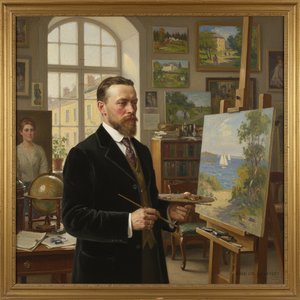
Early Life, Family and Training
Born in Berlin, Germany, on January 1, 1873, Albert Lamm was the son of Armand Max Hugo Lamm and Clara, née Schirmer. His family roots traced back to Burgundy before settling in Northern Germany. Before finding his footing in the visual arts, Lamm’s path took a more analytical turn. He spent two years studying mathematics and physics at the Polytechnikum in Berlin and Darmstadt, though he ultimately chose not to complete this academic pursuit.
His true vocation emerged when he turned toward the canvas. Between 1893 and 1895, Albert Lamm studied landscape painting at the Academy of Fine Arts Berlin under the guidance of Eugen Bracht. This period of formal instruction provided the foundation for a career defined by the natural world. Following these formative years, he spent time in Thuringia before further refining his technical skill under the mentorship of the landscape painter Ludwig Dill, serving as his master student from 1899 to 1901.
Life and Activity in Muggendorf
In 1901, Lamm moved to Muggendorf in Oberfranken, a decision that would define the middle chapter of his life. He remained in this rural setting for twenty-five years, establishing a quiet, steady presence in the landscape. While he was a fixture in the region, he lived a somewhat solitary existence, remaining largely isolated from the local village population. This detachment did not mean a total withdrawal from the world; instead, his social connections were concentrated among specific circles of collectors and peers.
His correspondence and social ties extended to the Nürnberger industrialist Ignaz Bing and his family. Through such connections, Lamm maintained a link to the broader cultural life of Germany despite his seclusion in the hills of Franconia. He was a man of specific habits, navigating the space between the quietude of Muggendorf and the professional requirements of his craft. By 1926, this long period of provincial life concluded when he returned to Berlin.
Artistic Style and Movements
Albert Lamm was a dedicated practitioner of Naturalism, seeking to capture the world through a lens of unadorned reality. His approach to the canvas was defined by a steadfast commitment to traditional observation, a stance that placed him in direct opposition to the radical shifts occurring in the early twentieth century. He held a profound aversion to the emerging modernisms of his era, vehemently rejecting the expressive distortions of Expressionism and the mechanical dynamism of Futurism. His sensibilities remained anchored in the works of artists like Max Slevogt and Lovis Corinth, favoring a style that prioritized the tangible essence of his subjects over the abstraction of the avant-garde. He found no place for the stylistic departures of van Gogh or Kandinsky in his disciplined vision.
This adherence to naturalistic principles was reflected in his meticulous preparation. Lamm often utilized small, scale-accurate pencil sketches to communicate the dimensions and intent of his compositions to potential collectors. Such precision ensured that the physical reality of the work was understood before a single drop of oil touched the canvas. His association with the Dürerbund in 1912 further underscored his alignment with a tradition that valued the integrity of the natural world and the classical foundations of German art. His work remains a study in the quiet tension between the evolving modern world and a painterly devotion to the observed truth.
- Ziegenhüter im Jura (1913)
Later Years and Death
The trajectory of Lamm's life took a sharp turn in 1914 when he volunteered for military service. His wartime experience was defined by labor and hardship rather than the quietude of the landscape. He served as a truck driver in France and spent time caring for typhus patients in a hospital. This period of service ended abruptly in 1916 when a car accident left him injured, necessitating a return to the relative seclusion of Muggendorf.
After spending twenty-five years in the rural landscape of Muggendorf, Lamm moved back to Berlin in 1926. His later years were marked by a commitment to social service; he worked as a drawing teacher and a supervisor at a municipal day center for unemployed youth. During this time, he also shared his experiences through his writing in the book Betrogene Jugend. His final years remained somewhat obscured by the shifting political landscape of the era. He died in Berlin on January 18, 1939, at the age of 66.
Where to See the Works Today
The physical remnants of Lamm’s career are found primarily in the Fränkische Schweiz-Museum in Tüchersfeld. This institution holds a selection of his paintings, including the work titled "Gänsehirte." These pieces offer a tangible connection to the landscapes he once inhabited and studied during his years in the region.
Other works from his period of productivity remain in private or various collections. His 1913 oil on canvas, "Ziegenhüter im Jura," serves as a notable example of his technical approach to the medium. While much of his output was distributed widely during his lifetime, the presence of his art in the Fränkische Schweiz-Museum ensures his connection to the landscape of Upper Franconia is preserved.
Historically, his presence was felt in the major artistic hubs of Germany. His paintings were featured in exhibitions at both the Berlin Secession and the Munich Secession. These appearances placed his naturalist perspective alongside the significant movements of his era, even as he remained personally distanced from the more radical shifts in modernism.
Questions & Answers
What colors did Albert Lamm use most often?
The color profile of Albert Lamm's work is shown on the artist's Palette Genome page.
What are the birthplace and birth year of Albert Lamm?
Albert Lamm was born in Berlin in 1873.
In which movements did Albert Lamm work?
Albert Lamm's works can be browsed by movement on the artist's All Movements page.
Can I browse Albert Lamm's works by medium?
Albert Lamm's works can be browsed by medium on the artist's All Medium page.