Atelier — Complimentary worldwide shipping — Delivery 2–6 weeks

      Auguste Clésinger

      1814 - 1883

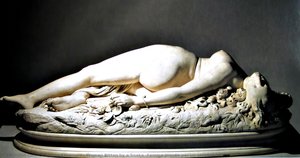
      Auguste Clésinger (1814–1883) painted Woman Bitten by a Snake, the best-known canvas of a catalogue of 10 works.

      At a glance

      • Top-ranked work: Woman Bitten by a Snake (Femme piquée par un serpent)
      • Also known as: Auguste Clesinger
      • Nationality: France
      • Museums on this site:
        • Los Angeles County Museum of Art
        • Musée d'Orsay
        • Germanisches Nationalmuseum
        • Saint-Sulpice
        • Musée de Picardie
      • Topics explored:
        • romanticism
        • sculpture
      • Color intensity: monochromatic
      • Emotional tone: melancholic
      • Top 3 works:
        • Woman Bitten by a Snake (Femme piquée par un serpent)
        • Woman Bitten by a Snake

      What is Auguste Clésinger's most famous painting?

      Woman Bitten by a Snake is the painting most linked to Auguste Clésinger; also well known: Angel of Grief and Chopin.

      Auguste Clésinger: Life and Legacy

      Early Life and Training

      • Born: October 22, 1814, in Besançon, France.
      • Auguste Clésinger came from an artistic family; his father, Georges-Philippe Clésinger, was a sculptor who provided Auguste with his initial training.
      • This early exposure instilled in him a foundational understanding of sculptural techniques and aesthetics.

      Artistic Development and Style

      • Clésinger’s artistic style evolved through the 19th century, initially embracing Neoclassical principles but gradually incorporating elements of Realism and Romanticism.
      • He skillfully blended technical precision with emotional intensity in his works.
      • His sculptures often depict dramatic narratives and sensuous figures, showcasing a mastery of anatomy and form.

      Major Works and Achievements

      • Woman Bitten by a Serpent (1847): This sculpture caused a sensation at the Paris Salon due to its dramatic realism and erotic undertones. It was modeled from life casts of Apollonie Sabatier.
      • Madame Sabatier (1847): A marble portrait of his model, Apollonie Sabatier, further establishing Clésinger’s reputation for capturing beauty and sensuality.
      • Chopin's Funerary Monument (1850): Commissioned after the composer Frédéric Chopin’s death, this white marble monument at Père Lachaise Cemetery is a poignant tribute to the musician.
      • Angel of Grief: A deeply moving sculpture embodying Baroque drama and pathos.
      • He also created busts of prominent figures like Rachel Félix and Théophile Gautier, and a statue of Louise of Savoy.

      Influences and Relationships

      • Influenced by: His father, Georges-Philippe Clésinger, provided his initial artistic foundation.
      • Clésinger’s association with Apollonie Sabatier, a salonnière and mistress of several prominent artists including Charles Baudelaire, exposed him to intellectual and artistic circles.
      • His marriage in 1847 to Solange Dudevant, daughter of George Sand, further connected him to literary society.

      Historical Significance and Legacy

      • Clésinger’s work reflects the artistic currents of 19th-century France, bridging Neoclassicism with emerging Realist tendencies.
      • Recognition: He received the Knight's Cross of the Légion d'honneur in 1849 and was promoted to Officer in 1864.
      • His sculptures continue to be admired for their technical skill, emotional depth, and dramatic impact. His works are displayed at prominent museums such as the Musée d’Orsay.
      • Death: He died on January 5, 1883, in Paris, and is buried in Père Lachaise Cemetery.

      A little quiz

      There is only one correct answer for each question.

      Question 1:
      Auguste Clésinger gained significant attention at the 1847 Salon with which sculpture?
      Question 2:
      Who served as the model for Clésinger's controversial sculpture, 'Woman Bitten by a Serpent'?
      Question 3:
      Clésinger created a funerary monument for which composer?
      Question 4:
      In what city was Auguste Clésinger born?
      Question 5:
      Clésinger's work is often associated with which two art movements?

      Questions & Answers

      What colors did Auguste Clésinger use most often?

      See the colors Auguste Clésinger used most often, measured across the artworks.

      Where can I see Auguste Clésinger's paintings?

      Auguste Clésinger's paintings can be seen at Musée d'Orsay, Los Angeles County Museum of Art and Germanisches Nationalmuseum.

      What are the birthplace and birth year of Auguste Clésinger?

      Auguste Clésinger was born in Besançon in 1814.

      Can I browse Auguste Clésinger's works by mood?

      See Auguste Clésinger's artworks arranged by mood: each work is placed by its atmosphere.

      What mediums did Auguste Clésinger use?

      The works by Auguste Clésinger listed on this website are mainly marble.

      How long did Auguste Clésinger live?

      Auguste Clésinger lived about 69 years, from 1814 to 1883.

      Can I buy a reproduction of a Auguste Clésinger painting?

      Yes. See Auguste Clésinger painting reproductions, available as hand-painted oil paintings and as prints.

      Which paintings is Auguste Clésinger known for?

      Auguste Clésinger is known for the works listed in the most famous paintings by Auguste Clésinger.

      In which historical period did Auguste Clésinger work?

      Auguste Clésinger worked in the 19th-Century period. The period situates the artist's activity in history.