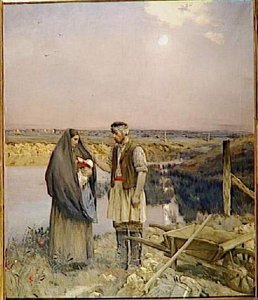
A Visionary of Light and Landscape
Jean Charles Cazin was a multifaceted French talent whose creative spirit spanned the realms of landscape painting, ceramics, and museum curation. Born in Samer, Pas-de-Calais, he emerged as a significant figure in the late 19th-century art world, carving out a niche that blended the spiritual with the natural. His early artistic journey was deeply shaped by his travels to England, where the ethereal and detailed influence of the Pre-Raphaeliate movement left an indelible mark on his sensibility. This period of exploration allowed him to develop a unique visual language, one that would later evolve from religious narratives into a profound mastery of atmospheric landscapes.
In his early career, Cazin’s work often centered on religious themes, capturing biblical stories with a sense of reverence and weight. Notable examples such as The Flight into Egypt and Hagar and Ishmael demonstrate this initial preoccupation with sacred subjects. However, as his style matured, he moved toward a more poetic and idealistic approach to subject painting. He became renowned for his ability to marry luminous landscapes with human figures, creating compositions like Souvenir de fête and Journée faite that breathed life into the French countryside. This transition marked his emergence as a leader of a new school of idealistic painting in France, where the landscape was not merely a backdrop but a vessel for emotion and atmosphere.
The Mastery of Tonalism and Atmosphere
As Cazin’s career progressed, he became increasingly celebrated for his tonalist approach, particularly in his depictions of seascapes and coastal scenes. His technique involved a delicate manipulation of light and weather, often utilizing a soft, diffused glow to evoke a sense of sfumato. In works such as Normandy Village, the boundaries between the man-made architecture and the natural world begin to blur, creating a dreamlike state of profound serenity. His ability to capture the ephemeral qualities of the sky and the subtle textures of the earth allowed him to create much more than mere scenery; he captured the very soul of the French landscape.
Beyond his canvases, Cazin’s artistic reach extended into the tactile world of ceramics. As a skilled ceramist, he contributed to the decorative arts, often working in ways that complemented his painterly visions. His life was also deeply intertwined with the art community through his marriage to Marie Cazin, an accomplished artist and sculptor in her own right. Together, they represented a significant artistic partnership within the French tradition. His legacy is further cemented by his recognition within the prestigious Legion of Honour, an honor bestowed upon him in 1889, reflecting his standing as a vital contributor to the cultural fabric of his era.
Questions & Answers
How can I follow Jean Charles Cazin's work year by year?
Jean Charles Cazin's artworks can be seen in chronological order on the artist's Artwork Timeline page.
Where is Jean Charles Cazin from?
Jean Charles Cazin was born in France.
What moods do Jean Charles Cazin's artworks express?
The artist's Mood Room page shows Jean Charles Cazin's artworks arranged by their atmosphere.