A Vision of the Highlands: The Life and Legacy of Robert Stevenson
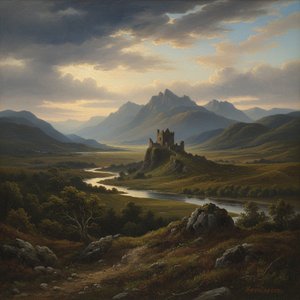
In the misty, atmospheric landscapes of the nineteenth century, few artists captured the quiet, spiritual resonance of the Scottish wilderness as poignantly as Robert Stevenson. Born in 1772 amidst the intellectual awakening of the Scottish Enlightenment, Stevenson’s life was a unique tapestry woven from the threads of scientific precision and romantic sensibility. While history often remembers him through the lens of his engineering prowess, his true artistic soul resided in the delicate interplay of light and shadow across the Highland moors. His journey began in Glasgow, shaped by early hardships following the loss of his father, yet it was nurtured by a profound engagement with the natural world—a fascination that would eventually lead him to document the sublime grandeur of his homeland with unparalleled intimacy.
Stevenson’s artistic development was deeply rooted in his multidisciplinary education. Having studied anatomy and drawing at the Andersonian Institute and the University of Edinburgh, he approached the canvas with a scholar's eye for detail and a scientist's understanding of structure. This dual mastery allowed him to transcend mere representation; he did not simply paint trees or water, but rather the very essence of their existence. Influenced by the neoclassical elegance of Joshua Reynolds and the atmospheric, tonal mastery of Claude Lorrain, Stevenson’s style matured from rigid formalist roots into a more expressive realism. He became a master of tonal gradation, using subtle shifts in light to create a sense of depth and movement that drew the viewer into the heart of the Scottish landscape.
The Poetry of Moonlight and Shadow
The true magic of Stevenson’s oeuvre lies in his ability to capture the ephemeral. He was particularly renowned for his nocturnal scenes, where the silver glow of the moon transformed familiar terrains into dreamlike realms. In works such as “Evensong”, one can witness the profound stillness of aged trees bathed in moonlight, a composition that speaks to the fleeting nature of time and the enduring presence of the natural world. Similarly, his piece “A Pool among Trees Moonlight” serves as a testament to his ability to render tranquil Highland scenes with remarkable, almost tactile detail. Through these works, Stevenson achieved a sense of spiritual resonance, inviting his audience to contemplate the profound mysteries hidden within the shadows of the forest.
His technical achievements were characterized by an extraordinary commitment to accuracy and atmospheric perspective. By prioritizing the way light interacts with moisture, foliage, and stone, he was able to convey the damp, cool air of the Highlands so effectively that the viewer can almost feel the mist upon their skin. This meticulous realism was never at odds with his romantic inclinations; rather, it served as the foundation upon which he built his emotional narratives. His paintings were not merely landscapes but were instead atmospheric portraits of a landscape in transition, capturing the quiet drama of the natural world during the Victorian era.
A Lasting Impression on Scottish Art
Beyond the borders of the canvas, Stevenson’s life was one of immense contribution to the intellectual and physical infrastructure of Scotland. His role as a Professor of Anatomy at the University of Edinburgh underscored his dedication to the intersection of art and science, proving that the observation required for medical study is fundamentally linked to the observation required for fine art. This period of his life reflected the broader cultural climate of his era—a time when the pursuit of knowledge and the appreciation of beauty were seen as two sides of the same coin.
Though he may have been overshadowed by more commercially successful contemporaries during his lifetime, the historical significance of Robert Stevenson has only grown with time. He remains a pivotal figure in the history of Scottish landscape painting, serving as a bridge between the structured traditions of neoclassicism and the emotive depths of romantic realism. His legacy lives on in every brushstroke that seeks to capture the sublime, reminding us that to truly see the world, one must possess both the precision of the scientist and the heart of the poet.