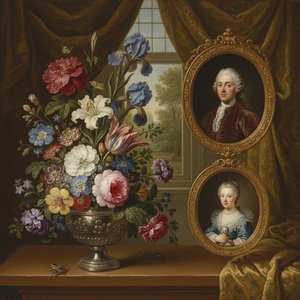
The Quiet Hand of Groningen
In the narrow streets of Groningen, the life of Wibrand Veltman unfolded between the mid-eighteenth and early nineteenth centuries. He was a man of many small, precise tasks. His hands moved between the delicate work of a miniaturist and the broader strokes of a painter. He did not merely paint; he drafted, illustrated, and captured likenesses on a scale that required a steady, patient eye. His presence in the Dutch art scene was marked by this versatility, a capacity to shift from the minute details of a small portrait to the more expansive requirements of a drawing.
His work period, stretching from the late 1750s until his death in 1800, reflects a steady engagement with the visual language of his time. He lived and worked in the same city where he was born, a constant in a changing landscape. There is a sense of local permanence in his biography, a life tied to the specific light and people of the Netherlands.
A Versatile Practice
Veltman’s skill was not confined to a single medium. He navigated several disciplines that required different levels of focus and physical control. His technical range included:
- Draftsmanship and sketching
- Miniature painting for intimate portraits
- Illustration for various texts
- General painting
This variety suggests a professional life spent meeting the specific needs of his patrons, whether they required a large portrait or a small, portable likeness. His ability to transition between these roles allowed him to remain active in the artistic community of Groningen for decades.
The Recorded Likeness
One of the most tangible traces of his hand remains in the collections of the Groninger Museum. In 1768, he produced a portrait of Sibylla Catharina Sichterman. This work serves as a window into his approach to portraiture, capturing a specific person from a specific moment in time. It is a piece that survives as a record of his ability to translate a human presence onto a surface, a skill that defined his career as a painter and miniaturist.
Questions & Answers
Where is Wibrand Veltman from?
Wibrand Veltman was born in Netherlands.
Can I study Wibrand Veltman's use of color across all works?
The Palette Genome of Wibrand Veltman is a page that presents the color profile of the artist's body of work.
How do I find all works by Wibrand Veltman in a given medium?
To find all works by Wibrand Veltman in a given medium, use the artist's All Medium page.
Can I visit a virtual museum of Wibrand Veltman's works?
Wibrand Veltman's artworks can be seen in a 3D gallery on the artist's 3D Museum page.