Amedeo Modigliani: Capturing Melancholy Beauty Through Elongated Forms
Amedeo Clemente Modigliani (1884-1920), an Italian painter and sculptor whose legacy continues to resonate with collectors and art enthusiasts worldwide, stands as a pivotal figure in the Expressionist movement. Born in Livorno into a Sephardic Jewish family grappling with financial hardship and recurring illness – experiences that profoundly shaped his artistic sensibility – Modigliani’s oeuvre transcends mere representation; it embodies an intense emotional landscape rendered through distinctive stylistic choices.
His signature style, characterized by elongated faces, necks, and figures, immediately distinguishes him from prevailing artistic conventions of the early 20th century. This deliberate distortion wasn't merely aesthetic experimentation—it served as a conduit for conveying profound psychological states: longing, sorrow, and an inescapable awareness of mortality. Modigliani’s approach aligns closely with the tenets of Expressionism, prioritizing subjective experience over objective observation.
The Influence of Nietzsche and Baudelaire
Modigliani's formative years were marked by intellectual stimulation fueled by his mother and grandfather who introduced him to the philosophical ideas of Friedrich Nietzsche and Charles Baudelaire. These thinkers championed individualism, pessimism, and a rejection of bourgeois morality—values that profoundly impacted Modigliani’s artistic worldview. Baudelaire’s exploration of beauty intertwined with decay served as an inspiration for Modigliani's depictions of human vulnerability and fragility.
Specifically, Nietzsche’s concept of the Übermensch – the “Superman” – challenged traditional notions of heroism and morality, encouraging artists to confront existential anxieties. This influence is palpable in Modigliani’s portraits, where he strives to capture not just physical likeness but also the inner turmoil beneath the surface.
Technique and Material Considerations
Modigliani primarily employed oil paint on canvas, utilizing a technique that prioritized subtle gradations of color and meticulous detail. He favored muted palettes—often dominated by earthy tones—creating an atmosphere of quiet contemplation. The artist’s painstaking brushwork contributes to the palpable sense of melancholy inherent in his compositions.
Furthermore, Modigliani experimented with sculpture, employing terracotta and bronze as mediums. His sculptures share the same stylistic hallmarks as his paintings: elongated forms and expressive eyes—elements that convey emotion with remarkable precision. The sculptor’s mastery of material lends a tactile quality to his work, inviting viewers to contemplate both visual beauty and sculptural form.
Symbolism and Emotional Resonance
Beyond mere aesthetic considerations, Modigliani's art is laden with symbolism reflecting the anxieties and uncertainties of the era. The elongated faces represent not just physical distortion but also a yearning for transcendence—a desire to escape the confines of earthly existence. The melancholic gaze captured in his portraits speaks volumes about the human condition: confronting loss, accepting impermanence, and embracing beauty amidst suffering.
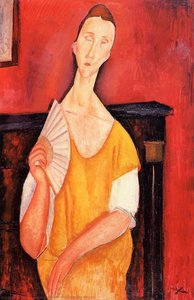
“Untitled (6698)” exemplifies Modigliani’s artistic vision perfectly. Its vibrant orange hue accentuates the prominent nose—a motif recurring throughout his oeuvre—while the subdued green background creates a striking contrast that enhances the emotional impact of the portrait. This artwork serves as a testament to Modigliani's ability to distill complex psychological states into visually arresting images, securing his place among the most enduring figures in modern art.



 Preview
 Switch to hand made Painting
 Enviar
 Compartir
 Detalles

 Descargar
 Similares
 Radiografía
 Presentación de diapositivas
 Ver más






































 La opción de vidrio solo está disponible en tamaños inferiores a 110 cm.